FinetuneDB
FinetuneDB is an all-in-one AI fine-tuning platform for developers. It simplifies the entire workflow of creating custom Large …
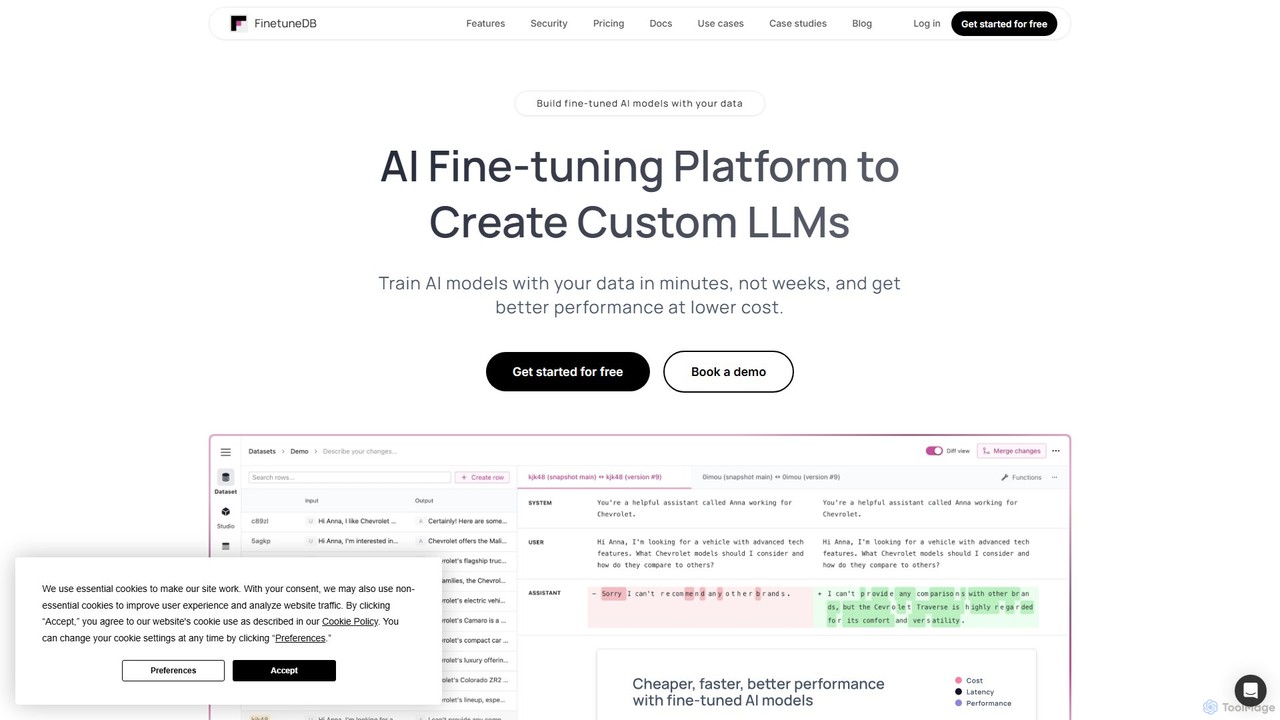
FinetuneDB is an all-in-one AI fine-tuning platform for developers. It simplifies the entire workflow of creating custom Large Language Models (LLMs), from building high-quality datasets and fine-tuning models like Llama 3 and GPT-4o mini, to deployment and continuous evaluation on a single, secure platform.
About Llmops
Llmops (Large Language Model Operations) tools are a specialized set of platforms and practices for managing the entire lifecycle of large language models in production. As a focused discipline within AI Infrastructure, they address the unique challenges of LLMs, such as prompt engineering, fine-tuning, and real-time performance monitoring. These tools enable teams to reliably develop, deploy, and maintain LLM-powered applications at scale. They provide the necessary framework for ensuring model quality, controlling costs, and accelerating the development cycle from prototype to production.
Core Features
- Prompt Management: Systematically version, test, and deploy prompts, enabling collaborative optimization and A/B testing.
- Fine-Tuning Workflows: Provides managed environments and tools for adapting pre-trained LLMs to specific domains using proprietary data.
- Monitoring & Observability: Tracks key metrics like token usage, cost, latency, and output quality to detect issues like hallucinations or model drift.
- Evaluation Frameworks: Automates the assessment of LLM responses against predefined benchmarks for accuracy, relevance, and safety.
- Orchestration & Chaining: Facilitates the creation of complex applications by linking multiple LLMs, APIs, and data sources into a single, manageable workflow.
Applicable Scenarios
Llmops tools are essential for any organization building production-grade applications on top of LLMs. This includes tech companies developing AI-powered features, enterprises automating internal workflows with custom chatbots, and startups creating novel generative AI products. They are primarily used by AI engineers, data scientists, and DevOps teams responsible for the reliability and efficiency of LLM systems.
Selection Criteria
When choosing an Llmops tool, consider its compatibility with your chosen LLMs (e.g., OpenAI, Anthropic, open-source models). Evaluate its integration capabilities with your existing tech stack, such as vector databases and cloud services. Assess whether its feature set covers your needs across the entire lifecycle, from prompt engineering to production monitoring. Finally, consider the platform's scalability and the technical expertise required to operate it effectively.

LlmopsUse Cases
Developing and Managing an Enterprise Chatbot
An AI development team is tasked with building a customer support chatbot using an LLM. They use an Llmops platform to manage the entire process. First, they version-control prompts for different user intents (e.g., order status, returns). Next, they fine-tune a base model on their company's support documentation to improve accuracy. Once deployed, the platform continuously monitors the chatbot's latency, token costs per conversation, and flags conversations where the model's responses were inaccurate or unhelpful. This allows the team to iteratively improve the chatbot's performance and control operational costs.
Automating Content Generation Pipelines
A marketing team uses an LLM to generate blog posts. Their workflow involves multiple steps: generating an outline, writing each section, and then creating a summary. They use an Llmops tool to orchestrate this chain of LLM calls. The tool manages the flow of information between steps, ensuring the output of one step correctly feeds into the next. It also includes an evaluation step that checks the final article for brand voice consistency and factual accuracy against a knowledge base. This automates a complex process, increasing content production speed by over 70% while maintaining quality standards.
Building and Monitoring RAG Systems
A company implements a Retrieval-Augmented Generation (RAG) system for its internal knowledge base. An Llmops platform is used to manage the entire RAG pipeline. It monitors the vector database for data freshness, evaluates the relevance of retrieved documents for each query, and tracks the final answer's quality. If the system provides an incorrect answer, the Llmops tool allows engineers to trace the issue back, whether it was a poor retrieval step or a hallucination in the generation step. This observability is critical for maintaining the reliability and trustworthiness of the RAG system in an enterprise setting.
A/B Testing Prompts for Marketing Campaigns
An e-commerce company wants to optimize the product descriptions generated by an LLM. Using an Llmops tool, they set up an A/B test with two different prompt templates: one focusing on technical specifications and the other on lifestyle benefits. The tool integrates with their e-commerce platform to serve different descriptions to different users and tracks key metrics like click-through rates and conversion rates for each version. After collecting enough data, the Llmops dashboard clearly shows which prompt performs better, allowing the marketing team to make a data-driven decision and deploy the winning prompt to all products, potentially increasing sales.
Ensuring LLM Compliance and Safety
A financial services firm uses an LLM to summarize client interaction logs. To comply with regulations, they must ensure no Personally Identifiable Information (PII) is leaked in the summaries. They use an Llmops tool that includes a safety and compliance layer. This layer automatically scans all LLM outputs for PII and other sensitive data patterns before they are stored. It also evaluates responses against a set of custom rules to prevent the generation of inappropriate financial advice. The tool logs all requests and responses for audit purposes, providing a clear trail to demonstrate regulatory compliance.
Fine-Tuning LLMs for Domain-Specific Tasks
A healthcare technology company wants to build a tool that summarizes medical research papers. General-purpose LLMs struggle with the specific terminology. They use an Llmops platform to fine-tune a base LLM on a curated dataset of thousands of medical journals. The platform manages the entire fine-tuning job, from data preparation and validation to model training and versioning. After fine-tuning, they use the platform's evaluation suite to compare the specialized model against the base model, demonstrating a significant improvement in summarization quality and accuracy. The Llmops tool versions this new model, making it easy to deploy and monitor in their application.