Ai Infrastructure Best in category 1 results Machine Learning Platform AI Tool

Popular AI tools in the Machine Learning Platform field of Ai Infrastructure include Databricks, etc., helping you quickly improve efficiency.

Databricks

Databricks

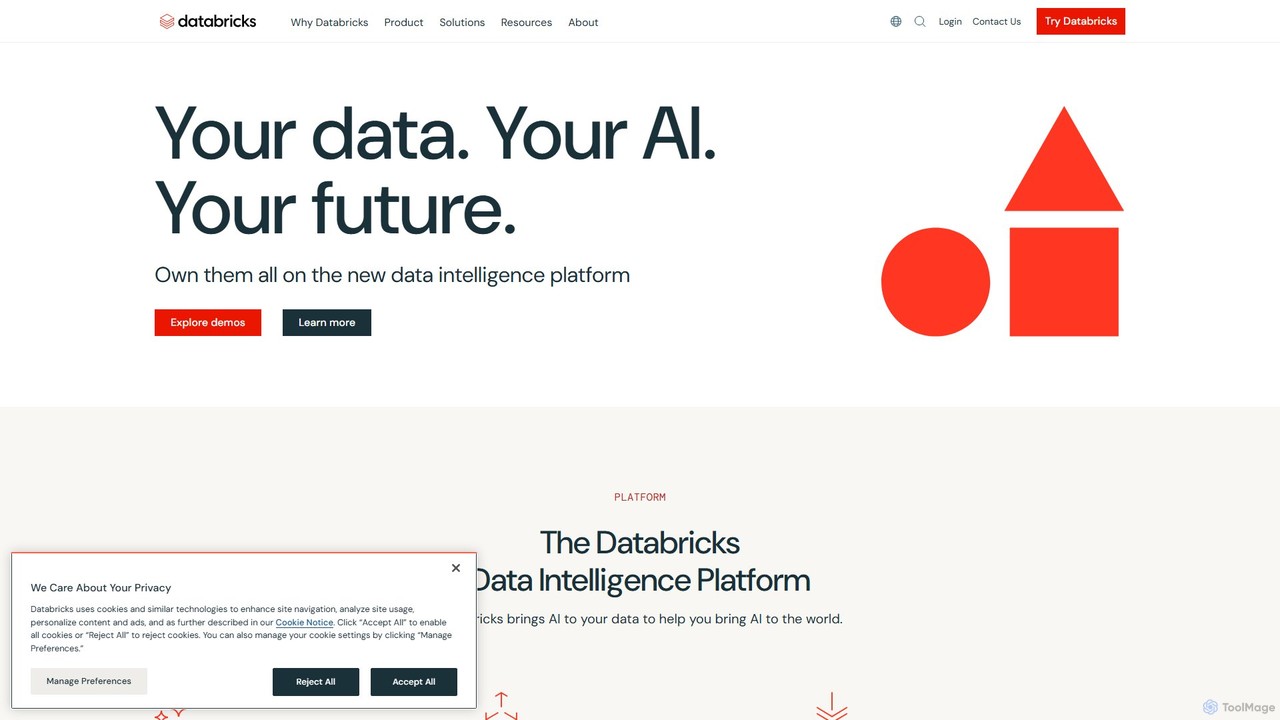
Databricks is a unified Data Intelligence Platform that combines data warehousing and data lakes into a lakehouse architecture. …

5.2M

About Machine Learning Platform

Machine Learning Platforms are integrated environments designed to streamline the entire lifecycle of machine learning model development, deployment, and management. As a crucial component within AI infrastructure, they provide a comprehensive suite of tools for data preparation, model training, evaluation, and operationalization. These platforms empower data scientists and engineers to accelerate innovation, improve model performance, and ensure robust MLOps practices, from experimentation to production.

Core Features

  • Data Management & Preparation: Tools for ingesting, cleaning, transforming, and versioning data, essential for model training.
  • Model Training & Experiment Tracking: Capabilities for running experiments, managing code, tracking metrics, and comparing different model versions.
  • Model Deployment & Serving: Features to deploy trained models as APIs or services, enabling real-time predictions and batch inference.
  • MLOps & Monitoring: Automation of ML pipelines, continuous integration/delivery (CI/CD) for models, and performance monitoring in production.
  • Resource Management: Efficient allocation and scaling of computational resources (CPU, GPU) for training and inference.

Applicable Scenarios

Machine Learning Platforms are indispensable for organizations building and scaling AI-driven products and services. They are widely used in enterprise AI development to manage complex model portfolios, in research institutions for collaborative experimentation, and by MLOps teams to automate the entire machine learning workflow from development to production, ensuring reliability and efficiency.

How to Choose

When selecting a Machine Learning Platform, consider its MLOps capabilities for automation and monitoring, scalability to handle growing data and model complexity, and integration with existing data infrastructure and development tools. Evaluate its support for various ML frameworks, ease of use for different skill levels, and the total cost of ownership, including infrastructure and licensing fees.

Machine Learning PlatformUse Cases

1

Streamlining MLOps for Large-Scale Enterprise Deployments

For large enterprises managing numerous AI initiatives, Machine Learning Platforms enable MLOps teams to automate the continuous integration, delivery, and monitoring of hundreds of ML models. This involves setting up automated pipelines for data validation, model retraining, version control, and performance tracking, ensuring models remain accurate and efficient in production environments, significantly reducing manual overhead and operational risks.

2

Accelerating Research and Development in Academia

Academic researchers and data science students utilize Machine Learning Platforms to accelerate their R&D efforts. These platforms provide collaborative environments for sharing datasets, code, and experimental results, facilitating rapid iteration and reproducibility. By abstracting away infrastructure complexities, researchers can focus more on model innovation and less on environment setup, leading to faster scientific discoveries and project completion.

3

Developing and Deploying Custom AI Solutions for Startups

Startups often leverage Machine Learning Platforms to rapidly develop and deploy custom AI solutions without significant upfront infrastructure investment. These platforms offer scalable compute resources and pre-built components, allowing small teams to quickly prototype, train, and launch AI-powered features. This agility helps startups bring innovative products to market faster and iterate based on user feedback, gaining a competitive edge.

4

Enhancing Data Scientist Productivity and Collaboration

Machine Learning Platforms significantly boost the productivity of data scientists by providing a unified environment for all ML-related tasks. Features like integrated development environments (IDEs), version control, and shared workspaces facilitate seamless collaboration among team members. This reduces context switching, standardizes workflows, and allows data scientists to focus on model building and insights generation rather than managing disparate tools and infrastructure.

5

Managing Model Lifecycle and Governance in Regulated Industries

In highly regulated industries like finance and healthcare, Machine Learning Platforms are crucial for managing the entire model lifecycle with robust governance and compliance. They provide features for audit trails, lineage tracking, model versioning, and explainability, ensuring transparency and accountability. This helps organizations meet regulatory requirements, mitigate risks, and maintain trust in their AI-driven decision-making processes.

6

Optimizing Resource Utilization for Cost-Effective ML Operations

Organizations use Machine Learning Platforms to optimize the utilization of expensive computational resources (GPUs, specialized hardware) for ML workloads. These platforms often include features for automated resource scaling, job scheduling, and cost monitoring, ensuring that models are trained and deployed efficiently without over-provisioning. This leads to significant cost savings, especially for companies running numerous or large-scale machine learning projects.

Machine Learning PlatformFrequently Asked Questions