Ai Infrastructure Best in category 3 results Model Development AI Tool

Popular AI tools in the Model Development field of Ai Infrastructure include Zyphra、Imandra、thinkaiagency, etc., helping you quickly improve efficiency.

Free
Zyphra

Zyphra

Zyphra is an open-source AI research company developing high-performance, efficient foundational models. They provide state-of-the-art small language models …

20.2K
thinkaiagency

thinkaiagency

thinkaiagency is a specialized development agency that transforms ideas into market-ready Minimum Viable Products (MVPs) in just 2-4 …

2.3K
Imandra

Imandra

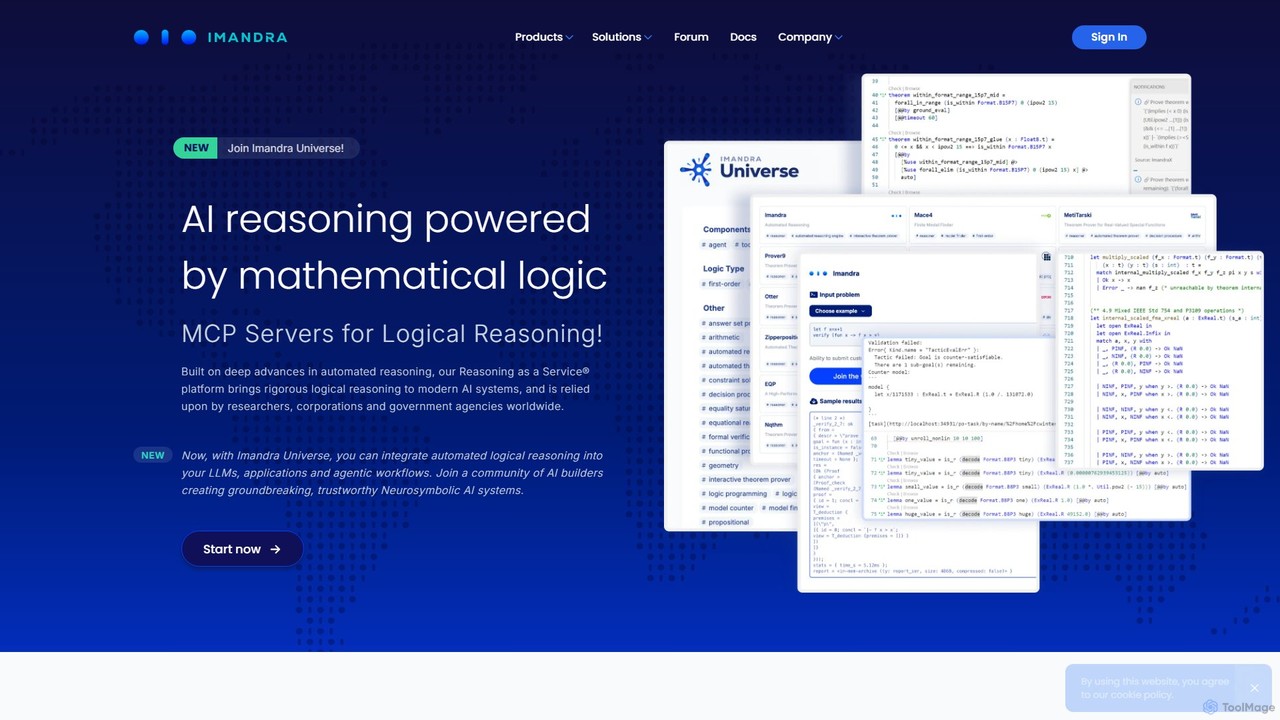
Imandra is a "Reasoning as a Service®" platform that brings mathematical logic and automated reasoning to AI and …

4.0K

About Model Development

Model Development tools are specialized platforms for building, training, and fine-tuning artificial intelligence models. As a core component of AI Infrastructure, they provide the environments and workflows for data scientists to transform raw data into functional predictive systems. These tools streamline the creation process, from data preparation and experiment tracking to model evaluation. This enables teams to develop custom AI solutions tailored to specific business challenges, such as fraud detection or natural language understanding.

Core Features

  • Integrated Development Environments (IDEs): Provides code notebooks and environments optimized for ML frameworks like PyTorch and TensorFlow.
  • Experiment Tracking: Logs and visualizes training metrics, parameters, and model artifacts for comparison and reproducibility.
  • Distributed Training Support: Facilitates scaling training jobs across multiple GPUs or machines to accelerate development.
  • Hyperparameter Optimization: Automates the process of finding the best model configurations for optimal performance.
  • Model Versioning & Registry: Manages different versions of models, making it easy to track lineage and prepare them for deployment.

Use Cases

These tools are essential for organizations creating proprietary AI capabilities. They are widely used in finance for credit scoring models, in healthcare for diagnostic imaging analysis, in e-commerce for building recommendation engines, and by tech companies developing foundational language or vision models.

How to Choose

When selecting a Model Development tool, consider its support for your preferred ML frameworks, its scalability for large datasets, and its integration with the broader MLOps ecosystem for deployment and monitoring. Also, evaluate the balance between ease of use (e.g., low-code features) and the flexibility required for advanced research and customization.

Model DevelopmentUse Cases

1

Developing a Custom Fraud Detection Model

A financial services company needs to build a machine learning model to detect fraudulent transactions in real-time. Using a Model Development platform, their data science team can preprocess millions of transaction records, experiment with different algorithms like Gradient Boosting or deep neural networks, and track the performance of each experiment. The platform's distributed training capabilities allow them to train models on large datasets quickly, leading to a highly accurate model that can be integrated into their transaction processing pipeline, reducing financial losses.

2

Fine-tuning an LLM for Legal Document Analysis

A law firm wants to leverage a large language model (LLM) for summarizing and analyzing legal contracts. Instead of using a generic model, they use a Model Development platform to fine-tune a pre-trained foundation model on their proprietary dataset of thousands of contracts. The platform provides the necessary GPU resources and tools to manage the fine-tuning process, track changes in performance, and evaluate the model's accuracy on legal-specific tasks. The result is a specialized LLM that understands legal jargon and provides more relevant and accurate analysis than a general-purpose model.

3

Training a Computer Vision Model for Retail Analytics

A large retail chain aims to understand in-store customer behavior. Their ML team uses a Model Development platform to build a computer vision model that analyzes security camera footage. The platform helps them manage and label a vast dataset of images, train a custom object detection model to identify customer paths and product interactions, and evaluate its accuracy. The experiment tracking features are crucial for comparing different model architectures and hyperparameters to find the most effective solution for deployment in their stores.

4

Building a Personalized Recommendation Engine

An e-commerce platform wants to increase user engagement and sales by providing personalized product recommendations. Machine learning engineers use a Model Development platform to build and train a collaborative filtering model. They can easily ingest user interaction data (clicks, purchases), experiment with different model variations, and use the platform's evaluation tools to measure metrics like precision and recall. The integrated environment allows for rapid iteration, enabling them to quickly deploy a model that significantly improves the relevance of recommendations shown to users.

5

Accelerating AI Research with Experiment Tracking

An academic research lab is developing a novel neural network architecture. The process involves hundreds of experiments with different parameters and dataset variations. A Model Development platform with robust experiment tracking is indispensable. Researchers can automatically log every run, compare performance metrics through visualizations, and share findings with collaborators. This systematic approach prevents lost work, ensures reproducibility of results for publication, and significantly speeds up the discovery process by making it easy to identify which experimental changes lead to improvements.

6

Creating a Predictive Maintenance Model for Manufacturing

A manufacturing company wants to predict equipment failures before they happen to reduce downtime. Their data scientists use a Model Development platform to build a time-series forecasting model based on sensor data from machinery. The platform provides tools for data cleaning, feature engineering, and training models like LSTMs or Transformers. By versioning their models and datasets, they can reliably track improvements and select the best-performing model to deploy for real-time monitoring, transitioning from reactive to proactive maintenance.

Model DevelopmentFrequently Asked Questions