
Ai Infrastructure Best in category 1 results Model Fine Tuning AI Tool

Popular AI tools in the Model Fine Tuning field of Ai Infrastructure include CGFT, etc., helping you quickly improve efficiency.

CGFT

CGFT

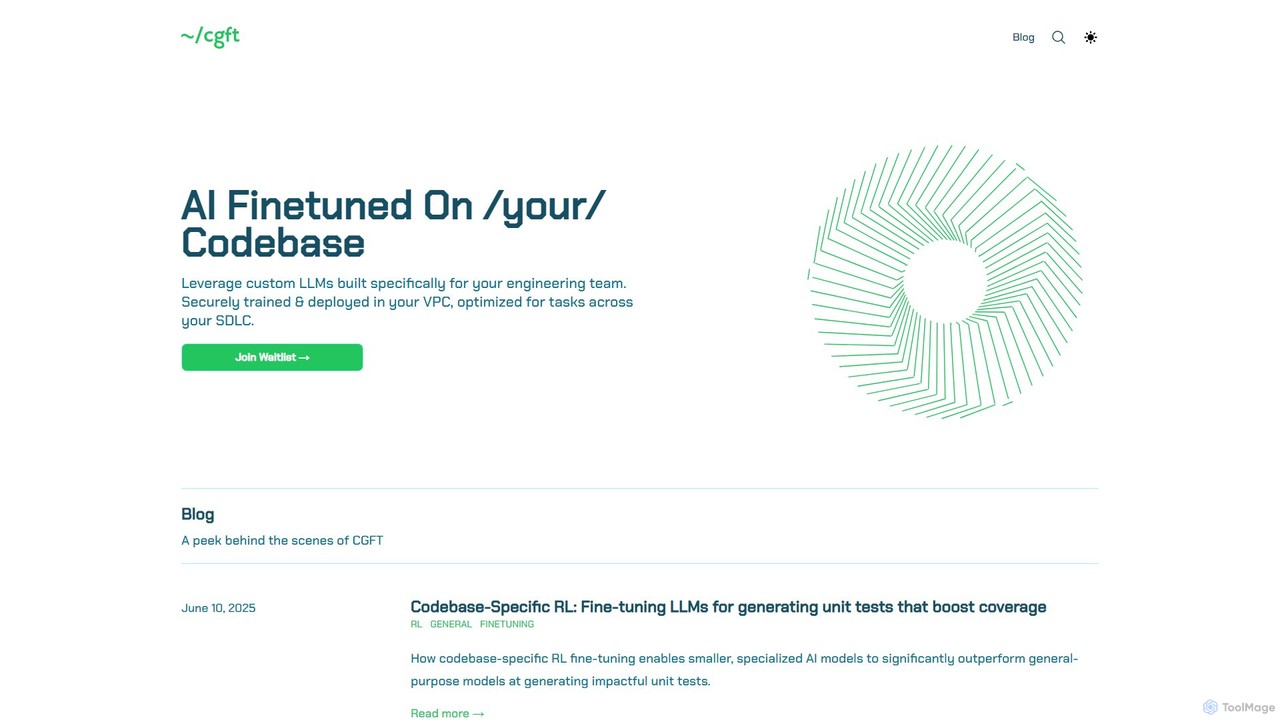
CGFT provides custom AI models for engineering teams, fine-tuned on your specific codebase. It delivers secure, high-performance code …

3.3K

About Model Fine Tuning

Model Fine Tuning is a crucial process in AI development that involves taking a pre-trained artificial intelligence model and further training it on a smaller, task-specific dataset. This technique leverages the broad knowledge acquired by a large foundational model, then specializes it to excel at a particular function or within a specific domain. It enables the creation of highly accurate and relevant AI applications without the need to train a model from scratch, significantly reducing computational resources and development time.

Core Features

  • Data Preparation: Tools for cleaning, labeling, and formatting domain-specific datasets suitable for fine-tuning.
  • Hyperparameter Optimization: Features to adjust learning rates, batch sizes, and other parameters to achieve optimal model performance.
  • Transfer Learning Capabilities: Facilitates the adaptation of knowledge from a general-purpose model to a new, related task.
  • Performance Evaluation: Metrics and tools to assess the fine-tuned model's accuracy, precision, recall, and other relevant performance indicators.
  • Model Deployment Integration: Streamlined processes for integrating the specialized model into existing applications or platforms.

Use Cases

Model Fine Tuning is widely adopted across various industries to tailor AI capabilities. It's essential for businesses seeking to customize generative AI models for brand-specific content creation, healthcare providers adapting vision models for specialized medical image analysis, and financial institutions enhancing fraud detection systems with proprietary transaction data.

How to Choose

When selecting a Model Fine Tuning tool, consider its compatibility with your existing pre-trained models and data formats, the flexibility of its hyperparameter tuning options, and the robustness of its performance evaluation metrics. Evaluate the platform's scalability for handling diverse datasets, its ease of integration with your deployment environment, and the overall cost-effectiveness, including computational resources and licensing fees.

Model Fine TuningUse Cases

1

Customize LLMs for Brand-Specific Content Generation

Marketing teams and content creators can fine-tune a large language model (LLM) on their company's specific style guides, product descriptions, and past successful campaigns. This allows the AI to generate marketing copy, social media posts, or blog articles that perfectly align with the brand's voice, tone, and terminology, significantly reducing editing time and ensuring consistent messaging across all platforms.

2

Enhance Customer Service Chatbots with Domain Knowledge

Companies can fine-tune a general-purpose chatbot model using their specific customer interaction logs, product FAQs, and support documentation. This specialization enables the chatbot to provide more accurate, relevant, and nuanced responses to customer queries about their unique products or services, improving customer satisfaction and reducing the workload on human support agents by handling complex, domain-specific questions effectively.

3

Improve Medical Image Analysis for Specific Conditions

Healthcare researchers and medical professionals can fine-tune pre-trained computer vision models on specialized datasets of medical images (e.g., X-rays, MRIs, CT scans) focusing on particular diseases or anomalies. This allows the AI to achieve higher accuracy in detecting subtle indicators of specific conditions like early-stage cancer or rare genetic disorders, assisting clinicians in faster and more reliable diagnoses, and ultimately improving patient outcomes.

4

Develop Specialized Code Generators for Proprietary Systems

Software development teams can fine-tune a code generation AI model on their company's internal codebase, coding standards, and specific programming language dialects or frameworks. This enables the AI to generate code snippets, functions, or even entire modules that are perfectly compatible with their proprietary systems, adhere to internal best practices, and significantly accelerate development cycles for complex, custom software projects, reducing manual coding effort.

5

Optimize Financial Fraud Detection with Transaction Data

Financial institutions can fine-tune a general anomaly detection model using their historical transaction data, including known fraud cases and legitimate transactions. This process trains the model to recognize subtle patterns and indicators specific to their unique operational environment and customer behavior, leading to a significant increase in the accuracy of fraud detection, a reduction in false positives, and enhanced security for financial assets.

6

Personalize Educational Content Generation for Specific Curricula

Educators and e-learning platforms can fine-tune generative AI models on specific curricula, textbooks, and learning materials for a particular subject or grade level. This enables the AI to create highly personalized quizzes, summaries, explanations, or practice problems that perfectly match the educational context and student needs, enhancing learning engagement and improving comprehension by providing tailored content that adapts to individual learning styles and progress.

Model Fine TuningFrequently Asked Questions