
Casco
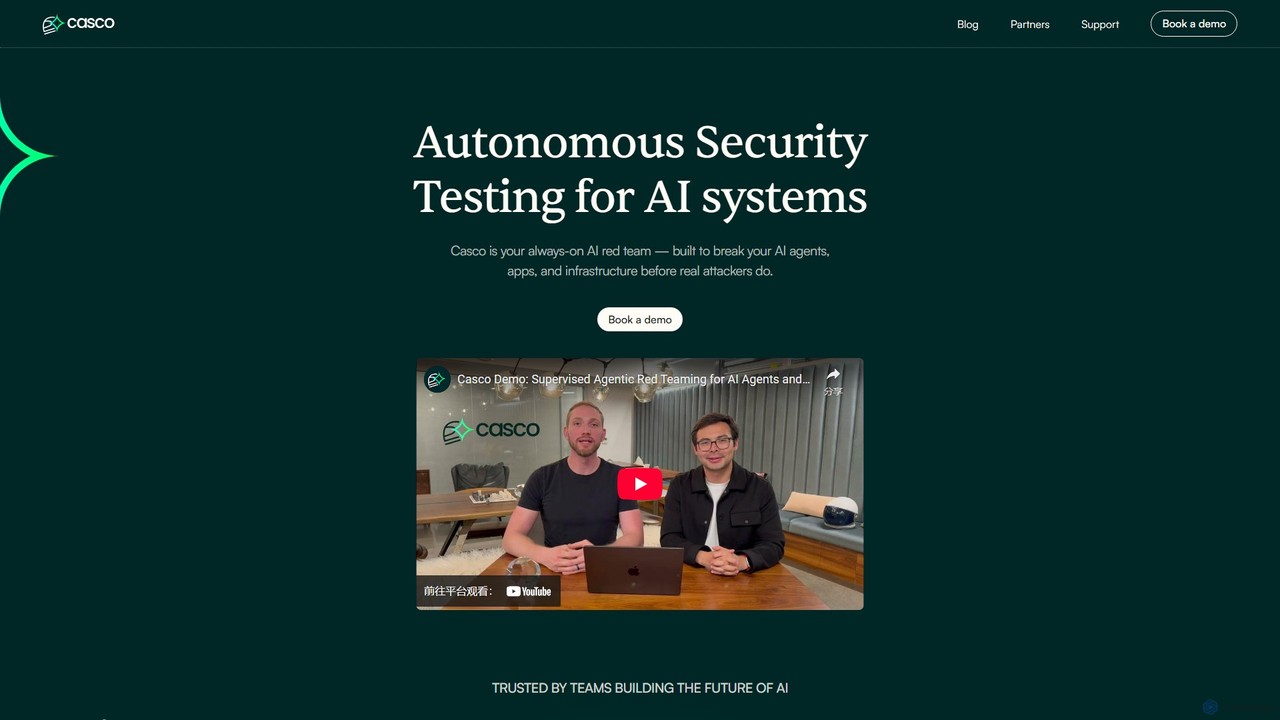
Casco is an autonomous security testing platform for AI systems. It acts as a continuous, always-on AI red …
Casco is an autonomous security testing platform for AI systems. It acts as a continuous, always-on AI red team, proactively identifying and helping to fix vulnerabilities in AI agents, applications, and infrastructure before malicious attackers can exploit them, replacing periodic penetration testing with year-round automated monitoring.
About Model Security
Model Security tools are a specialized class of software designed to protect machine learning models from unique AI-specific threats. They function by actively detecting and mitigating vulnerabilities such as adversarial attacks, data poisoning, and model theft. By implementing robust security measures, these tools ensure the integrity, reliability, and confidentiality of AI systems in production. This is crucial for maintaining user trust and meeting regulatory compliance in high-stakes applications.
Core Features
- Adversarial Attack Defense: Identifies and neutralizes malicious inputs crafted to deceive the model and cause incorrect outputs.
- Integrity Verification: Continuously monitors models for unauthorized changes, performance degradation, or signs of tampering.
- Data Poisoning Detection: Scans training and inference data to find and remove malicious samples intended to corrupt the model's behavior.
- Model IP Protection: Employs techniques like encryption and digital watermarking to prevent reverse-engineering and theft of proprietary models.
Applicable Scenarios
These tools are essential in industries where AI model failure has significant consequences. For example, in financial services to protect fraud detection systems, in autonomous driving to secure perception models, and in healthcare to ensure the accuracy of diagnostic AI.
Selection Criteria
When choosing a Model Security tool, evaluate its compatibility with your model frameworks (e.g., TensorFlow, PyTorch), the breadth of threats it covers, its ease of integration into your existing MLOps pipeline, and its ability to generate reports for compliance and auditing purposes.
Model SecurityUse Cases
Securing Financial Fraud Detection Models
A financial institution's security team uses a model security tool to protect its real-time transaction fraud detection AI. The tool continuously runs red-teaming simulations, testing the model against newly discovered adversarial attack techniques. When a vulnerability is found, it automatically alerts the MLOps team and suggests mitigation strategies, such as input sanitization or model retraining with augmented data. This proactive defense prevents fraudsters from crafting specific transactions designed to bypass the AI, maintaining the model's accuracy and saving the institution millions in potential losses.
Protecting Autonomous Vehicle Perception Systems
An automotive company integrates a model security platform into its development pipeline for self-driving cars. The platform specifically tests the car's computer vision models against physical adversarial attacks, such as stickers on traffic signs that could cause misclassification. By simulating thousands of potential real-world attacks in a virtual environment, developers can harden the models before deployment. This ensures the vehicle's perception system remains robust and reliable, a critical requirement for passenger safety and regulatory approval.
Preventing Model Theft for a Commercial AI API
A startup offers a proprietary language model through a paid API. To prevent competitors from stealing their model via model extraction attacks (querying the API repeatedly to reverse-engineer it), they use a model security tool. The tool implements query rate limiting, detects anomalous query patterns indicative of an attack, and embeds a unique digital watermark into the model's outputs. If a stolen model is found being used elsewhere, the watermark can be used as cryptographic proof of ownership, protecting the company's valuable intellectual property.
Auditing AI Models for Regulatory Compliance
A compliance officer at a large insurance company uses a model security platform to audit their AI models used for claims processing and risk assessment. The platform scans the models for vulnerabilities, biases, and potential privacy leaks (e.g., via model inversion attacks). It generates a comprehensive report detailing risks and compliance with regulations like GDPR and AI ethics frameworks. This automated auditing process reduces manual effort by over 80% and provides the necessary documentation to demonstrate due diligence to regulators.
Guarding Against Data Poisoning in Recommender Systems
An e-commerce platform's MLOps team uses a model security tool to protect its product recommendation engine. Before user interaction data is used to retrain the model, the tool scans it for signs of data poisoning attacks, where malicious actors try to manipulate recommendations by submitting fake reviews or clicks. The tool identifies and quarantines suspicious data clusters, preventing them from corrupting the model. This ensures that recommendations remain relevant and trustworthy, directly impacting user experience and sales.
Ensuring Integrity of Medical Diagnostic AI
A healthcare technology provider deploys a model security solution to safeguard its AI that analyzes medical scans for disease detection. The tool establishes a baseline for the model's expected behavior and continuously monitors its outputs during inference. If the model's predictions start to drift significantly or show anomalies inconsistent with clinical data, it triggers an alert for review by a human expert. This integrity monitoring acts as a critical safety net, ensuring that potential model degradation or subtle attacks do not lead to misdiagnoses, thereby protecting patient health.