Superagent
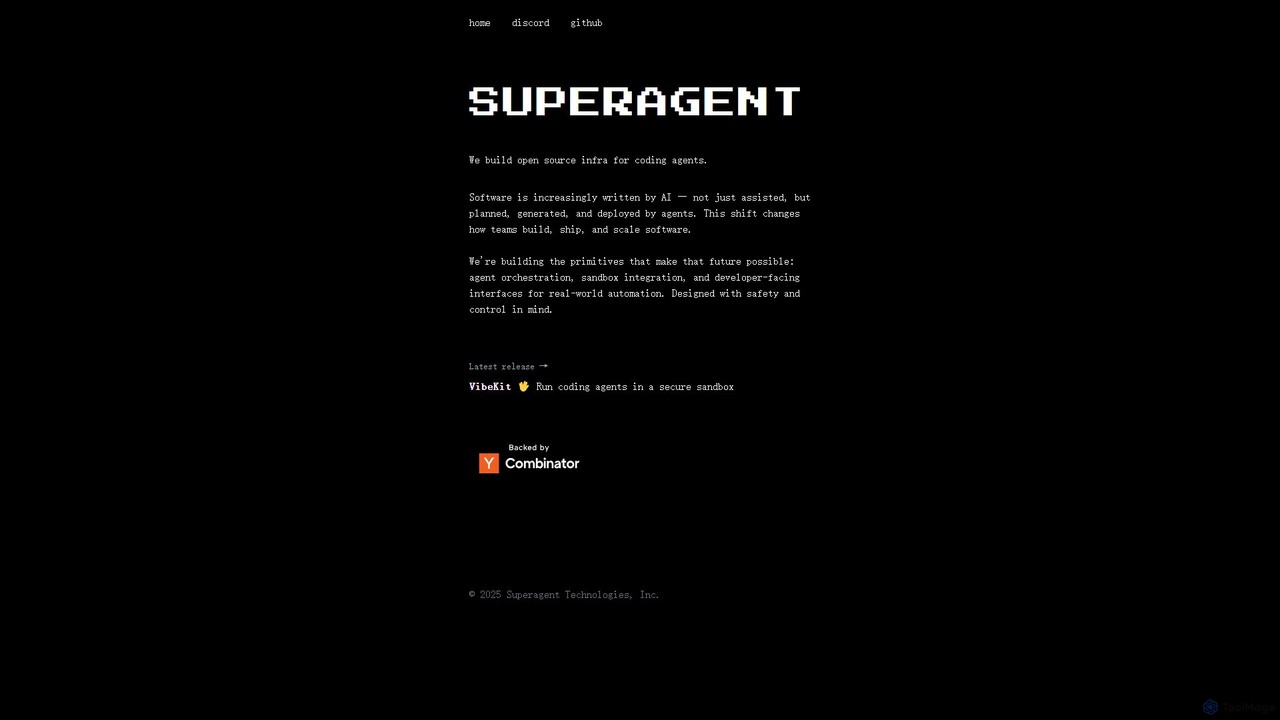
Superagent is an open-source infrastructure for building, managing, and deploying autonomous AI coding agents. Designed for developers, it …
Superagent is an open-source infrastructure for building, managing, and deploying autonomous AI coding agents. Designed for developers, it provides the essential primitives like agent orchestration, secure sandbox integration (VibeKit), and developer-friendly interfaces. This framework empowers teams to automate complex software development tasks, from feature generation and bug fixing to CI/CD management, shifting software creation into a new, AI-driven era with a strong emphasis on safety and control.
About Orchestration
AI Orchestration tools are frameworks designed to build complex applications by connecting multiple AI models, data sources, and external APIs into a cohesive workflow. These platforms provide the structure to chain together different components, such as Large Language Models (LLMs), vector databases, and code execution environments, enabling them to work in concert. The primary value of AI Orchestration is transforming simple prompt-response interactions into sophisticated, multi-step processes capable of reasoning, planning, and executing complex tasks. This enables the development of advanced applications like autonomous agents and sophisticated Retrieval-Augmented Generation (RAG) systems.
Core Features
- Workflow & Chain Construction: Build multi-step sequences and conditional logic for AI operations, either through code or visual interfaces.
- Agent & Tool Integration: Equip LLMs with the ability to use external tools like search engines, calculators, and custom APIs to perform actions.
- State & Memory Management: Maintain context and conversation history across multiple interactions and steps in a workflow.
- Debugging & Observability: Provide tools to trace the execution path of an AI application, inspect intermediate inputs/outputs, and identify errors.
- Component Modularity: Create, reuse, and share pre-built prompts, chains, and agents to accelerate development.
Use Cases
AI Orchestration is crucial for developers and engineers building next-generation AI applications. It's widely used in creating autonomous agents for research and task automation, developing advanced RAG systems that query private knowledge bases, and building complex customer service bots that can access user data and perform actions on their behalf. It is also fundamental for creating multi-modal generation pipelines that combine text, image, and audio models.
How to Choose
When selecting an AI Orchestration tool, consider its core paradigm (e.g., code-first like LangChain vs. visual builders). Evaluate the breadth of its integrations with different LLMs, vector stores, and APIs. Assess the robustness of its debugging and monitoring capabilities, as tracing complex AI workflows is critical. Finally, consider the learning curve, community support, and whether its architecture fits your scalability and deployment requirements.

OrchestrationUse Cases
Building a RAG System for Internal Knowledge Base
A developer is tasked with creating a chatbot that can answer employee questions based on hundreds of internal company documents. Using an AI Orchestration tool, they build a Retrieval-Augmented Generation (RAG) pipeline. The workflow is defined as: 1) Receive a user's question. 2) Use an embedding model to convert the question into a vector. 3) Query a vector database containing the document chunks to find the most relevant information. 4) Combine the original question and the retrieved context into a prompt for an LLM. 5) The LLM generates a concise, accurate answer based only on the provided documents. This orchestrated process ensures answers are factual and grounded in company data, preventing model hallucination.
Creating an Autonomous AI Research Agent
A market analyst needs to compile a report on emerging trends in a specific industry. They use an AI Orchestration platform to configure an autonomous agent. The agent's workflow involves a loop: 1) It starts with a high-level goal: 'Summarize top 3 AI trends in renewable energy'. 2) It uses a search engine tool to find relevant articles. 3) It uses a web scraping tool to read the content of the top links. 4) It uses an LLM to summarize each article and identify key trends. 5) It repeats the process, refining its search queries based on initial findings. The orchestration tool manages the agent's memory and the sequence of tool calls, allowing it to perform complex research that would normally take a human analyst hours to complete.
Automating Complex Customer Support Workflows
A customer support team wants to build a bot that does more than answer FAQs. Using an orchestration tool, they design a multi-step workflow. When a customer reports an issue, the AI agent first calls the company's CRM API to retrieve the customer's purchase history. Then, it queries a technical knowledge base for troubleshooting steps relevant to their products. If the issue persists, the agent can offer to create a support ticket by calling the ticketing system's API. The orchestration platform manages the flow of data between these systems (CRM, knowledge base, ticketing) and maintains the conversation's context, providing a seamless support experience that only escalates to a human when truly necessary.
Developing a Multi-Modal Content Generation Pipeline
A marketing team wants to automate the creation of short promotional videos. They use an AI Orchestration tool to link several specialized AI models. The pipeline starts with a product description text. Step 1: An LLM expands this text into a short video script. Step 2: Another LLM generates prompts for an image generation model based on the script. Step 3: The image model creates a series of visuals. Step 4: A text-to-speech model generates a voiceover from the script. The orchestration tool manages the dependencies and data handoffs between each step, ensuring the script, images, and audio are all generated and synchronized correctly to produce a final video asset, drastically reducing manual production time.
Creating a Data Analysis and Visualization Chain
A data analyst needs to quickly process and understand a new dataset. They construct a chain in an AI Orchestration tool. The first step uses a 'Code Interpreter' tool to ingest a CSV file, clean the data, and perform statistical analysis. The output, a summary of key findings, is then passed to an LLM. The LLM's task is to interpret these statistical results in plain language and suggest potential business insights. Finally, the structured data and insights are passed to a 'Charting API' tool, which automatically generates a bar chart and a pie chart. This orchestrated chain transforms raw data into understandable visualizations and narratives in minutes, a process that would typically involve multiple separate software tools.
Integrating LLMs into Enterprise Business Processes
An IT department aims to automate invoice processing. They use an AI Orchestration platform to create a robust workflow. When a new invoice PDF arrives, Step 1: An OCR tool extracts the raw text. Step 2: An LLM parses this text to identify and structure key information like vendor, invoice number, amount, and due date. Step 3: The structured data is used to call an internal API that validates the invoice against purchase orders in the ERP system. Step 4: If validated, another API call is made to schedule the payment. The orchestration tool handles error conditions, such as routing invoices with missing information to a human for review, creating a reliable, automated process that integrates AI intelligence directly into core business operations.