Defang
Defang is an AI-powered platform that simplifies cloud deployment. It enables developers to take any Docker Compose project …
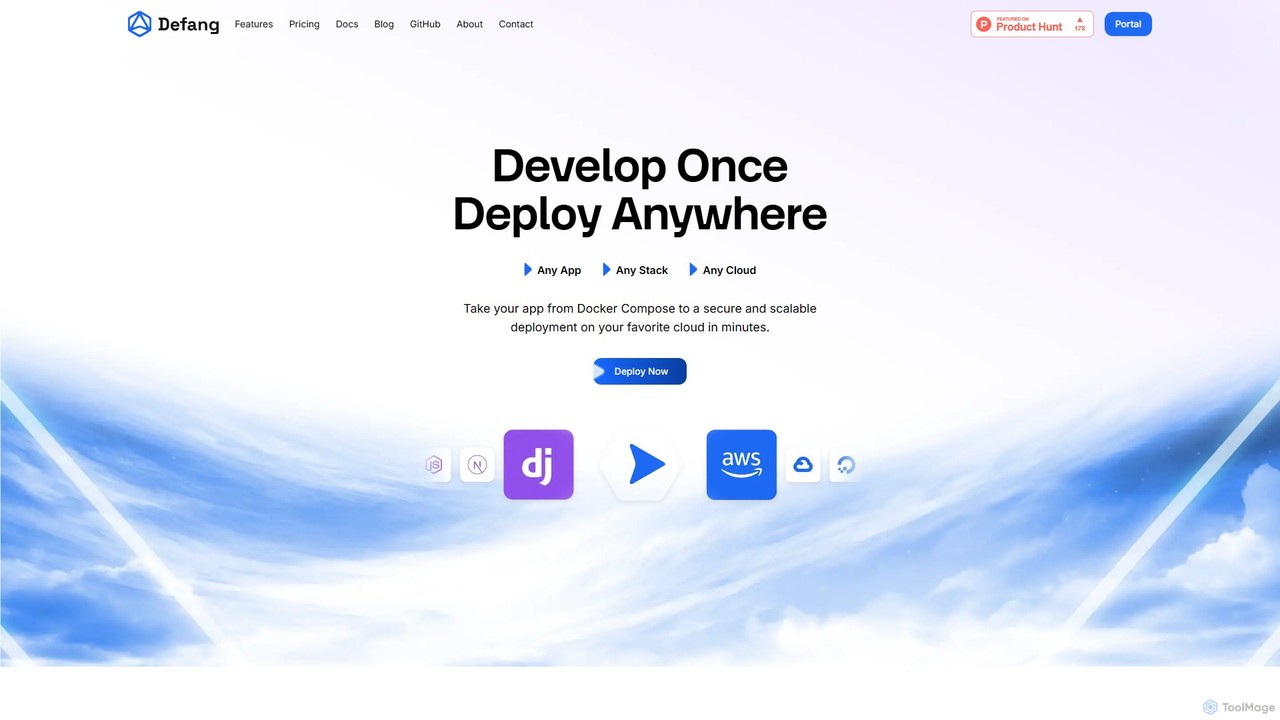
Defang is an AI-powered platform that simplifies cloud deployment. It enables developers to take any Docker Compose project and deploy it to major cloud providers like AWS and GCP with a single command, automating complex infrastructure setup, security, and scaling.
About Platform As A Service (Paas)
Platform as a Service (PaaS) for AI is a cloud computing environment that provides a complete framework to build, deploy, and manage AI applications. These platforms abstract away the underlying infrastructure, offering pre-configured environments, managed services, and integrated tools for the entire machine learning lifecycle. This allows teams to accelerate development, from data preparation and model training to deployment and monitoring, without managing complex hardware or software stacks. AI PaaS solutions are designed to streamline MLOps and enable rapid innovation.
Core Features
- Managed AI Environments: Pre-configured workspaces with popular frameworks like TensorFlow and PyTorch.
- End-to-End MLOps: Tools for experiment tracking, model versioning, automated training pipelines, and deployment.
- Scalable Compute Resources: On-demand access to CPUs, GPUs, and TPUs that scale automatically.
- Integrated Data Services: Tools for data ingestion, storage, preparation, and feature engineering.
- API-based Deployment: Simplified deployment of trained models as scalable API endpoints.
Use Cases
AI PaaS is widely used by data science teams, machine learning engineers, and application developers. It's ideal for organizations looking to build custom AI solutions, such as predictive analytics models, natural language processing applications, or computer vision systems, without the overhead of managing infrastructure.
How to Choose
When selecting an AI PaaS, consider the supported machine learning frameworks, the scope of its MLOps capabilities, integration with your existing data sources, and its pricing model. Also, evaluate the platform's scalability for both model training and real-time inference to ensure it meets your project's performance requirements.

Platform As A Service (Paas)Use Cases
Rapid Prototyping of Machine Learning Models
Data scientists can leverage an AI PaaS to quickly test new hypotheses. Instead of spending days setting up servers and installing libraries, they can spin up a pre-configured Jupyter environment with access to GPUs in minutes. This allows them to upload a dataset, build a model using frameworks like PyTorch or TensorFlow, and evaluate its performance immediately. The platform's integrated experiment tracking tools help log every run, making it easy to compare results and iterate on model architecture, significantly shortening the path from idea to a working prototype.
Building and Scaling a Custom Recommendation Engine
An e-commerce company can use an AI PaaS to develop and deploy a personalized product recommendation engine. Developers can use the platform's data processing services to handle user behavior logs and product catalogs. They can then train a collaborative filtering or deep learning model using scalable compute resources. Once trained, the model is deployed as a highly available API endpoint via the PaaS, which automatically handles scaling to manage traffic spikes during peak shopping seasons, ensuring a seamless user experience.
Implementing an Enterprise MLOps Pipeline
For a financial institution, an MLOps engineer can use an AI PaaS to automate the entire lifecycle of a fraud detection model. The platform provides tools to build a CI/CD pipeline that automatically triggers model retraining when new transaction data is available or when model performance degrades. The pipeline includes automated testing, validation, and deployment to a production environment. This ensures the fraud detection model remains accurate and up-to-date while maintaining compliance and governance through version control and audit trails.
Developing a Natural Language Processing (NLP) Application
A software development team building a customer support chatbot can utilize an AI PaaS. The platform offers managed services and pre-trained models for NLP tasks like sentiment analysis and named entity recognition. Developers can fine-tune these models on their specific customer interaction data. The PaaS simplifies hosting the final model as a scalable API, which the chatbot application can call to understand user queries and provide intelligent responses, without the team needing to become experts in infrastructure management.
Accelerating AI Research in Academia
University researchers working on complex simulations or deep learning models can use an AI PaaS to access high-performance computing resources on demand. Instead of waiting for shared university cluster resources, they can provision powerful GPU instances for intensive training tasks. The platform's collaborative features allow research teams to share datasets, code, and experiment results seamlessly, fostering collaboration and accelerating the pace of scientific discovery without requiring a large upfront investment in hardware.
Integrating Computer Vision into an Industrial IoT System
A manufacturing company can use an AI PaaS to build a quality control system. Developers can train a computer vision model to detect defects in products on an assembly line using images from IoT cameras. The PaaS manages the data pipeline from the cameras, provides the GPU resources for training, and allows the model to be deployed to edge devices or as a central API. This enables real-time defect detection, reduces manual inspection costs, and improves overall product quality.