Ai Infrastructure Best in category 2 results Platform AI Tool

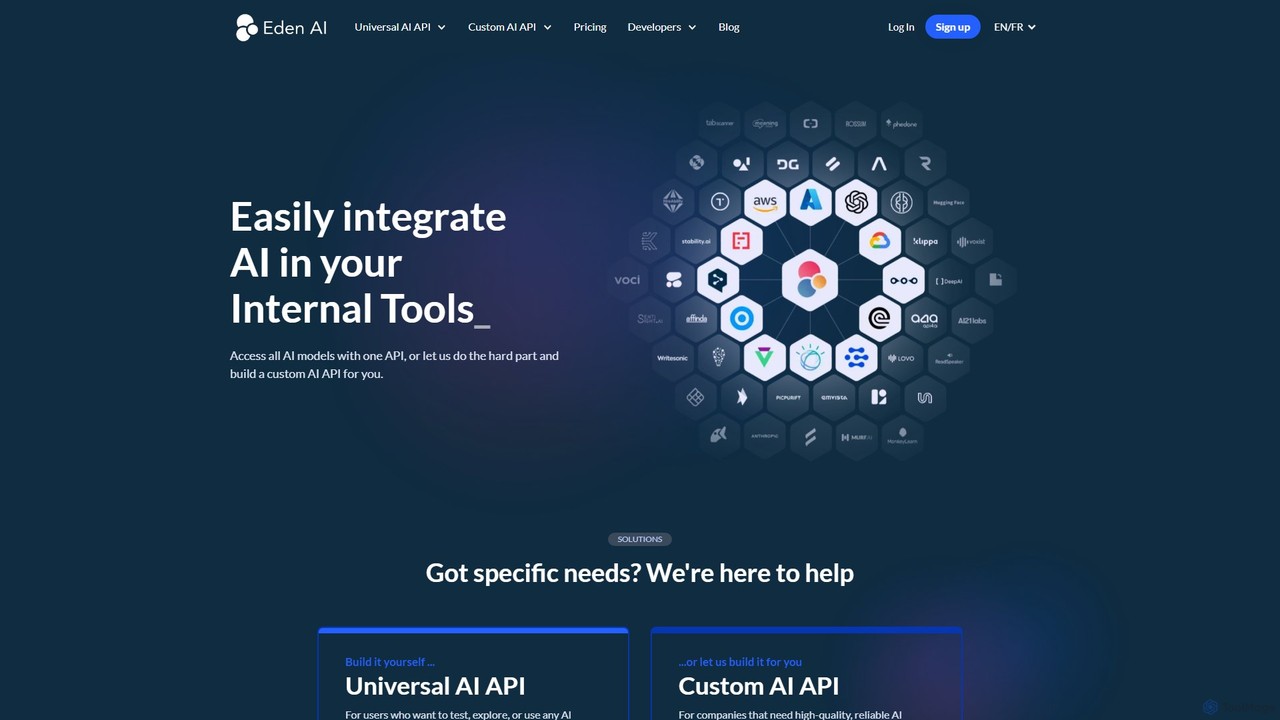
Popular AI tools in the Platform field of Ai Infrastructure include Eden AI、VisionLabs, etc., helping you quickly improve efficiency.

VisionLabs

VisionLabs

VisionLabs is a world-leading developer of enterprise-grade computer vision and machine learning solutions. Specializing in face, object, and …

16.0K
Eden AI

Eden AI

Eden AI is a unified API platform that allows developers to easily access and integrate the best AI …

126.9K

About Platform

AI Platforms are integrated environments that provide a comprehensive suite of tools for the entire machine learning lifecycle. They centralize resources for data preparation, model training, deployment, and monitoring, abstracting away complex underlying infrastructure. This allows teams to build, manage, and scale AI applications more efficiently and collaboratively. As a core component of AI Infrastructure, these platforms streamline the path from concept to production-ready AI systems.

Core Features

  • End-to-End MLOps: Provides a unified workflow for the complete machine learning lifecycle, including data versioning, experiment tracking, and automated pipelines.
  • Scalable Compute Resources: Offers on-demand access to powerful computing resources like GPUs and TPUs for training and inference at scale.
  • Model Registry & Management: A central repository for versioning, storing, and managing machine learning models to ensure reproducibility and governance.
  • One-Click Deployment: Simplifies the process of deploying trained models as scalable and secure APIs or services.
  • Collaborative Workspace: Enables data scientists, ML engineers, and stakeholders to work together on projects with shared resources and access controls.

Use Cases

AI Platforms are widely used by enterprises to develop custom AI solutions, such as fraud detection systems or recommendation engines. Startups leverage them to rapidly prototype and deploy AI-powered features. Research institutions also rely on these platforms to manage large-scale experiments and complex computational workflows.

How to Choose

When selecting an AI Platform, consider the scope of its services—does it cover your entire workflow? Evaluate its integration capabilities with your existing data stack and cloud services. Assess its scalability, security features, and whether its pricing model (e.g., pay-as-you-go vs. subscription) aligns with your budget and usage patterns. Finally, consider the balance between ease of use (low-code interfaces) and flexibility (code-first environments).

PlatformUse Cases

1

Developing Enterprise-Grade Fraud Detection Systems

A financial services company's data science team uses an AI platform to build a custom fraud detection model. They leverage the platform's integrated data preparation tools to clean and process millions of transaction records. The scalable GPU resources are used to train a complex deep learning model in hours instead of days. After training, the model is registered, versioned, and deployed as a low-latency API via the platform's one-click deployment feature, integrating seamlessly into their real-time transaction processing system.

2

Accelerating AI Feature Prototyping for Startups

A tech startup aims to add a personalized content recommendation feature to its mobile app. Using an AI platform, their small engineering team can bypass complex infrastructure setup. They use a managed notebook environment for rapid experimentation and leverage pre-trained models available on the platform as a starting point. The platform's experiment tracking capabilities allow them to compare different algorithms and hyperparameters efficiently. Within weeks, they deploy a prototype API to gather user feedback, significantly shortening their time-to-market.

3

Managing Large-Scale Academic Research Projects

A university research lab is studying climate change using massive satellite imagery datasets. An AI platform provides a collaborative environment where multiple researchers can access shared datasets and computational resources. They use the platform to orchestrate complex data processing pipelines and distribute model training jobs across a cluster of GPUs. The platform's experiment tracking automatically logs all parameters, code versions, and results, ensuring the research is fully reproducible and transparent for peer review and publication.

4

Automating MLOps for Continuous Model Improvement

An e-commerce company's ML team uses an AI platform to automate the lifecycle of their product recommendation model. They build a CI/CD pipeline within the platform that automatically triggers model retraining whenever new user interaction data is available. The pipeline runs automated tests for performance and bias before registering the new model. If tests pass, the platform automatically deploys the updated model to production with zero downtime, ensuring customers always receive the most relevant recommendations.

5

Centralizing Model Governance and Compliance

A healthcare organization developing AI for medical imaging needs to maintain strict regulatory compliance. They use an AI platform as a central model registry. Every model version, its training data, and performance metrics are logged and auditable. The platform's access control features ensure that only authorized personnel can modify or deploy models. This centralized governance simplifies the process of generating compliance reports for regulatory bodies like the FDA, demonstrating a clear and traceable development history for each AI model.

6

Building and Deploying Custom LLM Applications

A software company wants to build a chatbot powered by a Large Language Model (LLM) trained on its internal documentation. Using an AI platform, developers can easily fine-tune a foundation model like Llama 2 on their private dataset in a secure environment. The platform manages the complex GPU allocation and training process. Once fine-tuned, the model is deployed as a scalable API endpoint through the platform, which the company then integrates into its internal knowledge base portal for employees.

PlatformFrequently Asked Questions