Ai Infrastructure Best in category 1 results Serverless AI Tool

Popular AI tools in the Serverless field of Ai Infrastructure include Cloudflare Agents, etc., helping you quickly improve efficiency.

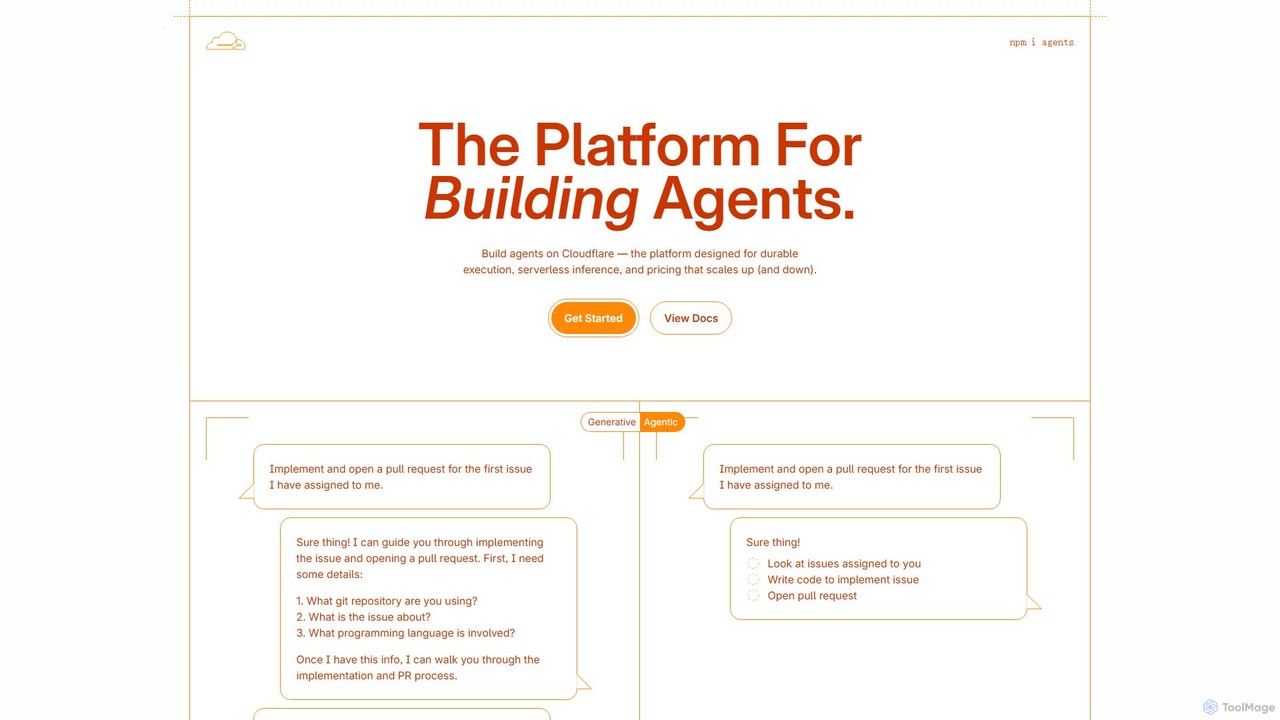
Cloudflare Agents

Cloudflare Agents

A comprehensive developer platform for building, deploying, and scaling autonomous AI agents. It leverages Cloudflare's serverless infrastructure for …

14.9K

About Serverless

Serverless platforms provide a cloud-native development model that allows developers to build and run AI applications and services without managing the underlying server infrastructure. These tools operate on an event-driven basis, executing code in response to specific triggers like an API call or a file upload. This approach enables developers to focus solely on writing code for their AI models and business logic, while the cloud provider handles server provisioning, scaling, and maintenance. The primary value lies in its automatic scalability and pay-per-execution pricing, making it highly efficient for workloads with variable traffic, such as AI inference endpoints.

Core Features

  • Event-Driven Execution: Code is executed automatically in response to triggers from various services, such as HTTP requests, database changes, or file uploads.
  • Automatic Scaling: The platform automatically scales the application by running code in parallel as needed, from zero to thousands of requests.
  • Managed Infrastructure: Eliminates the need for server management, including patching, capacity provisioning, and OS maintenance.
  • Pay-per-Use Billing: Users are charged only for the compute time their code actually consumes, down to the millisecond, resulting in no cost for idle time.

Use Cases

Serverless is widely used for building AI-powered backends, real-time data processing pipelines, and microservices. It is particularly effective for deploying machine learning model inference APIs, where traffic can be unpredictable. Other common applications include creating chatbots, processing IoT sensor data streams, and automating data preparation workflows for model training.

How to Choose

When selecting a Serverless platform for AI, consider the supported programming languages and frameworks (e.g., Python, TensorFlow, PyTorch). Evaluate performance metrics like cold start times, which can impact user experience. Also, check execution limits, such as maximum duration and memory allocation, to ensure they fit your model's requirements. Finally, assess the platform's integration with other cloud services, like storage, databases, and dedicated AI/ML platforms.

ServerlessUse Cases

1

Deploying a Real-time Image Recognition API

A mobile app developer needs to add a feature that identifies objects in user-uploaded photos. Instead of provisioning and managing a dedicated server, they deploy their pre-trained computer vision model using a serverless function. An API Gateway is configured to trigger this function whenever a new image is POSTed to an endpoint. The function loads the model, performs inference on the image, and returns the object labels (e.g., 'cat', 'tree', 'car') as a JSON response in under a second. This approach is highly cost-effective as they only pay for the few hundred milliseconds of compute time per photo, and it scales automatically to handle thousands of concurrent users during peak hours without any manual intervention.

2

Automated Data Preprocessing for Model Training

A data science team needs to process large volumes of raw data before it can be used for training machine learning models. They set up a serverless workflow where uploading a new CSV file to a cloud storage bucket automatically triggers a function. This function reads the file, performs cleaning operations like handling missing values, normalizes numerical features, and encodes categorical data. The processed data is then saved to a different bucket, ready for the training pipeline. This serverless automation eliminates manual scripts, ensures consistent data preparation, and scales effortlessly to handle hundreds of incoming files simultaneously, significantly accelerating the MLOps lifecycle.

3

Powering a Scalable Chatbot Backend

A customer service company wants to deploy an AI chatbot on their website to handle common queries. They build the chatbot's logic and integrate a Natural Language Processing (NLP) model within a serverless function. Each message sent by a user through the website's chat widget triggers the function via an API call. The function processes the user's text, determines the intent, queries a knowledge base if needed, and formulates a response. Because the workload is sporadic—intense during business hours and quiet overnight—the serverless model is ideal. It automatically scales to manage thousands of simultaneous conversations and scales down to zero when inactive, ensuring they only pay for active engagement and not for idle server capacity.

4

Real-time IoT Data Analysis and Alerting

An agricultural technology company uses thousands of IoT sensors to monitor soil moisture and temperature across vast farmlands. Each sensor sends data every minute to a cloud IoT service. This service is configured to trigger a serverless function for every new data point received. The function runs a small predictive model to check for anomalies, such as a sudden drop in moisture indicating a potential irrigation system failure. If an anomaly is detected, the function sends an immediate alert to the farm manager's mobile device via a push notification service. This event-driven, serverless architecture allows for massive-scale, real-time data ingestion and analysis at a low cost, as compute resources are only used for the brief moment each sensor reading is processed.

5

Scheduled Model Retraining Triggers

An MLOps engineer is responsible for keeping a fraud detection model up-to-date with the latest transaction data. They configure a serverless function to run on a schedule, for example, every Sunday at 2 AM. When triggered, the function executes a script that checks a data lake for new, labeled data from the past week. If sufficient new data exists, the function initiates a model retraining job on a dedicated ML platform like Amazon SageMaker or Google AI Platform. Upon completion of the training job, another event triggers the same function (or a different one) to evaluate the new model's performance and, if it passes, deploy it to production. This automates the entire retraining cycle without requiring a continuously running server to manage the schedule.

6

On-demand Video and Audio Transcription

A media company needs to generate transcripts for all video content uploaded to their platform. They create a serverless workflow where a new video file uploaded to a storage bucket triggers a function. This function calls a cloud-based AI transcription service (like AWS Transcribe or Google Speech-to-Text), passing the location of the video file. The transcription service processes the audio asynchronously. Once the transcription is complete, it sends a notification that triggers a second serverless function. This second function retrieves the transcript text, formats it into a standard subtitle file (e.g., .srt), and saves it in the same bucket as the original video. This entire process is automated, scalable, and cost-efficient, running only when new content is added.

ServerlessFrequently Asked Questions