ToolMage
Sign in

Best 3 Data Analysis AI tools for Ai Tools

Popular Data Analysis AI tools in Ai Tools include Feishu Base, HelloCheck, and Fonix, helping you work more efficiently.

HelloCheck
Free

HelloCheck

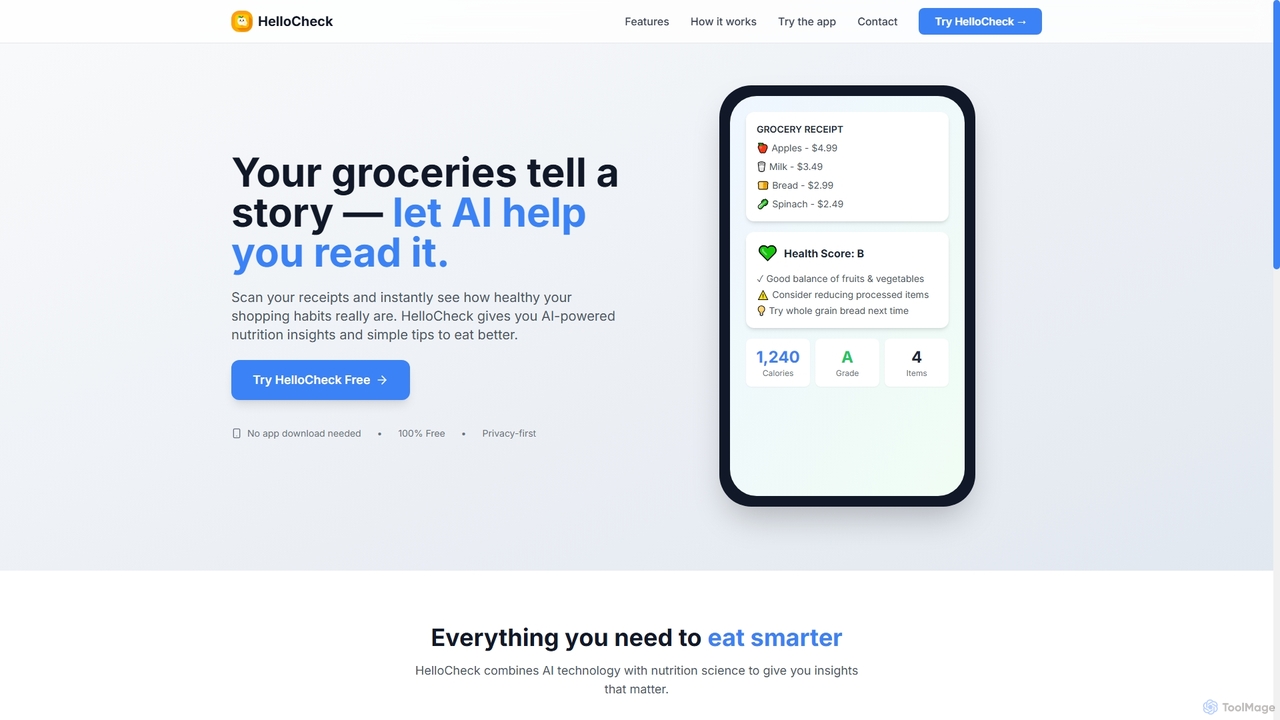
HelloCheck is a free, AI-powered tool that analyzes your grocery receipts to provide detailed nutrition insights. Simply scan a receipt to understand your shopping habits, get a health score (A-E), and receive personalized tips for healthier eating, all without downloading an app.

Data Analysis
Visits 7.1KFavorites 117Likes 94
Fonix
Freemium

Fonix

Fonix is an AI-powered cryptocurrency portfolio management platform that allows users to consolidate and track their assets from multiple exchanges and wallets in one place. It offers real-time market data, AI-driven news analysis, and automated profit/loss calculations. Designed with a focus on security, it uses read-only APIs to provide a comprehensive and secure overview of your entire crypto portfolio.

Data Analysis
Visits 7KFavorites 162Likes 165
Feishu Base
Freemium

Feishu Base

Feishu Base is an AI-powered no-code platform that combines the flexibility of a spreadsheet with the power of a database. It enables teams to build custom business systems, automate workflows, and analyze data through intuitive dashboards without writing any code. It's designed for seamless collaboration and data management.

Data Analysis
Visits 41.9KFavorites 110Likes 123

About Data Analysis

Data Analysis tools are AI-powered platforms designed to automate and enhance the process of extracting insights from complex datasets. These tools leverage machine learning, natural language processing, and advanced algorithms to identify patterns, predict trends, and generate actionable intelligence. They empower businesses and individuals to make data-driven decisions more efficiently and accurately, transforming raw data into strategic advantages by uncovering hidden correlations and future outcomes. As a crucial sub-category within AI Tools, they specifically focus on transforming raw data into valuable, understandable information.

Core Features

  • Automated Data Cleaning and Preparation: Automatically identifies, corrects, and standardizes errors, missing values, and inconsistencies across large datasets, significantly reducing manual effort and ensuring data quality for analysis.
  • Predictive Modeling and Forecasting: Builds and deploys sophisticated machine learning models to analyze historical data, identify underlying trends, and accurately forecast future outcomes, such as sales, demand, or market shifts.
  • Automated Insight Generation: Goes beyond simple reporting by automatically discovering key trends, anomalies, and complex correlations within data, presenting these findings in clear, understandable narratives or visualizations.
  • Natural Language Querying (NLQ): Allows users to interact with data using plain, conversational language, asking questions like "What were our sales last quarter?" and receiving instant, intelligent answers without needing to write complex queries.
  • Interactive Data Visualization: Creates dynamic and customizable charts, graphs, and dashboards that enable intuitive exploration of data, helping users to quickly grasp complex information and communicate findings effectively.

Applicable Scenarios

AI Data Analysis tools are invaluable across various sectors, from finance and retail to healthcare and manufacturing, for understanding market dynamics, optimizing operational efficiencies, and personalizing customer experiences. They assist data scientists in accelerating model development and validation, business analysts in uncovering critical insights without deep coding knowledge, and executives in making strategic decisions based on robust, evidence-based predictions. These tools are particularly useful in scenarios requiring rapid processing of vast datasets and the identification of subtle, non-obvious patterns.

How to Choose

When selecting an AI Data Analysis tool, consider its data integration capabilities with your existing databases, cloud platforms, and business intelligence systems to ensure seamless data flow. Evaluate the breadth and depth of its analytical features, including predictive, prescriptive, and diagnostic capabilities, to match your specific business needs. Assess the ease of use and user interface for your team's technical skill level, as well as its scalability to handle growing data volumes and increasing complexity. Finally, scrutinize the accuracy and explainability of its AI models, along with the security measures for sensitive data, to ensure trustworthiness and compliance.

Data Analysis use cases

1

Predicting Sales Trends and Demand

E-commerce managers and retail strategists utilize AI data analysis tools to forecast future sales volumes and product demand. By analyzing historical sales data, seasonal patterns, promotional impacts, and external market indicators, these tools provide accurate predictions. This enables businesses to optimize inventory levels, plan marketing campaigns more effectively, and make informed decisions on pricing and product assortment, significantly reducing stockouts and overstocking.

2

Customer Behavior Segmentation

Marketing and product teams leverage AI data analysis to segment customer bases into distinct groups based on demographics, purchase history, website interactions, and engagement patterns. These tools identify subtle behavioral clusters that manual analysis might miss. This enables businesses to tailor marketing messages, personalize product recommendations, and develop targeted strategies that resonate with specific customer segments, leading to higher conversion rates and improved customer loyalty.

3

Financial Fraud Detection

Financial institutions and fraud prevention specialists deploy AI data analysis tools to detect and prevent fraudulent activities. These tools continuously monitor vast streams of transaction data, identifying unusual patterns, anomalies, and deviations from normal behavior in real-time. By leveraging machine learning models, they can flag suspicious transactions with high accuracy, minimizing financial losses and enhancing security measures for customers and the institution.

4

Optimizing Supply Chain Logistics

Logistics and operations managers utilize AI data analysis to enhance supply chain efficiency. By analyzing vast datasets on shipping routes, weather patterns, supplier performance, inventory levels, and historical delivery times, these tools can predict potential delays, optimize routing, and identify bottlenecks. This leads to reduced operational costs, improved delivery times, and a more resilient and responsive supply chain network.

5

Personalized Healthcare Recommendations

Healthcare providers and medical researchers employ AI data analysis to offer personalized treatment plans and predict disease risks. By analyzing patient data, medical history, genetic information, and lifestyle factors, these tools can identify individual predispositions and recommend tailored interventions. This leads to more effective preventative care, optimized treatment protocols, and improved patient outcomes, moving towards precision medicine.

6

Automated Market Research Insights

Business strategists and market researchers leverage AI data analysis to process vast volumes of market data, competitor reports, social media sentiment, and news articles. These tools automatically extract key trends, identify emerging opportunities, and assess brand perception. This capability significantly accelerates the market research process, providing timely and comprehensive insights for strategic planning, product development, and competitive positioning, without extensive manual review.

Data Analysis FAQ

What are AI Data Analysis tools?

AI Data Analysis tools are software applications that leverage artificial intelligence, primarily machine learning and deep learning, to automate and enhance the process of examining large, complex datasets. They go beyond traditional methods by identifying intricate patterns, making accurate predictions, and generating actionable insights with minimal human intervention. These tools help users understand data more deeply, efficiently, and proactively, transforming raw information into strategic intelligence for decision-making.

How do AI Data Analysis tools differ from traditional BI tools?

Traditional Business Intelligence (BI) tools primarily focus on descriptive analytics, reporting past and present data to show "what happened." AI Data Analysis tools, however, leverage machine learning for predictive and prescriptive analytics, forecasting future outcomes ("what will happen") and recommending actions ("what should we do"). They also automate data preparation, insight generation, and can handle unstructured data more effectively, offering deeper, more proactive, and forward-looking insights compared to BI tools.

What are the key benefits of using AI for data analysis?

The key benefits of using AI for data analysis are numerous. Firstly, it significantly increases efficiency by automating repetitive tasks like data cleaning and insight generation, saving valuable time. Secondly, it improves accuracy in predictions and anomaly detection, as AI models can identify subtle patterns that human analysts might miss. Thirdly, it enables deeper insights from vast and complex datasets, leading to faster, more informed decision-making and a stronger competitive advantage for businesses.

Who can benefit most from using AI Data Analysis tools?

A wide range of professionals can benefit significantly from AI Data Analysis tools. This includes data scientists who can accelerate model development and validation, business analysts seeking deeper insights without extensive coding, marketing teams for advanced customer segmentation, financial analysts for risk assessment and fraud detection, and executives needing data-driven strategic guidance. Essentially, anyone dealing with large volumes of data and aiming for more efficient, accurate, and predictive insights can gain substantial value.

What should I consider when choosing an AI Data Analysis tool?

When choosing an AI Data Analysis tool, several factors are crucial. First, assess its data integration capabilities with your existing systems and data sources. Second, evaluate the breadth and depth of its analytical features, including predictive modeling, automated insight generation, and visualization options. Third, consider the ease of use and the learning curve for your team, as well as its scalability to handle future data growth. Finally, scrutinize the accuracy and explainability of its AI models, along with data security and compliance features, to ensure trustworthiness and alignment with regulations.