Ai Tools Best in category 1 results Data Enrichment AI Tool

Popular AI tools in the Data Enrichment field of Ai Tools include Tomat.AI, etc., helping you quickly improve efficiency.

Tomat.AI

Tomat.AI

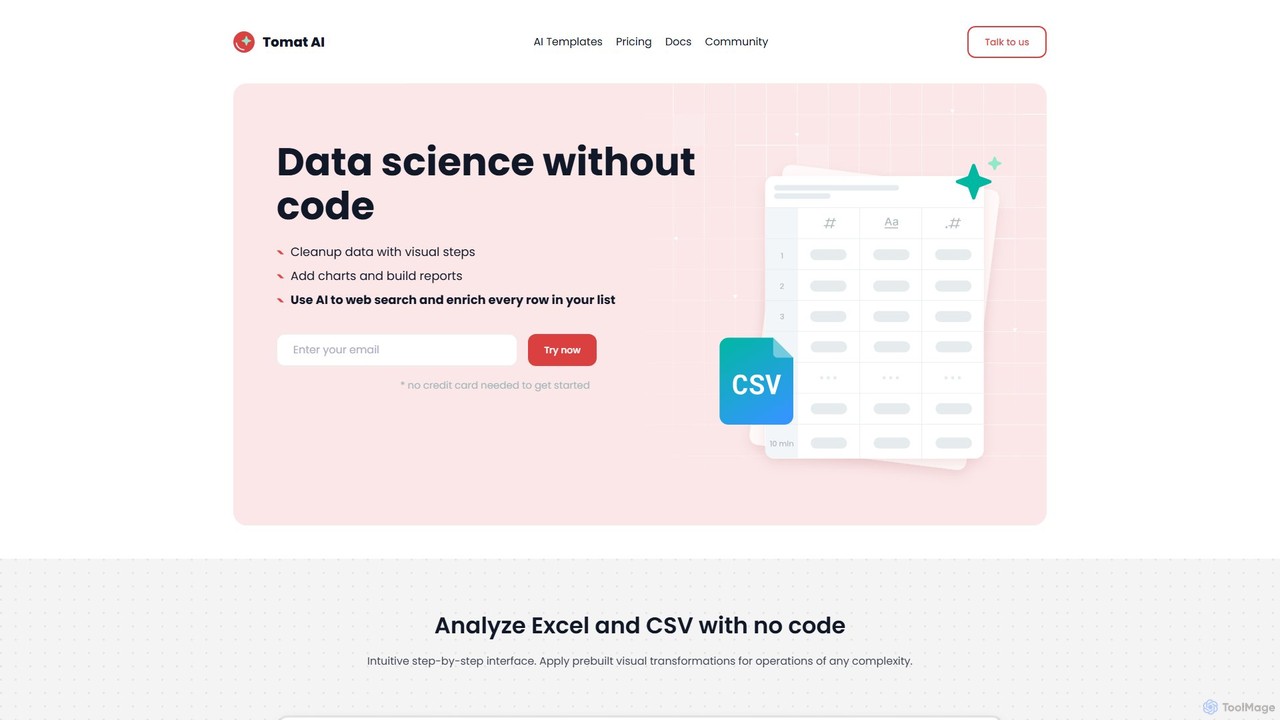
Tomat.AI is a no-code data science tool that empowers users to clean, analyze, and enrich data from Excel …

5.0K

About Data Enrichment

Data Enrichment tools are AI-powered platforms designed to enhance, refine, and append existing raw data with contextual information from external sources. These tools leverage machine learning and vast databases to identify entities, validate information, and add missing attributes like demographics, firmographics, or geographic details. This process transforms incomplete datasets into comprehensive, actionable assets crucial for sales, marketing, and risk analysis. Unlike simple data cleaning, data enrichment focuses on adding new, valuable layers of information to create a richer understanding of customers or leads.

Core Features

  • Contact Enrichment: Appends missing details like verified emails, phone numbers, and social profiles to contacts.
  • Firmographic Appending: Adds company-specific data such as industry, employee count, revenue, and technology stack.
  • Geospatial Enrichment: Incorporates location-based data like precise coordinates, postal codes, and regional demographics.
  • Data Verification: Cross-references existing data against authoritative sources to confirm accuracy and remove outdated information.
  • Technographic Data: Identifies the software and hardware technologies used by a company to enable targeted outreach.

Use Cases

Data Enrichment tools are widely used by sales, marketing, and business intelligence teams in B2B and B2C sectors. For instance, sales teams enrich lead lists before outreach to personalize communication, while marketing departments segment audiences for targeted campaigns. Financial institutions also use these tools to verify customer identity and assess risk.

How to Choose

When selecting a Data Enrichment tool, consider the quality and coverage of its data sources, ensuring they are accurate and frequently updated. Evaluate its integration capabilities with your existing CRM and marketing automation platforms. Also, confirm the tool's compliance with data privacy regulations like GDPR and CCPA, and analyze its pricing model to ensure it aligns with your usage volume.

Data EnrichmentUse Cases

1

Enhancing B2B Sales Lead Lists

A Sales Development Representative (SDR) receives a list of company names and job titles from a trade show. To make this raw data actionable, they use a data enrichment tool. The tool automatically appends direct phone numbers, verified work emails, LinkedIn profiles, company size, and the specific technology stack used by each company. This enriched information allows the SDR to craft highly personalized outreach messages, referencing the prospect's tech stack or company size, which significantly increases response rates and the quality of scheduled meetings.

2

Building Hyper-Personalized Marketing Campaigns

A marketing manager wants to create targeted email campaigns but only has a list of customer email addresses. By using a data enrichment tool, they can append firmographic data (like industry and company revenue) and demographic data (like job function) to each contact. This allows for precise audience segmentation. Instead of a generic message, they can send tailored content to 'Marketing Directors at SaaS companies with over 500 employees,' leading to higher open rates, click-through rates, and overall campaign ROI.

3

Improving Customer Support Context

A customer support team often receives tickets with little context about the user. By integrating a data enrichment API with their helpdesk software, each new ticket created from an email address is automatically enhanced. The support agent can instantly see the customer's company name, size, industry, and even their role. This context allows agents to prioritize tickets from enterprise clients, understand the user's potential technical environment, and provide faster, more relevant solutions without asking basic qualifying questions.

4

Conducting Accurate Market Research

A market analyst needs to understand the adoption rate of a specific technology across different industries. Starting with a list of known companies, they use a data enrichment tool to append technographic data (identifying their tech stack) and firmographic details. This process quickly reveals which industries have the highest adoption, the typical company size of a user, and identifies potential competitor strongholds. The resulting analysis is far more accurate and comprehensive than manual research, enabling data-driven strategic decisions.

5

Streamlining E-commerce Fraud Detection

An e-commerce risk manager needs to screen a high volume of online orders for potential fraud. By using a data enrichment tool, they can append data points to an order based on the provided email, phone number, and IP address. This includes verifying if the email address is associated with social media profiles, checking the age of the email domain, and cross-referencing the IP address location with the shipping address. These enriched signals make the fraud detection model more accurate, reducing false positives and catching sophisticated fraud attempts.

6

Cleansing and Standardizing CRM Data

A Revenue Operations (RevOps) specialist notices their company's CRM is filled with inconsistent and incomplete records. They use a data enrichment tool to perform a bulk update. The tool standardizes company names (e.g., changing 'IBM' and 'I.B.M.' to 'International Business Machines'), updates job titles for contacts who have moved roles, flags invalid emails, and fills in missing fields like industry or employee count. This creates a single source of truth, improving sales forecasting, marketing segmentation, and overall data hygiene.

Data EnrichmentFrequently Asked Questions