
ToolMage
Sign in

Best 1 Sql AI tools for Ai Tools

Popular Sql AI tools in Ai Tools include DB Sensei, helping you work more efficiently.

Freemium

DB Sensei

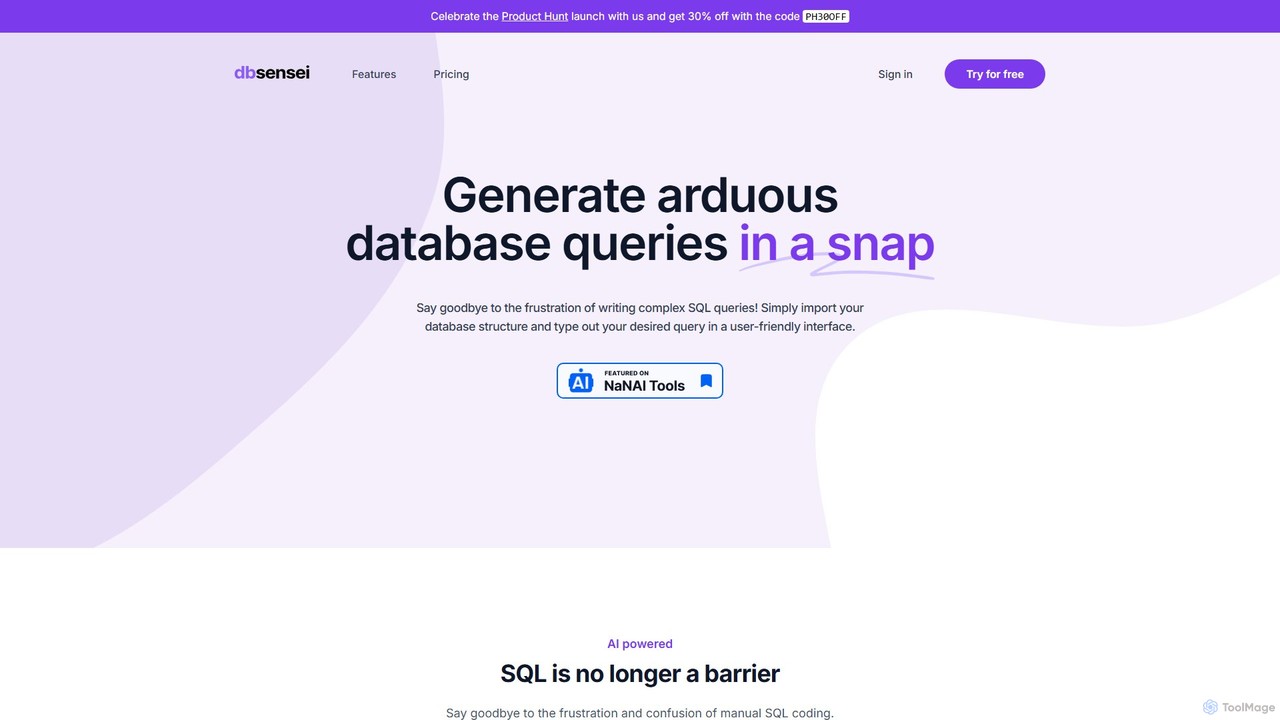
DB Sensei is an AI-powered toolkit for developers and DBAs that simplifies database management. It allows users to generate, fix, explain, and format complex SQL and Eloquent queries using natural language. By importing your database schema, the tool provides context-aware, accurate results, boosting productivity and helping users improve their database skills.

Sql
Visits 3.4KFavorites 114Likes 109

About Sql

AI SQL tools are applications that leverage artificial intelligence to generate, optimize, and explain SQL queries. They primarily use Natural Language Processing (NLP) to translate plain language requests into structured database commands. This capability makes complex data retrieval accessible to non-technical users and significantly accelerates the workflow for developers and analysts. Many tools also offer advanced features like automated performance tuning and error detection, bridging the gap between data and decision-making.

Core Features

  • Natural Language to SQL: Generates accurate SQL queries from simple, conversational English prompts.
  • SQL Optimization & Tuning: Analyzes existing queries and suggests improvements for faster execution and lower resource consumption.
  • Code Explanation & Debugging: Translates complex SQL code into plain language explanations and identifies potential errors or bugs.
  • Schema Intelligence: Understands the database schema to provide context-aware suggestions and auto-completions.
  • Automated Documentation: Automatically creates documentation for SQL queries, improving code maintainability.

Applicable Scenarios

These tools are widely used by business intelligence analysts, product managers, and marketing teams who need to perform ad-hoc data analysis without extensive SQL knowledge. Developers and data engineers use them to speed up development cycles, debug complex queries, and enforce coding standards. They are also valuable in educational settings for teaching database concepts.

Selection Criteria

When choosing an AI SQL tool, evaluate its compatibility with your specific database systems (e.g., PostgreSQL, Snowflake, BigQuery). Assess the accuracy and complexity of the SQL it can generate. Consider its integration capabilities with existing BI platforms and development environments. Finally, review its data privacy and security policies, especially when connecting to sensitive databases.

Featured tool rankings

Sql use cases

1

Ad-hoc Reporting for Business Teams

A product manager needs to understand user engagement with a new feature. Instead of waiting for the data team, they type a question like 'Show me the daily active users for the new feature since launch, broken down by subscription plan' into an AI SQL tool. The tool instantly generates the correct SQL query, runs it, and provides the data, allowing for immediate insights and faster decision-making without needing to write any code.

2

Accelerating Backend Development

A software developer is building a complex API endpoint that requires data from multiple tables. Writing the intricate SQL join manually would be time-consuming and prone to errors. By describing the required data structure in plain English to an AI SQL tool, they receive an optimized and syntactically correct query in seconds. This significantly reduces development time, minimizes bugs, and allows the developer to focus on application logic rather than database syntax.

3

Optimizing Slow Database Queries

A data analyst notices that a critical dashboard is loading very slowly. They identify the underlying SQL query, which is long and complex. By pasting this query into an AI SQL tool's optimization feature, the tool analyzes the execution plan, identifies bottlenecks like inefficient joins or missing indexes, and suggests a rewritten, more performant version of the query. Implementing the suggestion drastically improves the dashboard's loading speed, enhancing the user experience for all stakeholders.

4

Onboarding and Training New Analysts

A junior data analyst joins a company with a large and complex database schema. To get up to speed, they use an AI SQL tool's 'explain query' feature to understand existing reports and queries written by senior team members. When they need to build a new query, they can start by describing their goal in English to get a working template. This process acts as an interactive learning tool, accelerating their training and reducing the burden on senior staff for basic questions.

5

Automating SQL Code Documentation

A data engineering team manages hundreds of complex data transformation scripts written in SQL. Manually documenting each query is tedious and often neglected, leading to poor maintainability. They integrate an AI SQL tool into their workflow that automatically generates a plain-language summary for each query upon commit. This ensures that all code is consistently documented, making it easier for team members to understand, debug, and modify scripts in the future, thereby improving overall code quality and knowledge sharing.

6

Validating Data for Financial Audits

An internal auditor, who is not a SQL expert, needs to verify financial transactions against a set of compliance rules. They use an AI SQL tool to formulate complex queries based on audit requirements described in natural language, such as 'Find all transactions over $10,000 without a secondary approval'. The tool helps them independently pull and verify data directly from the source database, increasing the accuracy and efficiency of the audit process while reducing reliance on the IT department.

Sql FAQ

What are AI SQL tools?

AI SQL tools are software applications that use artificial intelligence, especially natural language processing (NLP), to assist with database tasks. Their primary function is to translate plain language questions into executable SQL queries. They also often include features for optimizing query performance, explaining complex code in simple terms, and automatically detecting errors. These tools empower users with little to no SQL knowledge to access data and help experienced developers work more efficiently.

How to choose the right AI SQL tool?

To choose the right tool, consider these factors:

  • Database Compatibility: Ensure the tool supports your specific database technology (e.g., PostgreSQL, MySQL, Snowflake, BigQuery).
  • Accuracy & Complexity: Evaluate how well it handles complex queries, joins, and specific dialects of SQL relevant to your work.
  • Integration: Check if it integrates with your existing workflow, such as BI tools (Tableau, Power BI) or code editors (VS Code).
  • Security & Privacy: Verify its security protocols, especially if you'll be connecting it to databases with sensitive information. Look for on-premise or VPC deployment options if needed.
  • User Interface: The tool should be intuitive for its intended users, whether they are technical developers or business analysts.
What's the difference between an AI SQL tool and a traditional SQL client?

A traditional SQL client (like DBeaver or SSMS) is an environment for manually writing, executing, and managing SQL queries and databases. It's a workbench for people who already know SQL. An AI SQL tool is an intelligent assistant that works within or alongside these clients. Its main role is to generate, optimize, or explain SQL code, effectively acting as a co-pilot. While a traditional client is the vehicle, the AI tool is the GPS navigation system that helps you get to your destination faster and more efficiently.

Who can benefit from using AI SQL tools?

A wide range of professionals can benefit:

  • Business Analysts & Product Managers: Can self-serve data for reports and analysis without relying on data teams.
  • Developers & Data Engineers: Can accelerate coding, debug complex queries, and automate documentation, improving productivity.
  • Data Scientists: Can quickly prototype data extraction and transformation queries for their models.
  • Students & Beginners: Can use them as an interactive learning aid to understand SQL concepts and database structures.
  • Executives & Marketers: Can get quick answers to business questions by asking in plain language.
How accurate is the SQL generated by AI?

The accuracy of AI-generated SQL is generally high for standard queries but can vary based on the complexity of the request and the tool's understanding of your database schema. For highly complex or business-specific logic, the generated query may require manual review and refinement. It's best to view these tools as powerful assistants that provide a very strong starting point, rather than infallible oracles. The best tools improve over time by learning from your schema and the corrections you make.