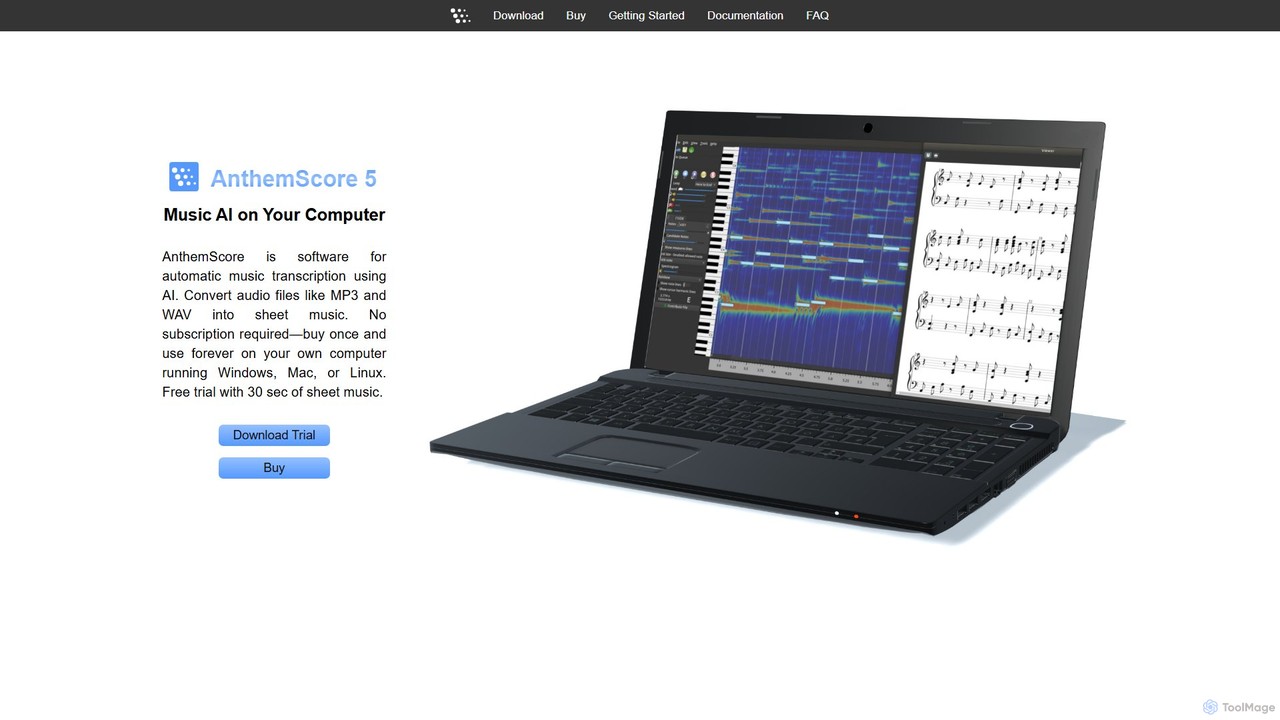
Music Transcription tools are AI-powered applications designed to convert audio recordings of music into various written formats, such as sheet music, MIDI files, chord charts, or textual representations of lyrics and musical elements. Leveraging advanced machine learning and signal processing algorithms, these tools analyze complex audio signals to identify pitches, rhythms, instrumentation, and harmonic structures. They provide invaluable assistance to musicians, composers, educators, and producers by automating the often time-consuming and intricate process of manually transcribing music, enabling faster analysis, learning, and creative workflows within the broader field of audio processing.
Core Features
- Pitch and Rhythm Detection: Accurately identifies individual notes, their duration, and timing within a musical piece.
- Instrument Separation: Isolates different instruments or vocal tracks from a mixed audio recording for clearer transcription.
- Chord Recognition: Automatically detects and labels chord progressions, useful for guitarists, pianists, and songwriters.
- Sheet Music Generation: Converts detected musical elements into standard musical notation, often exportable as PDF or MusicXML.
- MIDI Conversion: Transforms audio into MIDI data, allowing for editing in digital audio workstations (DAWs) or use with virtual instruments.
Use Cases
Music transcription tools are essential for a wide range of musical professionals and enthusiasts. Composers and arrangers use them to quickly capture melodic ideas or analyze existing works. Music students and educators benefit from automatically generated sheet music for learning and teaching complex pieces. Producers and sound engineers can separate instrument tracks for remixing or sampling, while songwriters can extract chord progressions and lyrics from demos to refine their compositions.
How to Choose
When selecting a music transcription tool, consider its accuracy in pitch and rhythm detection, especially for complex or polyphonic music. Evaluate the range of output formats (e.g., sheet music, MIDI, chord charts) and compatibility with your existing software (DAWs, notation editors). Look for features like instrument separation and real-time transcription if needed. Finally, assess the user interface's ease of use and the pricing model, whether subscription-based or one-time purchase, to match your budget and technical proficiency.