MPT
MPT is an AI-powered music platform that allows users to upload, create, and remix songs with ease. Separate …
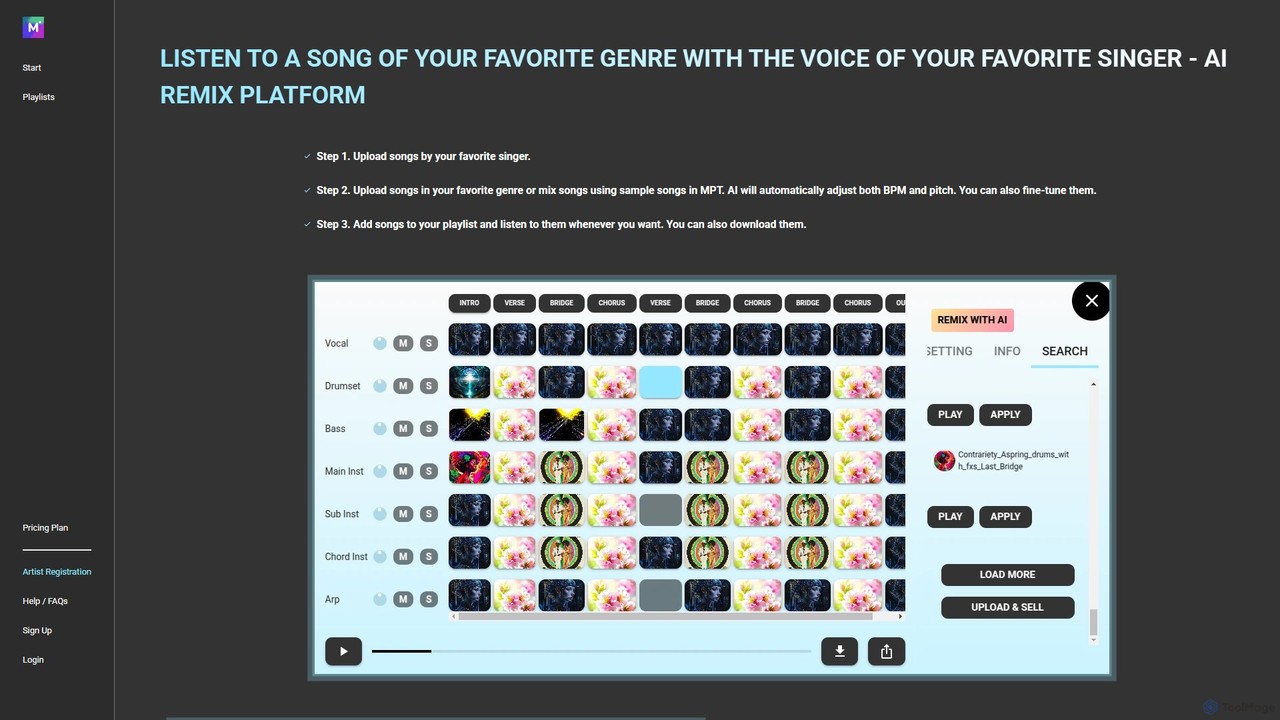
MPT is an AI-powered music platform that allows users to upload, create, and remix songs with ease. Separate songs into elements like vocals and instrumentals, then combine them to create unique mashups. The AI automatically adjusts BPM and pitch for seamless integration.
About Remixing
Remixing tools are AI-powered applications that enable users to creatively transform and reassemble existing audio content. These tools leverage advanced algorithms to deconstruct, manipulate, and reconstruct various elements of a track, such as vocals, instruments, and beats. They empower music producers, DJs, and content creators to generate new versions of songs, create mashups, or extract specific components for unique projects within the broader audio production landscape.
Core Features
- Stem Separation: Isolate vocals, drums, bass, and other instruments from a mixed track.
- Tempo & Pitch Adjustment: Precisely alter the speed and key of audio without affecting quality.
- Genre & Style Transfer: Apply the characteristics of one musical genre or style to another track.
- Beat Matching & Synchronization: Automatically align the tempo and rhythm of multiple audio sources.
- Vocal Manipulation: Modify vocal characteristics, add effects, or generate new vocal lines.
Use Cases
These tools are invaluable for music production, live performance, and multimedia content creation. They allow artists to experiment with new sounds, DJs to seamlessly blend tracks, and video editors to customize background music. From creating unique song covers to producing dynamic podcast intros, AI remixing capabilities open up new avenues for audio innovation.
How to Choose
When selecting an AI remixing tool, consider the quality of its stem separation, the range and precision of its manipulation features, and its compatibility with your existing workflow (e.g., DAW integration). Evaluate the supported audio formats, processing speed, and the overall ease of use. User reviews regarding output quality and flexibility are also crucial for making an informed decision.
RemixingUse Cases
Deconstruct Songs for Creative Remixes
A music producer wants to create a unique remix of an existing track. Using an AI remixing tool, they can automatically separate the song into individual stems (vocals, drums, bass, melody). This allows them to easily isolate, manipulate, and re-arrange specific elements, adding new instrumentation or effects to build a completely fresh version of the original, saving hours of manual editing and sampling.
Creating Unique DJ Mixes
DJs can utilize AI remixing tools to seamlessly blend tracks by automatically matching tempos and keys, or by isolating specific elements like basslines or vocal hooks from different songs. This allows for the creation of unique, professional-sounding live sets and recorded mixes that stand out from traditional transitions, enhancing the overall audience experience.
Adapt Tracks for DJ Sets and Live Performances
A DJ needs to seamlessly blend tracks with different tempos and keys during a live set. An AI remixing tool can instantly analyze and adjust the tempo and pitch of incoming tracks to match the current mix, ensuring smooth transitions without manual beatmatching or key shifting. This allows the DJ to focus on crowd engagement and creative mixing, enhancing the overall performance quality.
Producing Song Covers and Mashups
Content creators and musicians can use these tools to extract instrumentals or vocals from popular songs, enabling them to record their own cover versions or combine elements from multiple tracks into innovative mashups. This simplifies the complex process of audio separation and synchronization, fostering creative expression and reducing production time.
Customize Background Music for Video Content
A content creator has a video that requires background music of a specific mood and duration, but existing tracks don't quite fit. An AI remixing tool can take a suitable piece of music, adjust its tempo and structure to match the video's pacing, and even apply a style transfer to alter its emotional tone. This ensures the audio perfectly complements the visual content, enhancing viewer engagement and avoiding generic stock music.
Customizing Background Music for Videos
Video editors often need background music that perfectly fits the mood and length of their visuals. AI remixing tools allow them to adjust the tempo, pitch, or even rearrange sections of a licensed track to match video edits precisely. This ensures a cohesive audio-visual experience without requiring extensive manual audio engineering skills.
Generate Sound Variations for Game Development
A game sound designer needs a wide array of variations for a specific sound effect, such as footsteps on different surfaces or ambient noises. Instead of manually recording or synthesizing each variant, an AI remixing tool can take a base sound and generate numerous unique permutations by altering its pitch, timbre, duration, and spatial characteristics. This accelerates the sound design process, providing a rich and diverse audio landscape for the game.
Isolating Vocals for Acapella or Karaoke Tracks
Singers, karaoke enthusiasts, and vocal coaches can easily isolate vocal tracks from any song, creating clean acapella versions for practice, performance, or further remixing. Conversely, they can remove vocals to generate instrumental karaoke tracks, providing versatile options for musical engagement and learning.
Enhance Podcast Audio Quality and Flow
A podcast editor works with multi-speaker recordings where background noise or uneven vocal levels are common. An AI remixing tool can isolate individual speaker tracks, allowing for precise noise reduction and level normalization. Furthermore, it can intelligently re-mix the cleaned vocals with intro/outro music and sound effects, ensuring a professional and consistent audio experience for listeners, significantly reducing post-production time.
Experimenting with Genre Transformation
Music producers can explore new creative directions by applying the stylistic characteristics of one genre to a track originally composed in another. AI remixing tools can analyze and transfer elements like rhythm patterns, melodic structures, or harmonic progressions, offering a powerful way to innovate and discover fresh sounds for their compositions.
Experiment with Music Genre Blending
An experimental musician wants to fuse elements from disparate music genres, like classical and electronic, to create something entirely new. An AI remixing tool with style transfer capabilities allows them to apply the rhythmic patterns or harmonic structures of one genre to the instrumentation of another. This facilitates rapid prototyping of genre-bending compositions, opening up new avenues for musical exploration without extensive manual programming or arrangement.
Educational Music Analysis and Deconstruction
Music students and educators can use AI remixing tools to deconstruct complex musical pieces into their individual components (stems). This facilitates in-depth analysis of instrumentation, arrangement, and production techniques, providing a clearer understanding of how different elements contribute to the overall sound of a composition.