ToolMage
Sign in

Best 1 Voice Changing AI tools for Audio

Popular Voice Changing AI tools in Audio include Altered, helping you work more efficiently.

Altered
Freemium

Altered

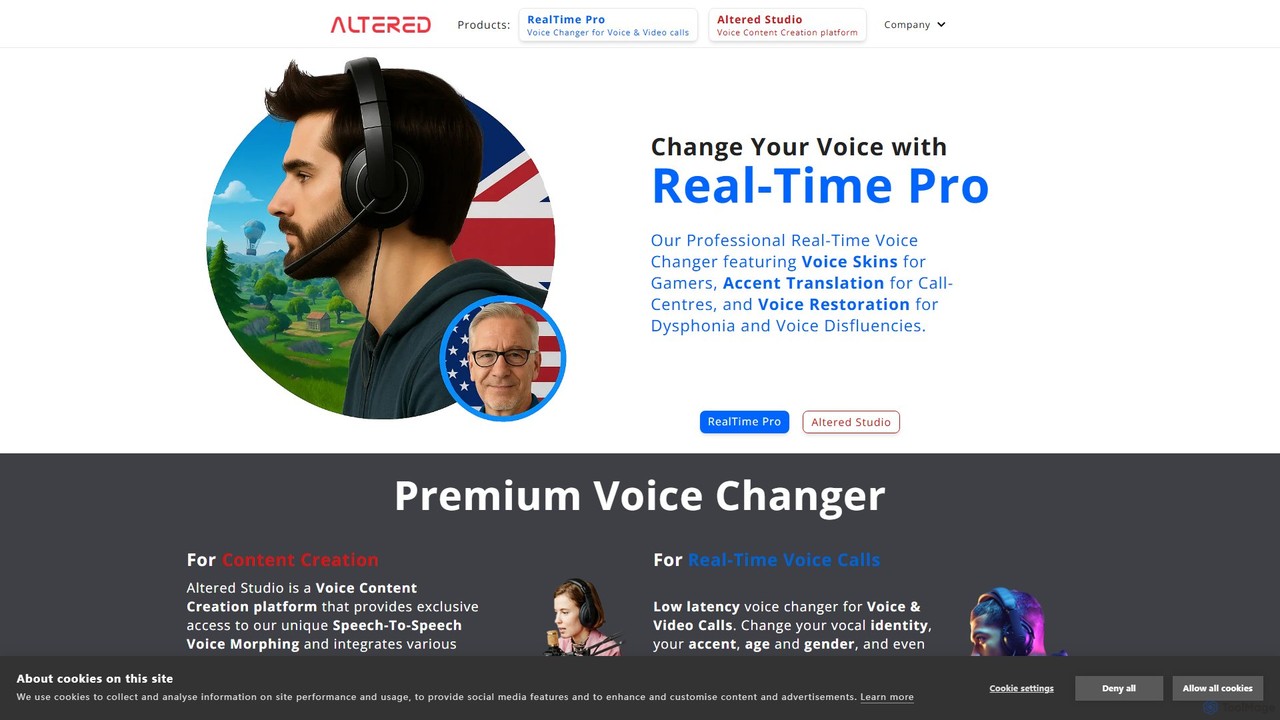
Altered is a professional AI voice technology platform offering both real-time voice changing and post-production voice editing. With its unique Speech-To-Speech morphing, users can change their voice to a curated portfolio, clone any voice, alter accents, or restore vocal clarity. It serves content creators, gamers, call centers, and individuals seeking voice modification or protection.

Voice Changing
Visits 39.5KFavorites 93Likes 107

About Voice Changing

Voice Changing tools are AI-powered applications designed to modify a user's voice in real-time or from pre-recorded audio. These tools leverage advanced deep learning algorithms to alter vocal characteristics such as pitch, timbre, gender, age, or even mimic specific voices. They offer a versatile solution for entertainment, content creation, privacy, and professional voiceovers, providing realistic and natural-sounding transformations beyond simple pitch shifting.

Core Features

  • Real-time Voice Transformation: Instantly change your voice during live streams, online gaming, or calls.
  • Timbre and Identity Alteration: Transform your voice to sound like a different gender, age, or a specific character.
  • Emotion Adjustment: Modify the emotional tone of your voice, from calm to excited, or sad to happy.
  • Voice Cloning/Mimicry: Learn and replicate the unique characteristics of a target voice.
  • Background Noise Suppression: Enhance audio quality by reducing unwanted background noise while applying voice changes.

Use Cases

Voice changing tools are widely adopted by various users for diverse applications. Gamers use them to role-play characters, content creators employ them for unique narration, and virtual streamers customize their digital personas. They are also valuable for privacy protection and creative audio production.

How to Choose

When selecting an AI voice changing tool, consider the naturalness and realism of the transformed voice, as advanced AI algorithms are crucial for high-quality output. Evaluate real-time performance and latency for live applications, the variety and customizability of voice libraries, and compatibility with your operating system, streaming software, or digital audio workstations (DAWs).

Featured tool rankings

Voice Changing use cases

1

Enhancing Gaming & Live Streaming Role-Play

Gamers and streamers use real-time voice changing to embody characters, adding immersion and entertainment to multiplayer games or live broadcasts, making interactions more engaging and fun. This allows them to maintain anonymity or create unique personas for their audience, enriching the overall user experience.

2

Customizing Virtual Streamer (VTuber) Voices

VTubers utilize voice changing tools to create a unique and consistent vocal identity that perfectly matches their virtual avatar, establishing a distinct brand presence without needing a professional voice actor. This helps build a stronger connection with their audience and reinforces their digital persona.

3

Producing Podcasts & Audiobooks with Diverse Characters

Content creators can voice multiple characters in podcasts or audiobooks using a single voice, significantly reducing production costs and time by eliminating the need to hire various voice actors. This allows for greater creative flexibility and faster content delivery, making diverse storytelling more accessible.

4

Protecting Privacy in Online Communications

Individuals can alter their voice during online calls or interactions to maintain anonymity and protect personal identity, especially in sensitive situations or when seeking to avoid recognition. This adds a layer of security and comfort for users who need to communicate without revealing their natural voice.

5

Rapid Prototyping for Film & Animation Voiceovers

Animators and filmmakers can quickly generate various voice options for animated characters or film scenes, allowing for efficient iteration and selection of the best vocal performance during pre-production. This accelerates the creative process and helps visualize character voices early in development, saving time and resources.

6

Creative Audio Production & Sound Design

Music producers and sound designers experiment with different vocal timbres and effects to create unique sounds for musical compositions, sound art installations, or special audio effects, expanding their creative palette. This allows for innovative sonic exploration and the development of distinctive audio experiences in various artistic projects.

Voice Changing FAQ

What are AI Voice Changing Tools?

AI voice changing tools are software applications that use artificial intelligence, particularly deep learning, to modify a person's voice in real-time or from recorded audio. They can alter pitch, timbre, gender, age, and even mimic specific voices, producing highly realistic and natural-sounding transformations for various purposes like entertainment or content creation.

How do AI Voice Changers differ from traditional voice changers?

Traditional voice changers typically rely on basic pitch shifting and formant adjustments, resulting in robotic or unnatural sounds. AI voice changers, however, leverage neural networks trained on vast datasets to understand and replicate complex vocal characteristics, offering far more natural, expressive, and convincing voice transformations, including the ability to mimic specific individuals.

How should I choose the right AI Voice Changing tool for my needs?

When selecting an AI voice changing tool, consider the naturalness and realism of the transformed voice, as this is a key differentiator. Evaluate its real-time performance and latency for live applications, the variety and quality of its pre-set voice libraries, and the ability to customize voices. Also, check for compatibility with your operating system and other software you use, along with its pricing model.

What are the main applications of AI Voice Changing tools?

AI voice changing tools are primarily used in gaming for role-playing, live streaming for entertainment, and by VTubers for character voice customization. They are also valuable for content creation like podcast and audiobook narration, protecting privacy in online communications, rapid prototyping for film and animation voiceovers, and creative audio production and sound design.

How does AI Voice Changing technology work?

AI voice changing technology typically works by employing deep learning models such as Variational Autoencoders (VAEs) or Generative Adversarial Networks (GANs). These models analyze the acoustic features of the input voice, extract its unique characteristics, and then map them onto the desired target voice's characteristics. Finally, they synthesize a new voice that retains the original speech content but with the altered vocal attributes, often in real-time.