Circulos
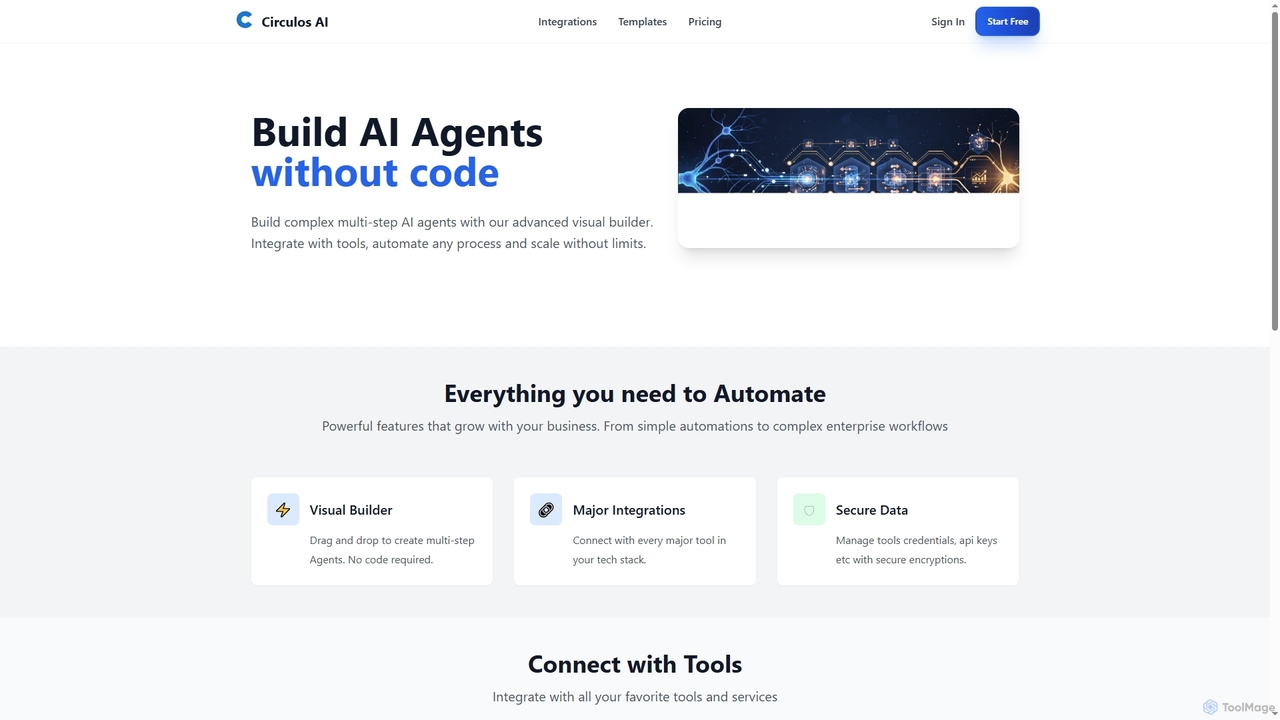
Circulos is a no-code AI automation platform that empowers businesses to build complex, multi-step AI agents using an …
Circulos is a no-code AI automation platform that empowers businesses to build complex, multi-step AI agents using an intuitive visual builder. It integrates with over 100 popular tools, automates diverse workflows, and offers scalable solutions for various business needs, from lead qualification to social media publishing.
About Ai Automation
AI Automation tools are a class of software that uses artificial intelligence to execute complex tasks that traditionally require human cognition and decision-making. These tools leverage technologies like machine learning (ML), natural language processing (NLP), and computer vision to interpret unstructured data, learn from outcomes, and adapt to new situations. Unlike rule-based automation which follows rigid scripts, AI Automation can handle variability, make predictions, and optimize workflows autonomously. This enables businesses to automate end-to-end processes that involve judgment and complex data analysis.
Core Features
- Intelligent Process Automation (IPA): Combines AI with Robotic Process Automation (RPA) to handle complex, exception-heavy workflows and unstructured data.
- Natural Language Processing (NLP): Automates tasks involving human language, such as classifying emails, analyzing customer feedback, or powering intelligent chatbots.
- Predictive Automation: Utilizes machine learning models to forecast future outcomes and trigger proactive automated actions based on those predictions.
- Cognitive Decision-Making: Analyzes diverse data sources to make and execute complex business decisions without direct human intervention.
- Adaptive Learning: Continuously improves performance by learning from new data and interaction outcomes, optimizing processes over time.
Use Cases
AI Automation is widely adopted in industries like finance for intelligent invoice processing and fraud detection, in customer service for advanced chatbots that understand user intent, and in marketing for personalizing customer journeys based on behavioral data. Operations managers and business analysts use these tools to streamline complex supply chain logistics and automate IT operations (AIOps).
How to Choose
When selecting an AI Automation tool, evaluate the specific AI capabilities offered (e.g., NLP, computer vision, predictive analytics). Assess its integration ecosystem to ensure it connects seamlessly with your existing software stack (CRM, ERP). Consider the tool's scalability to handle growing data volumes and process complexity. Finally, determine whether a no-code/low-code platform for business users or a more customizable, developer-focused framework better suits your team's technical skills.
Ai AutomationUse Cases
Intelligent Customer Service Automation
A customer support team uses an AI Automation platform to handle incoming service requests. The AI uses Natural Language Processing (NLP) to understand the intent and sentiment of customer emails and chats, even with complex or informal language. It automatically categorizes tickets, retrieves relevant information from a knowledge base, and provides instant, accurate responses to common queries. For complex issues, the system intelligently routes the ticket to the best-suited human agent along with a summary of the conversation, reducing resolution time by over 40% and freeing up agents to focus on high-value interactions.
Automated Financial Document Processing
An accounting department implements an AI Automation tool to streamline its accounts payable process. The system uses computer vision and Optical Character Recognition (OCR) to scan invoices received in various formats (PDF, JPG, paper scans). AI algorithms then intelligently extract key data points like invoice number, vendor name, amount due, and line items, even when layouts differ. The tool validates this data against purchase orders, flags discrepancies for human review, and automatically enters the approved data into the company's ERP system, reducing manual data entry by 90% and minimizing payment errors.
Dynamic Marketing Campaign Personalization
A marketing team uses an AI Automation platform to create highly personalized email campaigns. The system integrates with the company's CRM and website analytics. It analyzes customer data, browsing history, and past purchase behavior to predict individual interests and optimal engagement times. Based on these predictions, the AI automatically generates personalized email content, including product recommendations and special offers, and schedules delivery for each user's peak activity window. This level of dynamic personalization, impossible to manage manually at scale, results in a 30% increase in click-through rates and a significant uplift in conversion.
Automated Content Moderation at Scale
A social media platform deploys an AI Automation system to moderate user-generated content in real-time. The AI uses a combination of NLP and computer vision to analyze text, images, and videos as they are uploaded. It can identify and automatically flag or remove content that violates community guidelines, such as hate speech, spam, or explicit material. The system continuously learns from new examples and decisions made by human moderators, improving its accuracy over time. This allows the platform to maintain a safe environment for its users by handling millions of content pieces daily, a task that would be impossible for a human team alone.
Predictive IT Operations (AIOps)
An IT operations team uses an AIOps platform to proactively manage their complex infrastructure. The AI Automation tool continuously ingests and analyzes vast amounts of data from logs, metrics, and network traffic. It uses machine learning to establish normal performance baselines and predict potential issues like server failures or application slowdowns before they impact users. When an anomaly is detected, the system automatically correlates related alerts to identify the root cause and can trigger automated remediation scripts, such as restarting a service or reallocating resources, significantly reducing downtime and manual troubleshooting efforts.
E-commerce Supply Chain Optimization
An e-commerce company leverages AI Automation to manage its inventory and supply chain. The AI system analyzes real-time sales data, historical trends, seasonality, and even external factors like competitor pricing and social media trends. It generates highly accurate demand forecasts for thousands of products. Based on these forecasts, the system automatically triggers purchase orders to suppliers, optimizes stock levels across different warehouses to minimize shipping costs, and dynamically adjusts pricing to maximize revenue. This cognitive automation helps prevent stockouts, reduce excess inventory, and improve overall profitability.