
ToolMage
Sign in

Best 1 Fact Checking AI tools for Browser Extensions

Popular Fact Checking AI tools in Browser Extensions include Skeptic Reader, helping you work more efficiently.

Skeptic Reader
Free

Skeptic Reader

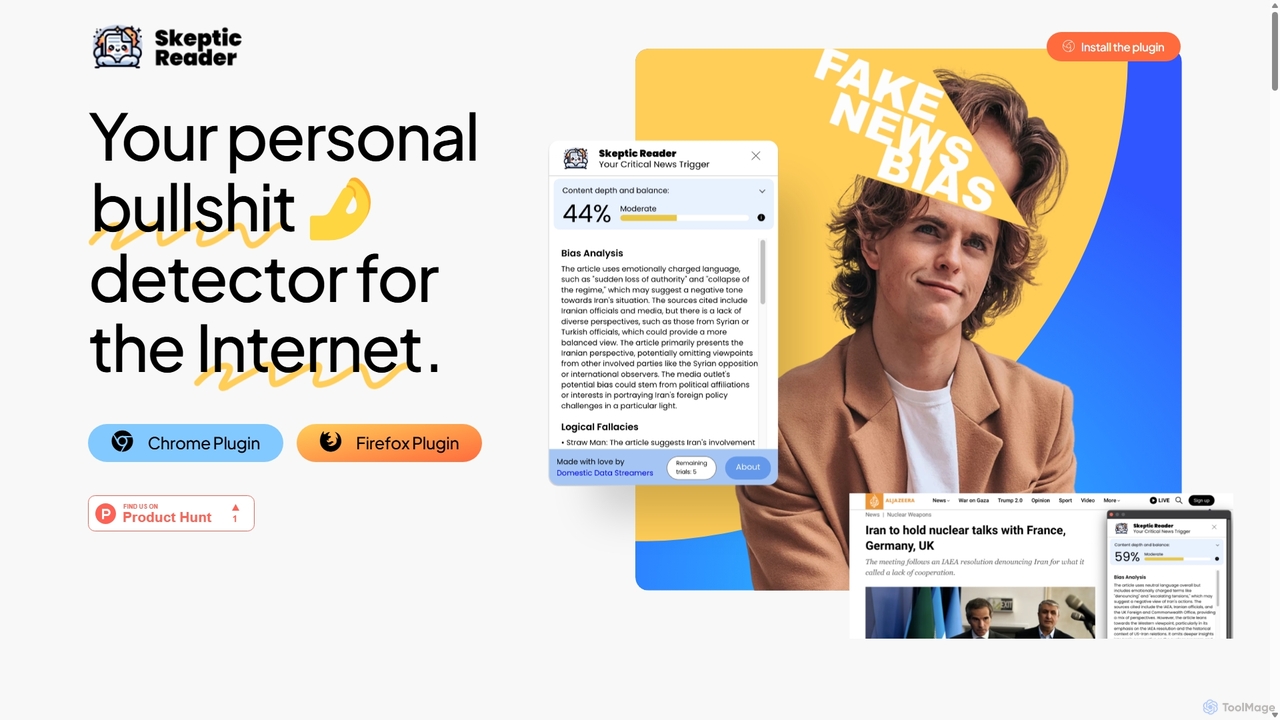
Skeptic Reader is a free AI-powered browser extension for Chrome and Firefox that detects biases and logical fallacies in real-time. It analyzes web articles and YouTube transcripts, providing content scores, counter-arguments, and summaries to promote critical thinking and informed online reading.

Fact Checking
Visits 5.3KFavorites 133Likes 116

About Fact Checking

Fact Checking AI tools are specialized browser extensions designed to combat misinformation and enhance digital literacy by verifying claims and sources in real-time. These tools leverage artificial intelligence, natural language processing, and extensive databases to analyze content, identify potential inaccuracies, and provide contextual information directly within your browser. They empower users to quickly assess the credibility of online articles, social media posts, and other digital content, fostering a more informed online experience.

Core Features

  • Real-time Verification: Instantly analyzes claims and sources as you browse.
  • Source Credibility Analysis: Evaluates the reputation and bias of information sources.
  • Claim Cross-referencing: Compares statements against a vast knowledge base and trusted sources.
  • Contextual Information: Provides additional background and related facts to aid understanding.
  • Bias Detection: Highlights potential ideological leanings in content.

Applicable Scenarios

Journalists and researchers use these tools to quickly verify news stories and academic claims. Students can cross-reference information for assignments, while general internet users can identify misleading content on social media platforms. They are invaluable for anyone seeking to make informed decisions based on accurate information.

How to Choose

When selecting a Fact Checking AI browser extension, consider its accuracy and the breadth of its source database. Evaluate its integration capabilities with your preferred browser and the types of content it can verify (text, images, video). User interface, ease of use, and transparency regarding its methodology are also crucial for an effective tool.

Featured tool rankings

Fact Checking use cases

1

Verifying News Articles for Journalists

Journalists and reporters can use AI fact-checking extensions to quickly assess the veracity of claims and sources in breaking news or investigative pieces. By highlighting dubious statements and providing alternative sources or corrections, the tool helps ensure the accuracy of published content, saving critical time in fast-paced news environments.

2

Academic Research and Essay Writing

Students and researchers can leverage these tools to cross-reference facts, statistics, and quotes found online for their academic papers. The extension can flag potentially unreliable sources or outdated information, helping to maintain the integrity and credibility of their research and preventing the unintentional spread of misinformation in their work.

3

Identifying Misinformation on Social Media

Everyday social media users can employ fact-checking extensions to quickly identify and question misleading posts, fake news, or manipulated content shared across platforms. This empowers individuals to make more informed decisions about what they consume and share, contributing to a healthier online information ecosystem.

4

Ensuring Factual Accuracy in Content Creation

Content creators, bloggers, and podcasters can integrate these tools into their workflow to verify facts, figures, and historical details before publishing. This ensures their audience receives accurate information, builds trust, and protects their reputation by preventing the unintentional dissemination of false or unverified claims.

5

Evaluating Market Data for Business Decisions

Business analysts and market researchers can use fact-checking extensions to validate data, reports, and competitor claims found on various websites. This helps in making more reliable strategic decisions, avoiding pitfalls based on inaccurate market intelligence, and ensuring that business strategies are built on solid, verifiable information.

6

Monitoring Brand Reputation and Public Discourse

Public relations professionals and brand managers can utilize these tools to monitor online discussions and news related to their brand. They can quickly identify and address false narratives or defamatory claims, allowing for timely responses and proactive management of their brand's public image and reputation.

Fact Checking FAQ

What are AI Fact Checking tools?

AI Fact Checking tools are browser extensions that use artificial intelligence to automatically analyze and verify the accuracy of online information. They typically feature real-time claim analysis, source credibility assessment, and cross-referencing against trusted databases to help users identify misinformation and understand the context of digital content.

How do I choose an effective AI Fact Checking browser extension?

When selecting an AI fact-checking extension, prioritize tools with a strong reputation for accuracy and transparency in their methodology. Consider the breadth of their source database, their ability to integrate seamlessly with your browser, and the types of content they can verify (e.g., text, images, videos). User reviews and the frequency of updates are also good indicators of reliability.

What types of information can AI Fact Checking tools verify?

AI Fact Checking tools are primarily designed to verify textual claims, statistics, and the credibility of news articles, social media posts, and website content. Some advanced tools may also offer basic analysis for images or videos by checking metadata or identifying known manipulations, though their capabilities in these areas are still evolving.

How do AI Fact Checking browser extensions differ from manual fact-checking?

AI fact-checking browser extensions offer speed and automation, providing instant assessments and flagging potential issues as you browse. Manual fact-checking, while more thorough and nuanced, is time-consuming and relies on human judgment. AI tools serve as a first line of defense, quickly identifying content that warrants deeper human investigation, rather than fully replacing it.

What are the limitations of AI Fact Checking tools?

While powerful, AI fact-checking tools have limitations. They may struggle with highly nuanced contexts, satire, or rapidly evolving situations where new information is scarce. Their accuracy depends heavily on the quality and recency of their training data and source databases. They are best used as an aid to human judgment, not a definitive authority, especially for complex or sensitive topics.