ToolMage
Sign in

Best 1 Dataset Marketplace AI tools for Data

Popular Dataset Marketplace AI tools in Data include PixtaAI, helping you work more efficiently.

PixtaAI
Paid

PixtaAI

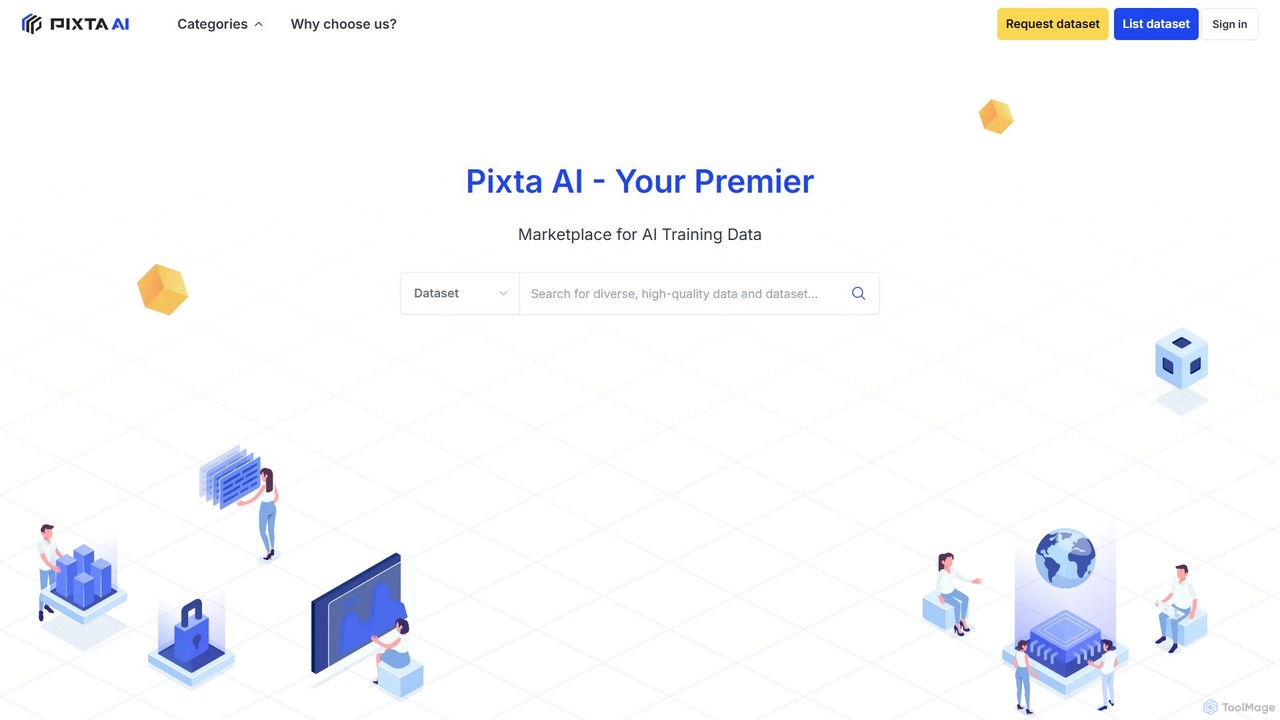
PixtaAI is a premier marketplace for high-quality AI training data. It connects AI developers and companies with top data providers, offering a diverse range of datasets including images, videos, audio, and text. The platform facilitates the discovery, purchase, and custom sourcing of annotated data to power machine learning models across various industries.

Dataset Marketplace
Visits 7.2KFavorites 181Likes 179

About Dataset Marketplace

Dataset Marketplaces are online platforms for discovering, purchasing, selling, and sharing datasets tailored for machine learning and data analysis. These platforms function like specialized e-commerce sites for data, providing the infrastructure for hosting, licensing, and secure transactions. They accelerate AI development by offering access to high-quality, often pre-labeled data, saving teams significant time and resources that would otherwise be spent on data collection and preparation. Many marketplaces also provide data quality metrics, detailed metadata, and APIs for programmatic access.

Core Features

  • Data Discovery and Search: Advanced filters to find datasets by type (image, text, audio), industry, size, and license.
  • Secure Transactions and Licensing: Manages payments and provides clear, legally defined usage rights for commercial or research purposes.
  • Data Quality Previews: Offers sample data, metadata, and quality scores to evaluate datasets before acquisition.
  • API Access: Allows programmatic integration to download or stream data directly into development workflows and MLOps pipelines.
  • Data Monetization: Enables organizations and individuals to upload, host, and sell their proprietary datasets to a global audience.

Use Cases

These platforms are essential for AI/ML engineers, data scientists, and researchers who need specialized data to train and validate models. They are widely used in industries like healthcare for medical imaging data, autonomous vehicles for sensor and lidar data, and retail for customer behavior analytics. Startups and academic institutions also leverage them to access large-scale datasets without prohibitive upfront investment.

How to Choose

When selecting a Dataset Marketplace, consider the following: First, evaluate the relevance and quality of its data catalog for your specific domain. Second, scrutinize the licensing terms to ensure they permit your intended use and comply with privacy regulations like GDPR. Third, compare pricing models, such as subscriptions versus pay-per-dataset, to align with your budget. Finally, assess the platform's API capabilities for seamless integration with your existing tools.

Dataset Marketplace use cases

1

Training a Custom Object Detection Model

A machine learning engineer at a retail tech startup needs to build a model to detect specific products on store shelves. In-house data collection is slow and expensive. Using a Dataset Marketplace, the engineer searches for and purchases a large, pre-labeled dataset of retail product images. They filter by image resolution, annotation format (e.g., COCO), and commercial use license. This allows them to acquire over 100,000 high-quality images in hours, reducing the project's data acquisition phase from months to a single day and significantly accelerating model development.

2

Sourcing Financial Data for Algorithmic Trading

A quantitative analyst at a hedge fund is developing a new trading strategy requiring historical market data and alternative data, like satellite imagery. Instead of managing multiple vendors, the analyst subscribes to a specialized financial data provider on a marketplace. They use the platform's API to stream historical prices and alternative datasets directly into their backtesting environment. This centralized access to diverse, clean datasets allows for faster iteration and validation of trading models, providing a competitive edge.

3

Acquiring Medical Images for Cancer Research

An academic researcher is investigating a new deep learning algorithm for detecting tumors in MRI scans but lacks a sufficiently large and diverse dataset due to patient privacy constraints. They access an anonymized and HIPAA-compliant medical imaging dataset from a reputable marketplace specializing in healthcare data. The platform ensures all data is ethically sourced and stripped of personal identifiers. This provides a large-scale, research-grade dataset to validate their algorithm, enabling a publishable study without compromising patient privacy.

4

Monetizing Proprietary Industry Data

A logistics company has collected years of valuable, anonymized shipping and supply chain data. A business development manager sees an opportunity to create a new revenue stream. They partner with a Dataset Marketplace to package, price, and list their data for sale. The marketplace handles the hosting, marketing, customer billing, and secure delivery of the data. This allows the company to monetize a previously untapped asset by reaching a global audience of data consumers, such as financial analysts and market researchers, without building their own distribution infrastructure.

5

Finding Multilingual Text for NLP Model Training

An NLP specialist at a global software company needs to improve a translation tool's performance for low-resource languages. They search a marketplace for parallel corpora and labeled text datasets in specific languages like Swahili or Vietnamese. Using the platform's preview feature, they assess the quality and domain relevance of the text. By procuring high-quality, domain-specific text data, they can significantly improve model accuracy for underserved language markets, expanding their product's global reach.

6

Sourcing Geospatial Data for Urban Planning

An urban planner for a municipal government is tasked with analyzing traffic flow to propose new public transport routes. They acquire anonymized location data, satellite imagery, and point-of-interest (POI) datasets from a marketplace. By filtering for data covering their specific city within a recent time frame, they can combine multiple sources to build a comprehensive model of urban mobility. This data-driven approach leads to more effective and efficient infrastructure planning compared to traditional survey methods, saving public funds and improving city services.

Dataset Marketplace FAQ

What is a Dataset Marketplace?

A Dataset Marketplace is an online platform where data providers and consumers can buy, sell, or share datasets. Think of it as an app store, but for data used in AI training and analysis. These platforms connect organizations that have valuable data with developers, researchers, and businesses that need it. They typically handle data hosting, licensing, secure payments, and discovery, making it much easier to find and acquire high-quality data for specific projects without having to collect it from scratch.

How do I choose the right Dataset Marketplace?

Choosing the right marketplace depends on your specific needs. Consider these key factors:

  • Data Relevance & Quality: Does the platform specialize in your domain (e.g., medical, financial, automotive)? Check for data documentation, quality scores, and sample data.
  • Licensing & Compliance: Ensure the data licenses permit your intended use (e.g., commercial product vs. academic research) and comply with privacy laws like GDPR or HIPAA.
  • Pricing Model: Compare one-time purchases, subscriptions, or revenue-sharing models to find one that fits your budget and project scope.
  • Technical Integration: Evaluate the ease of access. Does it offer a user-friendly interface and, more importantly, a robust API for programmatic access to integrate with your MLOps pipeline?
What's the difference between a Dataset Marketplace and a Data Annotation Tool?

The key difference lies in their primary function: acquisition versus creation. A Dataset Marketplace is for acquiring existing, often pre-labeled datasets. You use it when you need data you don't have. In contrast, a Data Annotation Tool is for creating labels on your own raw data. You use it when you already have the data (e.g., thousands of images) but need to add information to it (e.g., drawing bounding boxes around cars) to make it usable for training a machine learning model. Some platforms may offer both, but they solve two different steps in the data preparation pipeline.

What types of data are available on these marketplaces?

Dataset Marketplaces offer a vast range of data types to support various AI applications. Common categories include:

  • Images and Video: Labeled photos and video clips for computer vision tasks like object detection, image segmentation, and facial recognition.
  • Text: Large corpora for Natural Language Processing (NLP), including text for sentiment analysis, entity recognition, and machine translation.
  • Audio: Speech datasets for voice recognition, speaker identification, and sound classification.
  • Sensor Data: Time-series data from IoT devices, lidar, and radar, crucial for autonomous vehicles and predictive maintenance.
  • Tabular Data: Structured datasets covering finance, e-commerce, healthcare, and more, used for analytics and predictive modeling.
Is the data on Dataset Marketplaces ready for machine learning?

Often, yes, but it's crucial to verify. Reputable marketplaces provide datasets that are cleaned, structured, and labeled in standard formats (like COCO or YOLO for images). This significantly reduces the pre-processing work required. However, data quality can vary. Always use the platform's preview features, read the documentation thoroughly, and check the metadata to ensure the annotation consistency and overall quality meet your project's standards. You may still need to perform some final validation or minor adjustments to fit your specific model architecture.