remyx
Remyx is an ExperimentOps platform designed for AI development. It helps AI and product teams operationalize knowledge by …
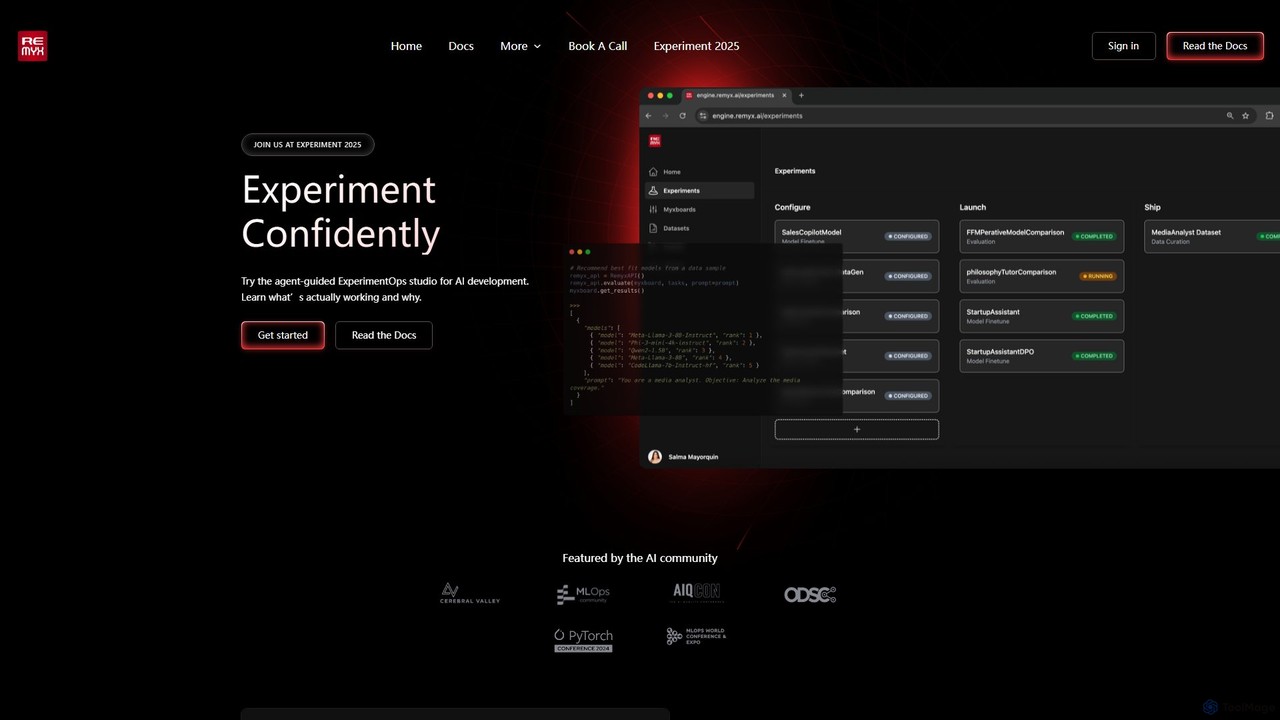
Remyx is an ExperimentOps platform designed for AI development. It helps AI and product teams operationalize knowledge by providing a collaborative studio for structured, reusable, and traceable experiments. By focusing on custom metrics and guided learning loops, Remyx accelerates the AI development lifecycle, ensuring that AI systems are aligned with real-world business goals and user impact.
About Experimentation
AI Experimentation tools are platforms designed to systematically test hypotheses and measure the impact of changes on key business metrics. These tools leverage statistical models and AI algorithms to manage A/B tests, multivariate tests, and feature rollouts with precision. They empower product managers, marketers, and developers to make data-driven decisions, optimize user experiences, and accelerate innovation cycles. Many platforms use AI to automate analysis, personalize experiences in real-time, and reduce the risk associated with deploying new features.
Core Features
- A/B/n and Multivariate Testing: Compare multiple versions of a webpage, app feature, or campaign to identify the best performer.
- Feature Flagging & Management: Control feature releases, enabling phased rollouts and targeted experiments for specific user segments.
- Advanced Statistical Engine: Provides reliable analysis of results, calculating statistical significance, confidence intervals, and business impact.
- Dynamic Traffic Allocation: Utilizes AI algorithms like multi-armed bandits to automatically shift traffic towards winning variations during a test.
- Result Visualization & Reporting: Offers intuitive dashboards and reports to interpret experiment outcomes and share insights.
Use Cases
These tools are essential in tech, e-commerce, and media industries. Product teams use them to validate new features before a full launch. Marketing teams test landing pages, ad copy, and email campaigns to maximize conversion rates. Engineering teams use them for safe, controlled deployments and performance testing of backend changes.
How to Choose
When selecting a tool, evaluate its statistical methodology (e.g., Bayesian vs. Frequentist) for rigor. Consider its integration capabilities with your existing analytics and development stack. Assess its scalability to handle your user traffic and the complexity of experiments you plan to run. Finally, compare the user interface for both technical and non-technical team members to ensure broad adoption.

ExperimentationUse Cases
Optimizing E-commerce Conversion Rates
An e-commerce manager wants to improve the checkout conversion rate. Using an AI experimentation tool, they set up a multivariate test on the checkout page, simultaneously testing three different button colors, two headline variations, and two payment layout options. The tool automatically allocates traffic and uses its statistical engine to identify the combination that increases completed purchases by 8%, providing clear data to justify the design change.
Validating a New Mobile App Feature
A product manager for a mobile app needs to launch a new 'social sharing' feature without disrupting the user experience. They use feature flagging within an experimentation platform to release the feature to only 5% of users initially. They monitor engagement metrics and crash reports for this segment. The test confirms the feature is stable and increases user engagement, allowing them to confidently roll it out to 100% of users over the next week.
Personalizing Marketing Landing Pages
A digital marketing team aims to increase lead generation from a high-traffic landing page. They implement an A/B/n test to compare the performance of a generic headline versus three personalized headlines based on the visitor's industry. The experimentation tool's AI capabilities might even use a multi-armed bandit algorithm to dynamically show the best-performing headline to more users in real-time, maximizing lead capture during the campaign.
Reducing Churn with Onboarding Flow Tests
A SaaS company's growth team hypothesizes that a simplified onboarding process will reduce new user churn. They design two alternative onboarding flows: one with interactive tutorials and another with a skippable checklist. They run an A/B test targeting all new sign-ups for one month. The tool tracks user progression and 30-day retention rates, revealing that the interactive tutorial flow reduces churn by 15%, providing a clear path for product improvement.
Testing Backend Algorithm Performance
A data science team at a streaming service develops a new recommendation algorithm. To test its effectiveness against the current one, they use an experimentation tool to run a server-side A/B test. 50% of users receive recommendations from the old algorithm, and 50% from the new one. The platform measures key metrics like click-through rate on recommendations and total watch time, allowing the team to prove the new algorithm's superior performance with statistical confidence before full deployment.
A/B Testing Email Subject Lines for Higher Opens
An email marketer is preparing a newsletter for 100,000 subscribers. To maximize open rates, they use an experimentation tool integrated with their email platform. They create two subject lines and run an automated A/B test on a 20% sample of their list (10% for each version). After two hours, the tool determines the winning subject line based on open rates and automatically sends it to the remaining 80% of subscribers, significantly boosting the campaign's overall engagement.