Reliable Agents
A definitive guide and benchmarking platform for agentic automation. It provides developers with interactive market maps, performance analysis, …
A definitive guide and benchmarking platform for agentic automation. It provides developers with interactive market maps, performance analysis, and reports on tools for web browsing and computer control, helping them build reliable AI agents.
Inven
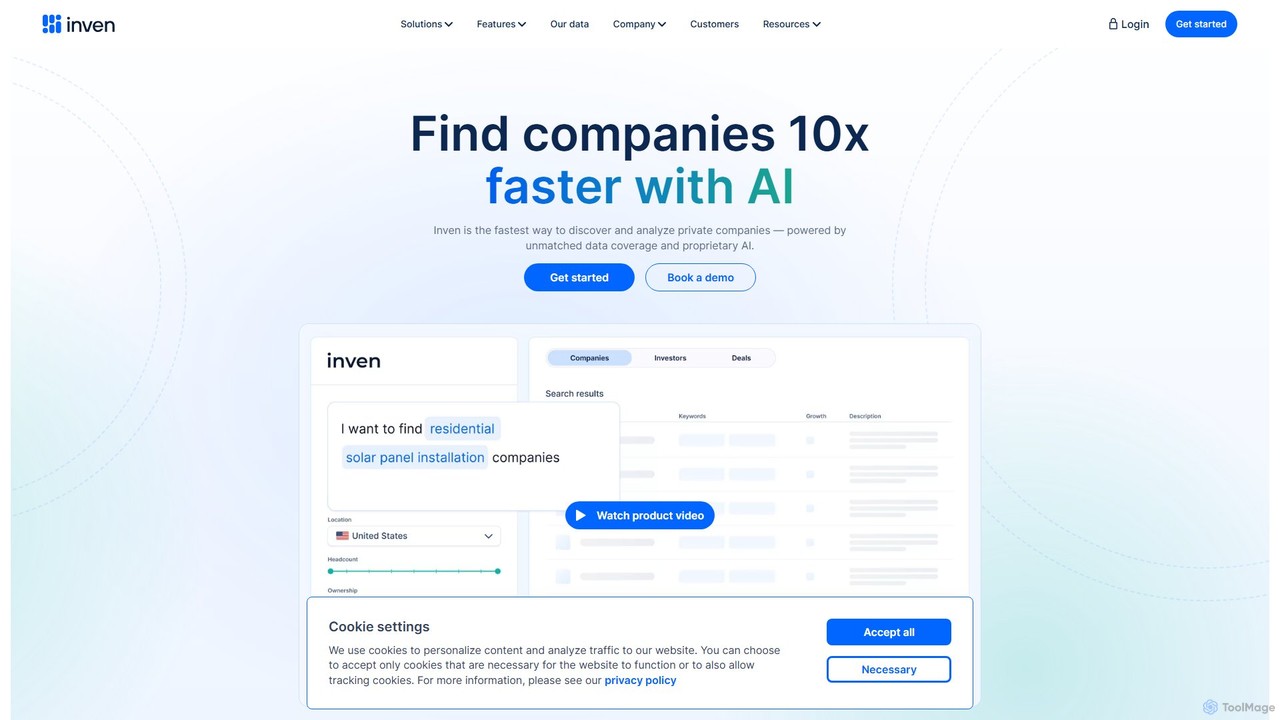
Inven is an AI-powered platform for M&A professionals, investment bankers, and private equity firms, designed to find M&A …
Inven is an AI-powered platform for M&A professionals, investment bankers, and private equity firms, designed to find M&A targets 10x faster. It leverages AI and NLP to scan millions of data sources, providing a comprehensive company database, advanced search, and real-time alerts to streamline deal sourcing, enhance market research, and provide a significant competitive advantage.
About Market Research
AI Market Research tools are a category of AI-powered solutions designed to automate and enhance the process of gathering, analyzing, and interpreting market data. These tools leverage advanced machine learning, natural language processing, and predictive analytics to extract actionable insights from vast, often unstructured, datasets. They enable businesses to understand consumer behavior, identify market trends, and analyze competitive landscapes with greater speed and accuracy than traditional methods. This leads to more informed strategic decisions and optimized business outcomes.
Core Features
- Sentiment Analysis: Automatically identifies and quantifies emotional tones in text data from reviews, social media, and surveys.
- Trend Forecasting: Predicts future market shifts, consumer preferences, and demand patterns based on historical data and real-time signals.
- Competitor Intelligence: Monitors and analyzes competitor activities, product launches, pricing strategies, and market positioning.
- Customer Segmentation: Divides target audiences into distinct groups based on demographics, psychographics, and behavioral data for personalized strategies.
- Data Visualization: Transforms complex market data into intuitive charts, graphs, and dashboards for easier interpretation and reporting.
Applicable Scenarios
Market Research AI tools are invaluable for product development teams seeking to identify unmet customer needs, marketing departments analyzing campaign effectiveness and audience sentiment, and business strategists forecasting market growth and identifying new opportunities. They are also used by brand managers to monitor brand perception and by sales teams to understand purchasing drivers.
How to Choose
When selecting an AI market research tool, consider its data integration capabilities (e.g., social media, web, internal CRM), the depth and breadth of its analytical features (e.g., NLP, predictive modeling, image analysis), and its reporting and visualization options. Evaluate the tool's scalability to handle growing data volumes, its ease of use for your team, and its compliance with data privacy regulations. Finally, assess the vendor's support and the tool's customization options to fit specific research needs.

Market ResearchUse Cases
Identify Emerging Market Trends
Business strategists and product managers can leverage AI market research tools to proactively spot nascent trends. By scanning vast amounts of unstructured data from news articles, social media, academic papers, and patent filings, these tools identify keywords, sentiment shifts, and topic clusters that signal new consumer demands or technological shifts. This enables companies to be early movers, guiding product development and market entry strategies before competitors catch on, ensuring a competitive edge.
Automate Competitor Intelligence Gathering
Marketing analysts and competitive intelligence specialists often find manual tracking of competitor activities time-consuming and incomplete. AI market research tools can be configured to continuously monitor competitor websites, social media channels, press releases, and pricing changes. They summarize key updates, analyze sentiment around competitor moves, and identify strategic shifts in real-time. This provides a comprehensive, up-to-date overview of the competitive landscape, enabling agile adjustments to marketing campaigns or pricing strategies.
Understand Customer Sentiment from Unstructured Data
Customer experience managers and brand managers face the challenge of processing large volumes of unstructured customer feedback from reviews, support tickets, and social media comments. AI sentiment analysis tools can ingest this data, categorize feedback by topic, and determine the emotional tone (positive, negative, neutral). This capability allows businesses to quickly pinpoint specific product features or service aspects causing dissatisfaction or delight, guiding targeted improvements and enhancing overall brand perception and customer satisfaction.
Optimize Product Features Based on User Feedback
Product development teams and UX researchers constantly need to prioritize new features or refine existing ones. AI market research tools analyze user reviews, feature requests, and forum discussions to identify recurring themes, pain points, and desired functionalities. By processing this qualitative data at scale, AI provides data-driven insights into what users truly value. This enables teams to make informed decisions about their product roadmap, ensuring development efforts align with actual user needs and market demand, leading to higher adoption and satisfaction.
Forecast Sales and Demand for New Products
Sales managers and supply chain planners launching new products require accurate sales predictions for inventory and resource allocation. AI market research tools can ingest historical sales data, market indicators, economic trends, and even competitor performance to generate highly accurate demand forecasts. These predictive models go beyond simple extrapolations, identifying complex patterns that influence purchasing behavior. The result is more precise inventory management, reduced waste, and optimized production schedules, leading to improved profitability and smoother product launches.
Segment Target Audiences for Personalized Marketing
Digital marketing specialists and campaign managers often struggle with generic marketing messages yielding low engagement. AI market research tools excel at analyzing vast amounts of demographic, psychographic, and behavioral data from CRM systems, website analytics, and social media. They can identify granular customer segments with shared characteristics and preferences. This enables the creation of highly personalized marketing campaigns tailored to each segment's specific needs and interests, significantly increasing conversion rates, customer loyalty, and overall return on investment (ROI).