Ocean Protocol
Ocean Protocol is a decentralized data exchange protocol that unlocks data for AI and research. It uses blockchain …
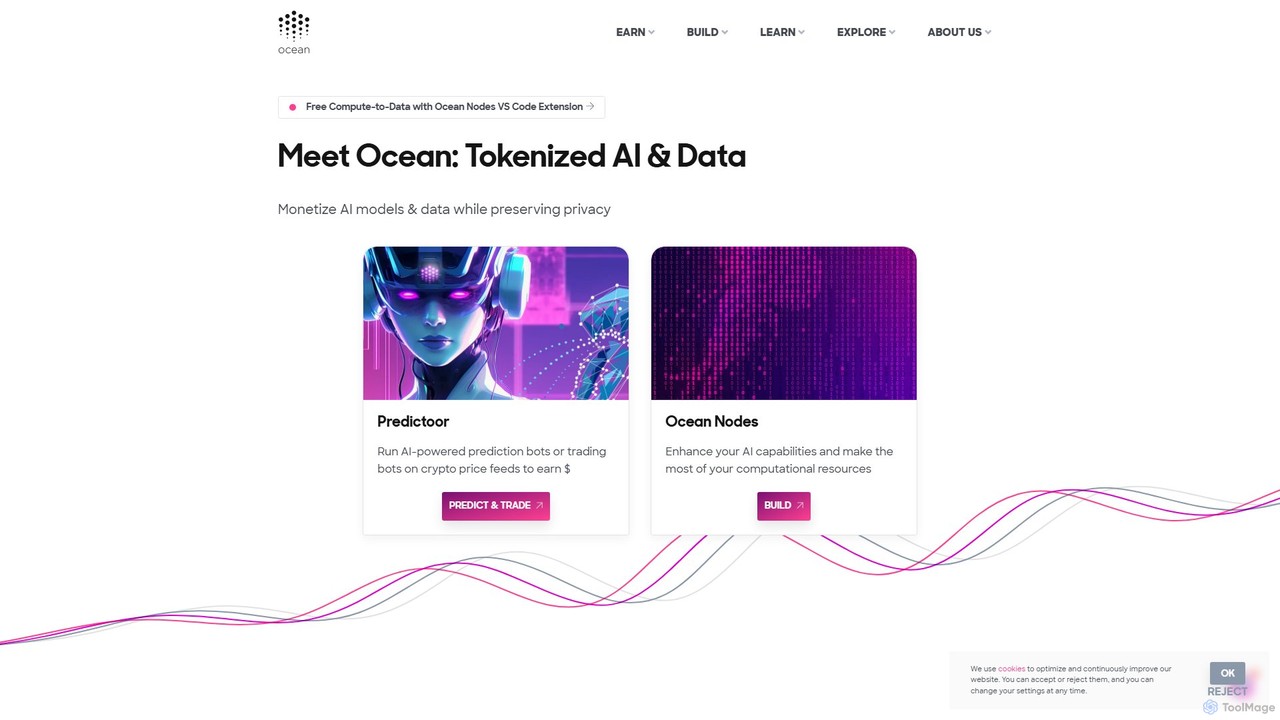
Ocean Protocol is a decentralized data exchange protocol that unlocks data for AI and research. It uses blockchain technology, Data NFTs, and datatokens to enable secure, privacy-preserving data sharing and monetization. Data owners retain control and can sell access to their data without compromising privacy through its innovative Compute-to-Data feature, fostering a new data economy.
About Marketplace
AI Marketplace tools are specialized platforms that facilitate the buying, selling, and exchange of AI models, datasets, and AI-powered services. These platforms leverage advanced AI algorithms to intelligently match buyers with suitable sellers, ensure the quality and relevance of listed assets, and streamline complex transactions. They empower businesses, researchers, and developers to efficiently access specialized AI resources or monetize their own valuable AI creations, significantly accelerating innovation within the broader data and AI ecosystem.
Core Features
- AI-driven Matching: Connects users with relevant AI models, datasets, or services based on specific needs and criteria.
- Data/Model Curation: Ensures the quality, integrity, and ethical compliance of listed AI assets through automated checks.
- Secure Transactions: Provides secure payment gateways and smart contract functionalities for asset exchange.
- Performance Evaluation: Offers metrics and benchmarks for assessing AI model performance before purchase.
- API Integration: Enables seamless integration of purchased AI services or models into existing workflows.
Use Cases
These tools are vital for organizations seeking to rapidly acquire specialized AI capabilities without extensive in-house development. Data scientists can find pre-trained models for specific tasks, while startups can license unique datasets to accelerate their product development. Content creators might use them to buy or sell AI-generated media assets.
How to Choose
When selecting an AI Marketplace, consider the breadth and quality of its offerings, focusing on whether it provides the specific AI models, datasets, or services you need. Evaluate its security protocols, data governance policies, and the transparency of its pricing and licensing models. Also, assess its integration capabilities with your existing infrastructure and the level of community support available.

MarketplaceUse Cases
Sourcing Specialized Datasets for ML Training
A machine learning engineer needs a highly specific dataset, such as annotated medical images or rare linguistic corpora, for training a new AI model. Instead of costly and time-consuming manual collection, they use an AI marketplace to browse, evaluate, and license pre-existing, high-quality datasets from expert providers, significantly accelerating their model development cycle and reducing resource expenditure.
Monetizing Proprietary AI Models and Algorithms
An AI research lab has developed a novel AI model for anomaly detection with superior performance. To generate revenue and expand its impact, the lab lists its model on an AI marketplace. Other businesses can then subscribe to or license the model's API access, allowing the lab to monetize its intellectual property without managing individual client integrations, reaching a broader audience of potential users.
Accessing Niche AI-powered API Services
A small e-commerce startup requires advanced AI capabilities like sentiment analysis for customer reviews or intelligent product recommendations, but lacks the resources to build these in-house. Through an AI marketplace, they discover and integrate ready-to-use AI API services offered by third-party developers, paying only for usage. This enables them to enhance their platform with sophisticated AI features quickly and cost-effectively.
Licensing AI-Generated Content for Creative Projects
A digital marketing agency needs a large volume of unique, high-quality AI-generated images or text snippets for various campaigns. Instead of generating everything from scratch or hiring multiple freelancers, they utilize an AI content marketplace. Here, they can browse and license diverse AI-generated assets, ensuring originality and scalability for their creative projects while adhering to licensing terms.
Finding Data Annotation and Labeling Services
A company developing a computer vision system has a vast amount of raw image data that requires precise annotation (e.g., object detection bounding boxes) for supervised learning. They post their project on an AI marketplace specializing in data services. Verified human annotators or specialized AI-assisted labeling teams on the platform bid on the task, providing high-quality labeled data efficiently and at scale.
Evaluating and Purchasing Pre-trained AI Models
A developer is building an application that requires a robust natural language processing (NLP) component, such as text summarization or entity recognition. They visit an AI model marketplace to compare various pre-trained NLP models. The marketplace provides performance benchmarks, user reviews, and trial access, allowing the developer to make an informed decision and purchase the most suitable model for integration into their application.