Jungle AI
Jungle AI provides advanced AI solutions to optimize the performance and reliability of industrial assets, particularly in the …
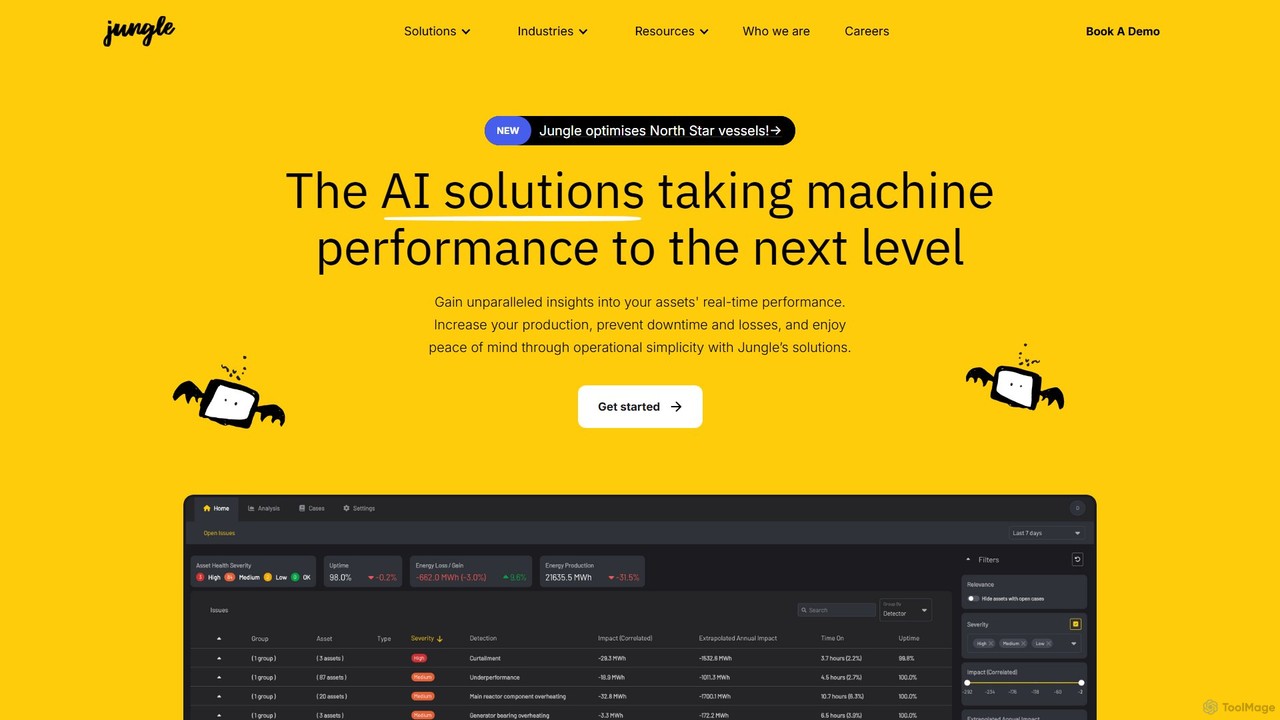
Jungle AI provides advanced AI solutions to optimize the performance and reliability of industrial assets, particularly in the renewable energy (wind, solar) and maritime sectors. Its platforms, Canopy and Toucan, offer predictive maintenance, performance monitoring, and power forecasting to prevent failures, reduce downtime, and maximize operational efficiency.
About Monitoring
AI Monitoring tools are a specialized class of software that uses machine learning to automatically track, analyze, and alert on the health and performance of systems, applications, and data pipelines in real time. They go beyond traditional rule-based systems by leveraging algorithms to detect complex anomalies, predict future failures, and identify root causes without manual intervention. This proactive approach helps organizations maintain operational stability, ensure service reliability, and prevent critical issues before they impact users. These tools are a crucial component of modern data operations, particularly in AIOps and MLOps environments.
Core Features
- Anomaly Detection: Automatically identifies unusual patterns and outliers in time-series data that deviate from normal behavior.
- Predictive Alerting: Forecasts potential issues, such as system overloads or performance degradation, before they occur.
- Root Cause Analysis (RCA): Pinpoints the most likely sources of an issue by correlating events across multiple data sources.
- Model Performance Tracking: Specifically monitors machine learning models for data drift, concept drift, and accuracy decay.
- Intelligent Dashboards: Visualizes complex system health data and highlights critical insights for quick decision-making.
Use Cases
These tools are essential for IT operations teams (AIOps), data scientists (MLOps), DevOps engineers, and security analysts. They are widely used in industries like finance for fraud detection, e-commerce for website performance monitoring, and manufacturing for predictive maintenance of industrial equipment.
How to Choose
When selecting an AI Monitoring tool, consider its integration capabilities with your existing tech stack (e.g., cloud services, databases). Evaluate the sophistication of its machine learning models for anomaly detection and RCA. Also, assess the customization options for alerts and dashboards, and consider the pricing model based on data volume or monitored endpoints.

MonitoringUse Cases
Proactive IT Infrastructure Health Monitoring
An IT Operations team for a large e-commerce platform uses an AI Monitoring tool to oversee hundreds of servers and microservices. Instead of setting manual thresholds for CPU usage or memory, the AI learns the normal operational patterns for each service, including daily and weekly cycles. When a service begins to show subtle signs of memory leak, the tool detects this anomalous behavior long before it triggers a critical failure. It automatically correlates the anomaly with a recent code deployment, providing the DevOps team with a precise root cause, reducing downtime by an estimated 40% and minimizing manual troubleshooting.
Ensuring AI Model Performance in Production
A data science team at a financial institution has deployed a credit scoring model. They use an AI Monitoring tool specifically for MLOps to track its performance. The tool continuously monitors the input data for drift, meaning the real-world data is starting to differ from the training data. It also tracks the model's prediction accuracy against actual outcomes. After a few months, the tool alerts the team to a significant data drift in the 'income level' feature and a corresponding 5% drop in accuracy. This allows the team to proactively retrain the model with new data, maintaining its reliability and preventing incorrect credit decisions.
Real-time Business Activity Monitoring
A SaaS company monitors its user sign-up funnel in real time. The AI monitoring tool establishes a baseline for normal sign-up rates, including variations by time of day and marketing campaigns. One afternoon, the tool detects a sudden, sharp drop in sign-ups that doesn't fit any normal pattern. It automatically correlates this drop with a spike in API errors from a third-party authentication service. The product team is alerted immediately, identifies the issue with the external service, and posts a status update for users, preventing a flood of support tickets and protecting the user experience before most users are even aware of a problem.
Automated Cybersecurity Threat Detection
A security operations center (SOC) analyst uses an AI monitoring platform to analyze network traffic data. The AI establishes a baseline of normal communication patterns between internal servers and external endpoints. It then detects a highly unusual pattern: a server that typically only communicates with internal systems begins sending small, encrypted data packets to an unknown external IP address at regular intervals. This behavior, which would be missed by rule-based firewalls, is flagged as a potential data exfiltration attempt. The AI provides the analyst with all correlated events, enabling a rapid investigation and containment of a potential breach, reducing the median time to detection from days to minutes.
Predictive Maintenance for Industrial IoT
A manufacturing plant manager uses an AI monitoring system connected to sensors on their production line machinery. The system analyzes real-time data streams, including vibration, temperature, and pressure. It learns the unique operational signature of each machine when it's healthy. The AI detects a subtle, developing pattern of increased vibration in a critical motor that is still within standard operating thresholds but deviates from its own historical norm. It predicts a 90% probability of failure within the next 72 hours and automatically creates a maintenance ticket. This allows technicians to replace the part during scheduled downtime, preventing a costly unplanned shutdown of the entire production line.
Monitoring Brand Reputation on Social Media
A marketing manager for a global consumer brand uses an AI monitoring tool to track brand mentions across social media platforms. The tool analyzes the sentiment of millions of posts in real time. It establishes a baseline of normal positive, negative, and neutral sentiment ratios. Following the launch of a new product, the AI detects an anomalous spike in negative sentiment originating from a specific geographic region. It identifies the root cause as a series of influential negative reviews about a product defect. This early warning allows the PR and product teams to quickly address the issue, issue a public statement, and mitigate a potential brand crisis before it spreads globally.