ToolMage
Sign in

Best 1 News Api AI tools for Data

Popular News Api AI tools in Data include AskNews, helping you work more efficiently.

AskNews
Freemium

AskNews

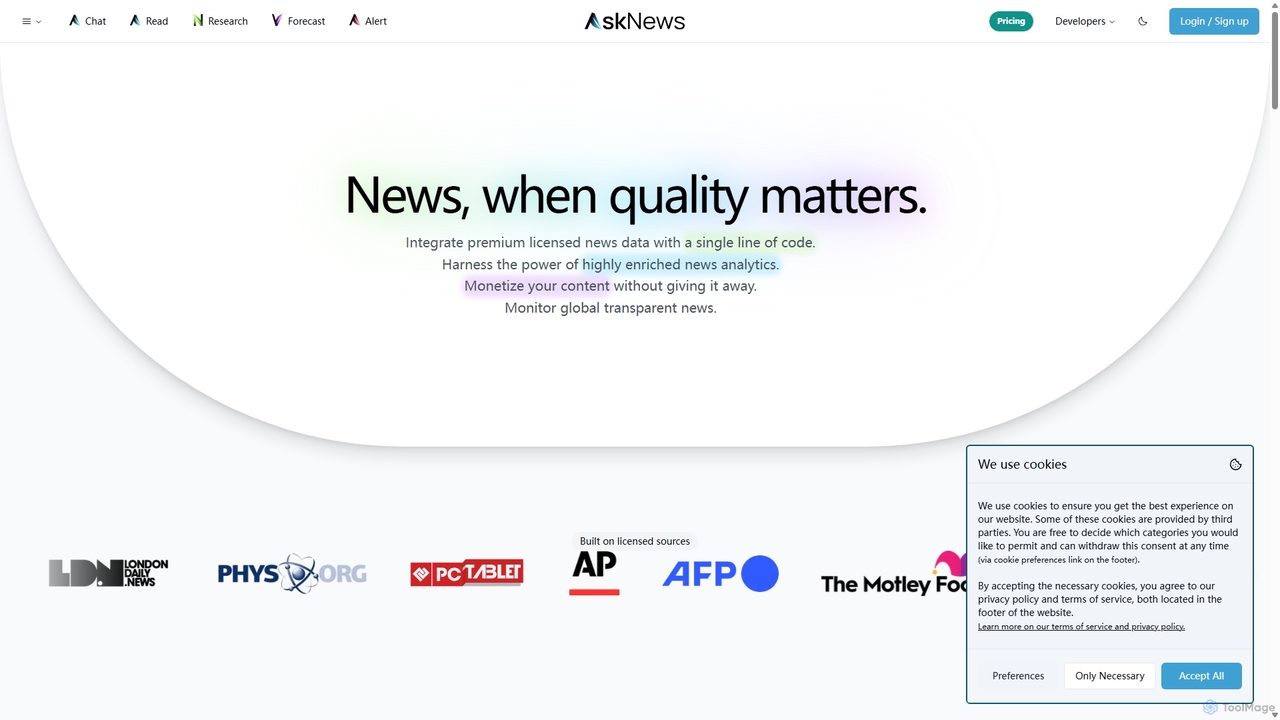
AskNews is an AI-powered news intelligence platform providing high-quality, licensed global news data through a powerful API. It offers enriched news analytics, a conversational AI for insights, and monetization tools for publishers. Ideal for developers, analysts, and researchers needing reliable, structured, and real-time news information.

Intelligence
Visits 7.7KFavorites 156Likes 163

About News Api

News APIs are specialized tools within the broader data category that provide programmatic access to a vast, structured collection of news articles, headlines, and associated metadata from diverse global sources. These APIs enable developers and businesses to integrate real-time or historical news content directly into their applications, platforms, or analytical systems. They are crucial for applications requiring up-to-date information, trend analysis, or content aggregation, offering a reliable and efficient way to consume news data without manual scraping.

Core Features

  • Comprehensive Data Access: Provides access to a wide range of news articles, headlines, authors, publication dates, and source information.
  • Real-time Updates: Delivers fresh news content as it's published, ensuring access to the latest information.
  • Advanced Search & Filtering: Allows users to query news by keywords, topics, sources, dates, languages, and even sentiment.
  • Structured Data Output: Returns data in easily parsable formats like JSON or XML, simplifying integration and analysis.
  • Historical Data Archives: Offers access to extensive archives of past news articles for research, trend analysis, and retrospective studies.

Use Cases

News APIs are widely adopted across various sectors. Media companies use them for content aggregation and personalized news feeds, while financial institutions leverage them for market sentiment analysis and risk assessment. PR agencies monitor brand mentions and track media coverage, and researchers analyze large datasets to identify journalistic trends or public opinion shifts.

How to Choose

Selecting the right News API involves evaluating several key factors. Consider the data coverage (number of sources, geographical reach, languages), update frequency (real-time vs. hourly/daily), data quality and accuracy, and the granularity of search and filtering options. Additionally, assess the API's reliability and uptime, documentation quality, ease of integration, and the pricing model based on your anticipated usage volume and specific feature requirements.

News Api use cases

1

Content Aggregation for News Portals

News websites and content platforms utilize News APIs to automatically pull articles and headlines from hundreds of global sources. This allows them to create comprehensive news feeds, categorize content by topic, and present a diverse range of information to their users, significantly reducing the manual effort of content curation and ensuring up-to-date coverage.

2

Market Sentiment Analysis for Finance

Financial analysts and investment firms leverage News APIs to monitor real-time news about specific companies, industries, or economic indicators. By processing vast amounts of news data, often combined with natural language processing (NLP) tools, they can gauge public sentiment, identify emerging trends, and make more informed trading or investment decisions, reacting quickly to market-moving news.

3

Real-time Media Monitoring for PR & Brand Management

Public relations agencies and brand managers use News APIs to track mentions of their clients, products, or brands across thousands of news outlets globally. This enables them to monitor media coverage in real-time, identify potential crises, measure campaign effectiveness, and respond promptly to public discourse, ensuring proactive reputation management and strategic communication.

4

Academic Research on Media Trends

Academics and researchers in fields like sociology, political science, and media studies use News APIs to access large datasets of historical news articles. They analyze these datasets to identify long-term trends in reporting, study media bias, track the evolution of public discourse on specific topics, or examine the impact of news coverage on societal changes, facilitating data-driven scholarly work.

5

Personalized News Feeds for Applications

Developers building mobile apps or web platforms can integrate News APIs to offer highly personalized news feeds to their users. By analyzing user preferences, reading history, and explicit interests, the API can fetch and filter relevant articles, ensuring users receive content tailored to their specific needs and improving engagement within the application.

6

Competitive Intelligence & Industry Monitoring

Businesses and market research firms leverage News APIs to continuously monitor news related to their competitors, industry trends, and regulatory changes. This allows them to gain competitive intelligence, identify emerging opportunities or threats, and stay informed about the broader market landscape, supporting strategic decision-making and business development efforts.

News Api FAQ

What are News APIs?

News APIs are web services that provide structured access to news content from various sources, including articles, headlines, and metadata. They allow developers to programmatically search, retrieve, and integrate news data into their applications or systems. Key features often include real-time updates, extensive historical archives, and advanced filtering capabilities by topic, source, or language.

How to choose the right News API for my project?

When selecting a News API, consider the data coverage (number of sources, geographical reach, languages), update frequency (real-time vs. delayed), and data quality (accuracy, completeness). Evaluate the API's features like advanced search, sentiment analysis, and categorization. Also, assess the API's reliability, documentation, ease of integration, and pricing model to ensure it aligns with your project's technical and budgetary requirements.

What's the difference between using a News API and web scraping for news?

A News API provides structured, authorized, and often real-time access to news data through a predefined interface, ensuring data consistency and legal compliance. Web scraping, conversely, involves extracting data directly from websites, which can be legally ambiguous, prone to breaking with website changes, and requires significant maintenance. APIs offer reliability, scalability, and often richer metadata, while scraping provides maximum flexibility for niche sources but at higher risk and operational cost.

What kind of data can I typically get from a News API?

News APIs typically provide a rich set of data points for each news item. This includes the article's title, full content/summary, publication source, author, publish date and time, URL, and often associated images or videos. More advanced APIs may also offer additional metadata such as categories/topics, keywords, sentiment scores, and geographic relevance, enabling deeper analysis and filtering.

Who benefits most from using News APIs?

A wide range of users benefit from News APIs. Media companies and content aggregators use them to power their platforms with fresh content. Financial analysts and investment firms leverage them for market intelligence and sentiment analysis. PR and marketing agencies utilize them for brand monitoring and crisis management. Researchers and academics find them invaluable for data-driven studies on media trends. Finally, developers integrate them into custom applications requiring dynamic news feeds or data.

Are News APIs suitable for small businesses or individual developers?

Yes, many News APIs offer flexible pricing tiers, including free plans or low-cost options, making them accessible for small businesses and individual developers. These APIs can be highly beneficial for quickly adding dynamic news content to a website, building a niche news aggregator, or conducting market research without the overhead of building a complex data collection system. It's important to check the specific API's usage limits and pricing to match project scale.