Perigon
Perigon is an AI-powered contextual intelligence platform and news API. It analyzes global information in real-time, providing structured …
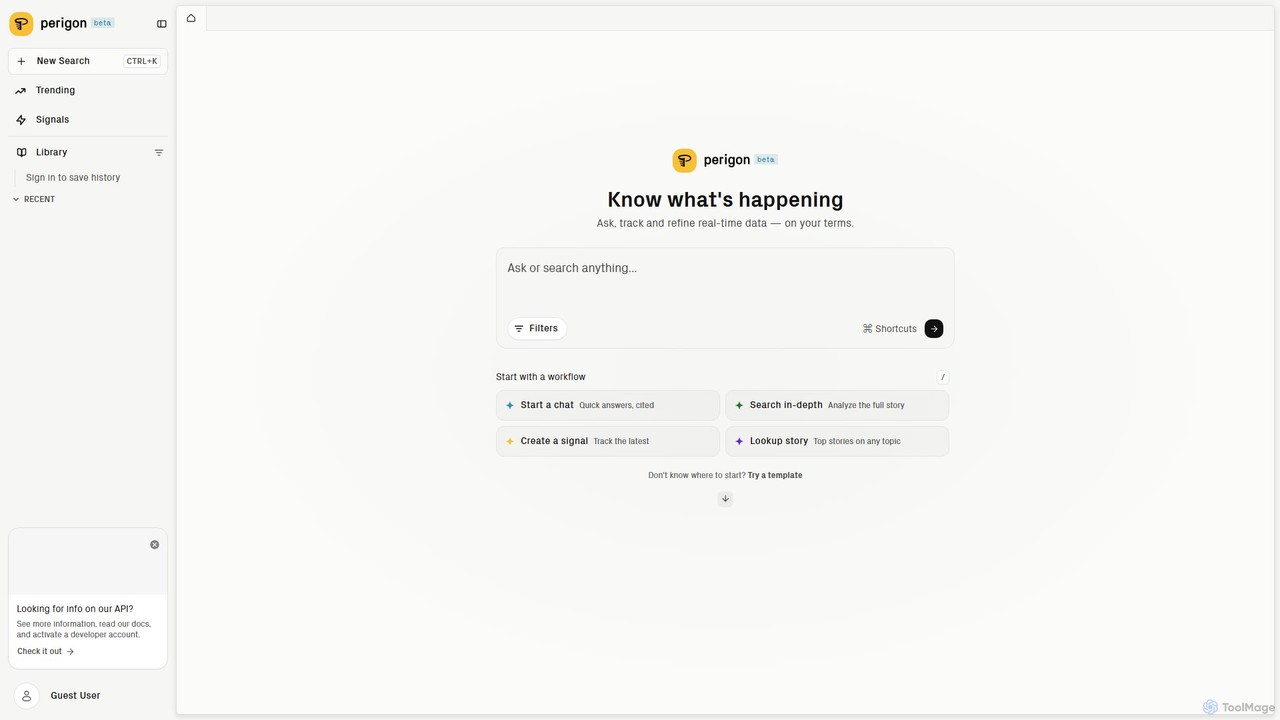
Perigon is an AI-powered contextual intelligence platform and news API. It analyzes global information in real-time, providing structured data, AI-generated summaries, and deep insights. It's designed for researchers, developers, and enterprises to track topics, understand market trends, and cut through information noise to get the complete story.
About News & Research
AI News & Research tools are a specialized category of data tools that automate the aggregation, analysis, and summarization of information from diverse sources. They utilize Natural Language Processing (NLP) to process vast amounts of text from news outlets, academic journals, and market reports. This enables users to track trends, monitor specific topics, and extract key insights in real-time without extensive manual effort. These tools transform unstructured information into structured, actionable intelligence for strategic decision-making.
Core Features
- Real-time Monitoring: Continuously track keywords, topics, or brands across thousands of online sources.
- Trend & Topic Analysis: Identify emerging themes, popular subjects, and shifts in conversation over time.
- Sentiment Analysis: Automatically gauge the emotional tone (positive, negative, neutral) of articles and mentions.
- Automated Summarization: Generate concise summaries of long articles, reports, or research papers to save reading time.
- Source Aggregation: Collect and organize information from a wide range of sources like news sites, blogs, and academic databases.
Use Cases
These tools are widely used by market researchers, public relations professionals, financial analysts, and academic researchers. For instance, a marketing team can monitor brand mentions and competitor news, while a financial analyst can track market-moving events and industry trends. Academics use them to accelerate literature reviews by quickly identifying and summarizing relevant papers.
How to Choose
When selecting an AI News & Research tool, consider the breadth and quality of its data sources. Evaluate the depth of its analytical features, such as sentiment accuracy and trend detection capabilities. Also, assess its real-time alerting functions, integration options with other platforms (like Slack or BI tools), and whether its pricing model aligns with your usage volume and team size.

News & ResearchUse Cases
Monitoring Brand Reputation and PR Crises
A public relations manager uses an AI News & Research tool to set up real-time alerts for their client's brand name and key executives. The tool continuously scans news sites, blogs, and social media. When a sudden spike in negative sentiment is detected, the manager receives an instant notification. They can quickly analyze the source of the negative coverage, understand the context, and formulate a timely response, mitigating potential damage to the brand's reputation before the story escalates.
Conducting Academic Literature Reviews
A postgraduate researcher needs to conduct a comprehensive literature review for their thesis. Instead of manually searching multiple academic databases, they use an AI research tool. They input keywords related to their topic, and the tool aggregates hundreds of relevant papers from sources like IEEE, PubMed, and arXiv. It then automatically groups papers by theme and generates a concise summary for each, allowing the researcher to quickly identify the most seminal works and understand the current state of research in hours instead of weeks.
Tracking Competitor Strategy and Product Launches
A competitive intelligence analyst for a tech company needs to stay ahead of market shifts. They configure an AI tool to monitor all news, press releases, and blog posts from their top five competitors. The tool identifies patterns, such as increased hiring for AI roles or mentions of a new product category. It compiles a weekly digest summarizing key competitor activities, product launch announcements, and strategic partnerships. This automated intelligence allows the strategy team to anticipate competitor moves and adjust their own roadmap proactively.
Identifying Investment Opportunities and Risks
A financial analyst at a venture capital firm uses an AI research tool to track emerging technologies and startups. They set up feeds to monitor news related to specific sectors like fintech or renewable energy. The tool flags companies that are frequently mentioned alongside positive trends, such as securing new patents or partnerships. Conversely, it also alerts the analyst to negative news, like regulatory challenges or executive departures, helping them to assess both opportunities and risks in their investment portfolio more efficiently.
Curating Content for Industry Newsletters
A content marketer is responsible for a weekly industry newsletter. To save time finding relevant content, they use an AI news aggregator. The tool is set to track dozens of top industry blogs and news sites. Each morning, it delivers a ranked list of the most shared and discussed articles from the past 24 hours, complete with AI-generated summaries. The marketer can quickly scan the summaries, select the most impactful stories, and compile the newsletter in under an hour, ensuring their audience always receives fresh and relevant information.
Analyzing Public Policy and Legislative Changes
A policy analyst at a non-profit organization needs to track legislative changes that could impact their mission. They use an AI research tool to monitor government websites, official publications, and news outlets for keywords related to new bills and regulations. The tool aggregates all relevant documents and discussions, identifies key stakeholders, and summarizes the potential impact of proposed policies. This allows the analyst to provide timely and well-informed briefings to their leadership, enabling proactive advocacy and strategic planning.