
Data Best in category 1 results Proxy Service AI Tool

Popular AI tools in the Proxy Service field of Data include Thordata, etc., helping you quickly improve efficiency.

Thordata

Thordata

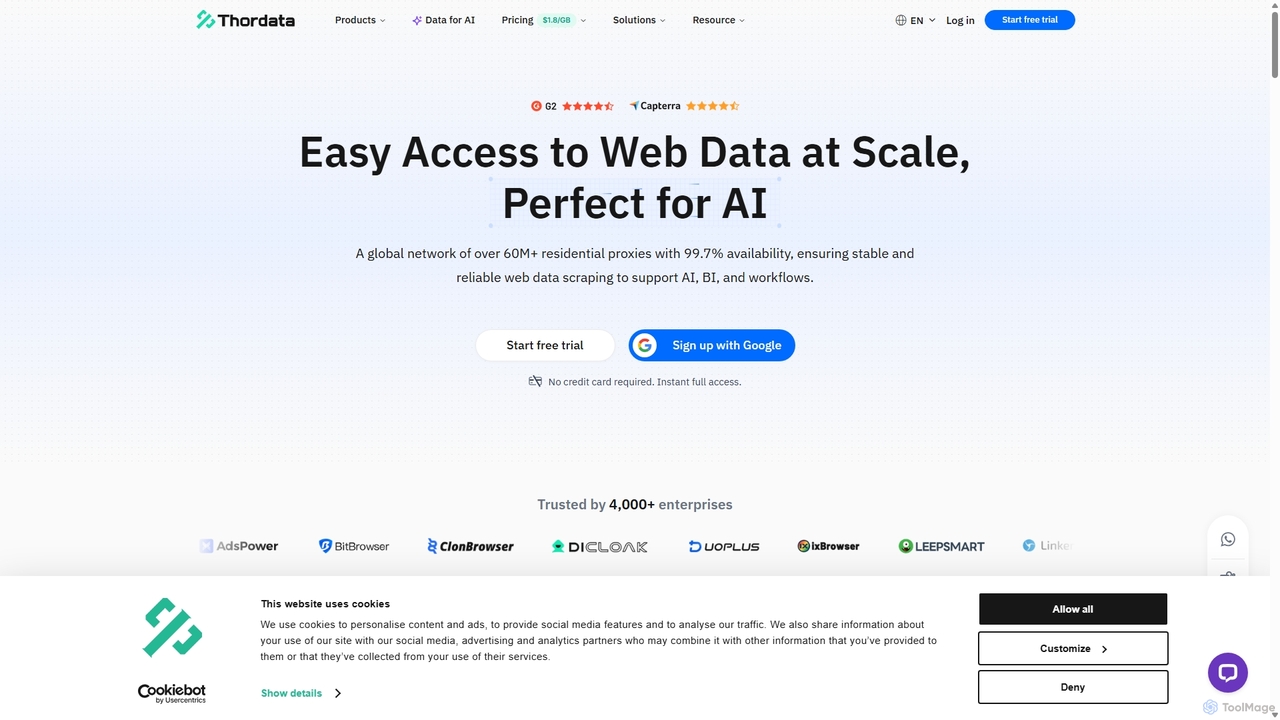
Thordata is a high-performance proxy service provider designed for large-scale web data scraping and AI applications. It offers …

307.7K

About Proxy Service

Proxy Services are tools that provide intermediary servers to route internet traffic, masking a user's original IP address. These services act as a gateway, forwarding requests on behalf of the user to websites and online services. This process is essential for tasks requiring anonymity, bypassing geographic restrictions, or managing a high volume of requests without being blocked. By offering a pool of diverse IP addresses, they enable reliable and large-scale data collection and online operations.

Core Features

  • IP Rotation: Automatically changes the IP address for each request or at set intervals to prevent detection and IP-based blocking.
  • Geo-Targeting: Allows selection of proxies from specific countries, cities, or even mobile carriers to access localized content and data.
  • Diverse Proxy Types: Provides various options such as residential, datacenter, and mobile IPs, each suited for different levels of anonymity and performance.
  • Session Management: Offers 'sticky' sessions that maintain the same IP address for a specific duration, crucial for tasks requiring a consistent user session.
  • API Access: Enables programmatic integration and management of proxies within custom applications, scripts, and data collection workflows.

Use Cases

Proxy Services are widely used by data scientists, SEO specialists, and market researchers for large-scale web scraping and competitive analysis. Digital marketing agencies use them for ad verification and testing localized campaigns. They are also utilized by e-commerce businesses for price monitoring and by individuals for managing multiple social media accounts or accessing region-locked content.

How to Choose

When selecting a Proxy Service, consider the proxy type (residential for high anonymity, datacenter for speed). Evaluate the IP rotation policy—whether you need rotating IPs for scraping or static IPs for account management. Check the geographic coverage to ensure it includes your target regions. Finally, assess performance metrics like success rate and connection speed, and compare pricing models (e.g., per-gigabyte vs. per-IP) to fit your budget and usage scale.

Proxy ServiceUse Cases

1

Large-Scale Web Scraping for Market Research

A data analyst at an e-commerce intelligence firm needs to collect daily pricing, stock levels, and customer reviews for thousands of products across multiple competitor websites. Attempting this from a single IP address would result in immediate rate limiting or permanent blocks. By using a proxy service with a large pool of rotating residential IPs, their scraping scripts can distribute requests across thousands of unique addresses. This makes the traffic appear as if it's coming from genuine individual users, allowing them to gather accurate, real-time market data reliably and without interruption.

2

SEO Performance Monitoring and Rank Tracking

An SEO specialist at a digital marketing agency needs to track keyword rankings for a client's website across different search engine regions, such as Google.com, Google.co.uk, and Google.de. Search results are heavily localized, so checking from their own location provides inaccurate data. They configure their rank tracking software to use geo-targeted proxies, sending each query through an IP address located in the target country. This allows them to retrieve unbiased, localized search engine results pages (SERPs), providing the client with precise data on their international SEO performance.

3

Ad Verification and Campaign Testing

A digital marketer for a global brand launches a campaign with ads tailored for different countries. They need to verify that these ads are displayed correctly, on the right websites, and without any fraudulent activity. By using a proxy service, they can simulate user traffic from specific target countries and even from mobile carrier networks. This allows them to view their ads exactly as a local user would, ensuring proper ad placement, checking for malware, and confirming that landing pages are correctly localized, thereby protecting their ad spend and brand reputation.

4

Managing Multiple Social Media Accounts

A social media marketing agency manages dozens of client accounts on platforms like Instagram and Facebook. These platforms often flag or suspend accounts if multiple are accessed from the same IP address, viewing it as bot-like behavior. To avoid this, the agency assigns a unique, static residential proxy to each client account. This makes each login appear to come from a different, legitimate residential location. This practice significantly reduces the risk of account suspension and allows the agency to manage their client portfolio safely and efficiently.

5

Bypassing Geo-Restrictions for Content Access

A market analyst for a streaming service needs to study the content library and user interface of competitor platforms in different countries. However, these platforms are geo-restricted and only show content available in the user's current region. The analyst uses a proxy service to route their connection through a server located in the target country, for example, Japan. This makes it appear as if they are browsing from Japan, granting them full access to the Japanese version of the competitor's service for their research and analysis.

6

E-commerce Price Monitoring and Aggregation

A price comparison website needs to continuously scan hundreds of e-commerce sites to gather the latest product prices. Many e-commerce platforms employ sophisticated anti-bot measures that block IPs making an unusually high number of requests. The service uses a proxy provider with a vast pool of rotating datacenter and residential IPs. This allows their price crawlers to operate 24/7, distributing requests across many different IPs to mimic normal user behavior and avoid detection, ensuring their pricing data remains fresh and comprehensive.

Proxy ServiceFrequently Asked Questions