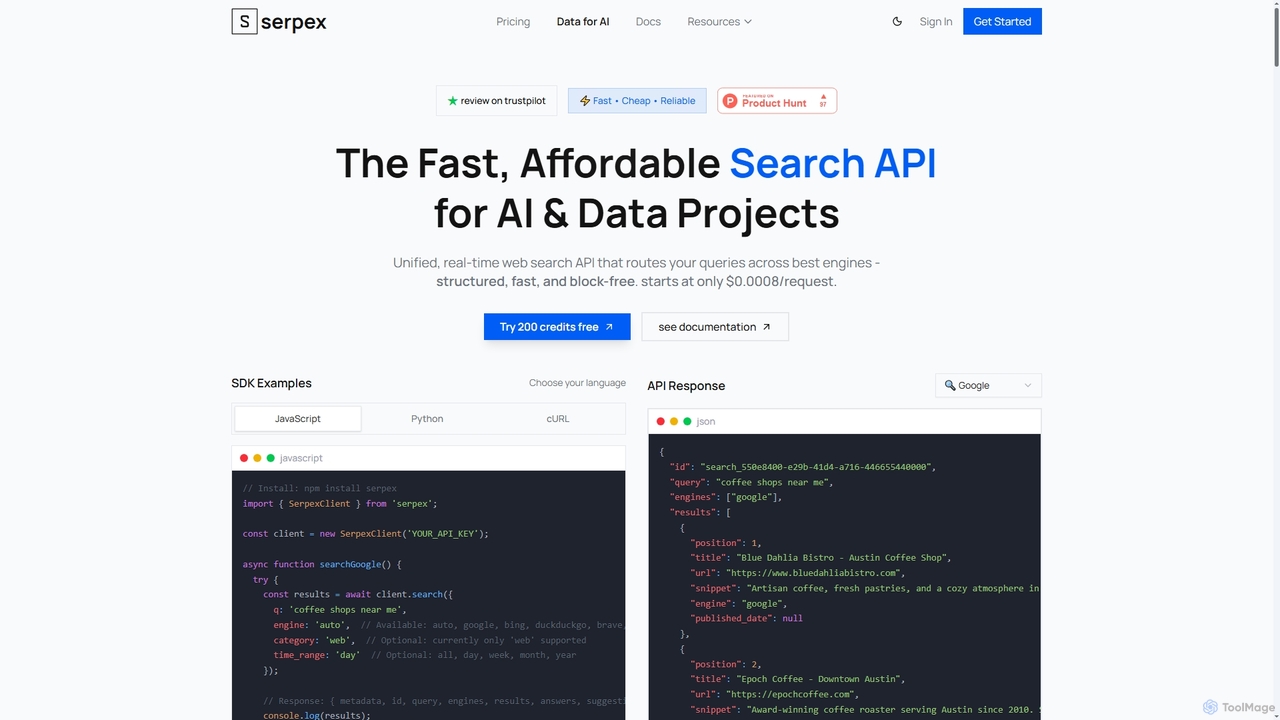
Search APIs are specialized interfaces that allow applications to programmatically query and retrieve real-time data from search engines or large databases. They function by accepting a query and returning structured results, typically in JSON format, eliminating the need to build and maintain a complex search infrastructure. These APIs are crucial for developers and businesses needing to integrate live web search, news, image, or product data directly into their websites, applications, or market analysis workflows. As a specific type of Data API, they focus exclusively on retrieving information through search queries rather than general data manipulation.
Core Features
- Real-time Data Retrieval: Access up-to-the-minute search results from major search engines.
- Structured Data Output: Deliver results in machine-readable formats like JSON for easy integration and parsing.
- Advanced Query Parameters: Support complex searches using operators, location filters, language specifications, and device types.
- Multiple Search Verticals: Offer access to various data types, including web pages, images, news, maps, and shopping results.
- Scalable Request Handling: Designed to manage a high volume of queries efficiently without performance degradation.
Use Cases
Search APIs are widely used in SEO monitoring tools for rank tracking, market research platforms for competitive analysis, and e-commerce sites for price comparison. They also power news aggregation services, fact-checking applications, and AI models that require access to current information from the web to provide accurate responses.
How to Choose
When selecting a Search API, consider factors like data source reliability (e.g., which search engines are covered), query limits and pricing models, the accuracy and completeness of the parsed data, and the ease of integration through clear documentation and SDKs. Also, evaluate the latency and success rate for requests to ensure performance meets your application's needs.