
ToolMage
Sign in

Best 1 Specialized Search AI tools for Data

Popular Specialized Search AI tools in Data include Airgeek, helping you work more efficiently.

Airgeek
Freemium

Airgeek

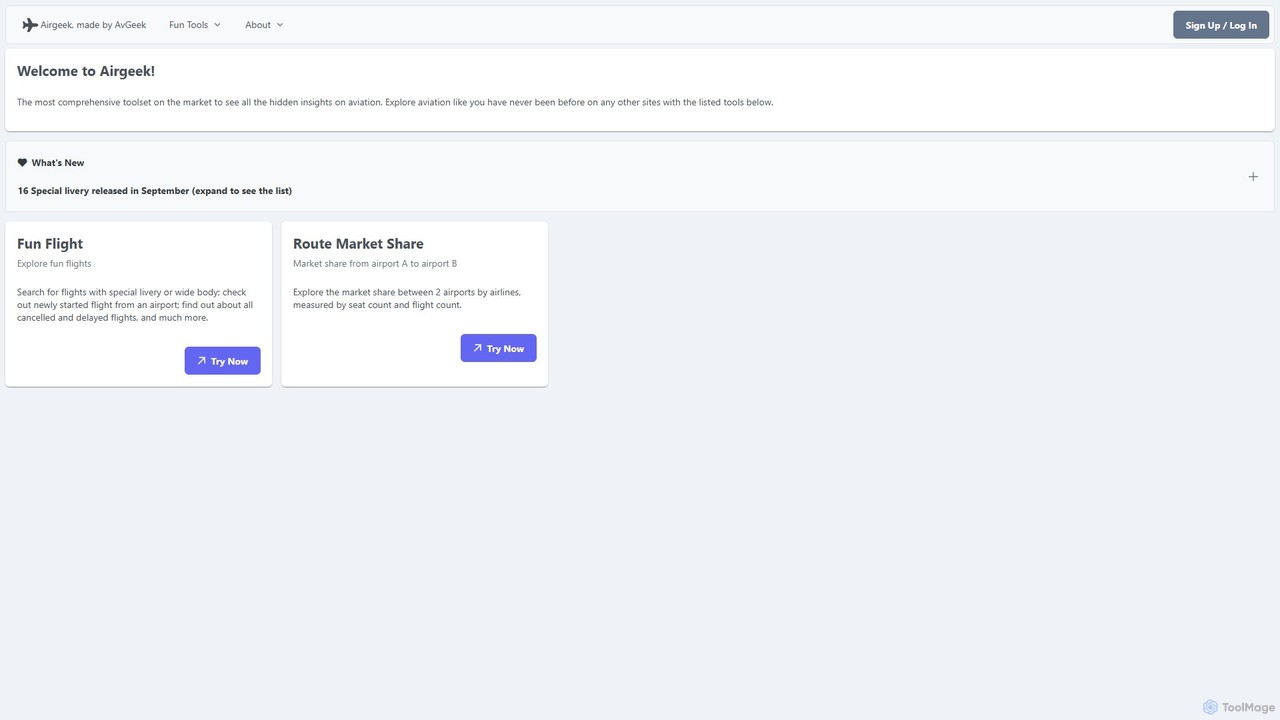
Airgeek is a comprehensive data analysis platform for aviation enthusiasts and professionals. It provides deep insights into the world of aviation, allowing users to explore flights with special liveries, analyze route market share, track flight delays and cancellations, and discover new routes. Designed by AvGeeks for AvGeeks, it's the ultimate toolset for uncovering hidden trends and data in the airline industry.

Specialized Search
Visits 4.2KFavorites 145Likes 141

About Specialized Search

Specialized Search tools are AI-powered platforms designed for highly precise and context-aware information retrieval within specific domains or datasets. They leverage advanced Natural Language Processing (NLP) and semantic understanding to go beyond simple keyword matching. These tools enable users to quickly find relevant data, extract entities, and gain deep insights from vast, often unstructured, information repositories. This significantly reduces research time and improves decision-making accuracy compared to general search engines.

Core Features

  • Semantic Search: Understands query intent and context, returning conceptually relevant results even without exact keyword matches.
  • Entity Recognition: Automatically identifies and extracts specific entities like names, dates, organizations, or technical terms from documents.
  • Domain-Specific Indexing: Builds and maintains indexes tailored to particular industries or data types, ensuring high relevance and precision.
  • Contextual Filtering: Allows users to refine searches based on specific attributes, relationships, or metadata within the dataset.
  • Knowledge Graph Integration: Connects disparate pieces of information to provide a holistic view and uncover hidden relationships.

Use Cases

Specialized Search tools are indispensable for professionals who need to extract precise information from large, complex datasets. For instance, legal teams use them for e-discovery, medical researchers for literature reviews, and financial analysts for market intelligence. They streamline the process of finding specific data points, accelerating research and analysis across various sectors.

How to Choose

When selecting a Specialized Search tool, prioritize its domain relevance, ensuring its models are optimized for your industry's terminology and data types. Evaluate its data source compatibility to confirm seamless integration with your existing repositories. Assess its precision and recall capabilities to guarantee accurate and comprehensive results. Finally, consider customization options and scalability to meet evolving data volumes and specific search requirements.

Featured tool rankings

Specialized Search use cases

1

Legal Document Discovery

Legal teams utilize specialized search tools to efficiently sift through millions of legal documents, contracts, and case precedents. They can quickly identify relevant clauses, entities, and arguments crucial for litigation, due diligence, or compliance. This significantly reduces the manual review time, enhances accuracy in legal research, and ensures no critical information is overlooked in vast legal archives.

2

Scientific Literature Review

Researchers in fields like medicine, biology, or engineering employ specialized search to navigate vast academic databases, journals, and patents. They can find specific experimental data, gene sequences, drug interactions, or technical specifications, accelerating literature reviews, identifying novel research opportunities, and staying abreast of the latest scientific advancements with high precision.

3

Internal Knowledge Management

Large enterprises and organizations leverage specialized search to empower employees to find specific information within vast internal documents, reports, emails, and wikis. This improves access to institutional knowledge, reduces duplicate efforts, streamlines onboarding processes for new hires, and ensures consistent information sharing across departments, boosting overall productivity.

4

Competitive Intelligence Analysis

Marketing and business intelligence teams leverage specialized search to monitor industry trends, competitor activities, and market sentiments across news articles, social media, financial reports, and regulatory filings. They extract key insights to inform strategic decisions, identify emerging threats or opportunities, and maintain a competitive edge by understanding the market landscape in depth.

5

Technical Documentation Retrieval

Engineers, developers, and support staff in complex industries (e.g., aerospace, software development, manufacturing) use specialized search to locate precise technical specifications, troubleshooting guides, code snippets, or design documents within extensive documentation libraries. This ensures quick problem resolution, adherence to technical standards, and efficient knowledge transfer across technical teams.

6

Patent Search and Analysis

Intellectual property professionals and innovators use specialized search tools to conduct thorough patent searches, identifying prior art, analyzing patent landscapes, and assessing the novelty of inventions. These tools can process complex technical language and classification systems, significantly improving the efficiency and accuracy of patent examination and strategic IP planning.

Specialized Search FAQ

What are Specialized Search tools?

Specialized Search tools are AI-powered platforms designed for highly precise and context-aware information retrieval within specific domains or datasets. They leverage advanced Natural Language Processing (NLP) and semantic understanding to go beyond simple keyword matching, enabling users to find relevant data, extract entities, and gain deep insights from vast, often unstructured, information repositories.

How do Specialized Search tools differ from general search engines?

General search engines (like Google) are designed for broad web indexing and keyword-based queries, offering wide but often less precise results. Specialized Search tools, conversely, focus on specific domains or internal datasets, using semantic understanding, entity recognition, and domain-specific indexing to provide highly accurate, contextually relevant, and noise-reduced results. They are built for depth and precision rather than breadth.

What are the core benefits of using Specialized Search tools?

The core benefits include significantly improved search precision and relevance, drastically reduced time spent on information retrieval, and the ability to uncover hidden insights from complex, domain-specific data. These tools enhance decision-making accuracy, streamline research workflows, and provide a competitive advantage by enabling users to access and analyze highly targeted information more effectively than with general search methods.

Who typically uses Specialized Search tools?

Professionals across various industries utilize these tools, including legal teams for e-discovery and case research, medical researchers for literature reviews and clinical trial data, financial analysts for market intelligence and regulatory compliance, and engineers for technical documentation retrieval. Additionally, large enterprises use them for internal knowledge management, and intellectual property professionals for patent search and analysis. Anyone needing deep, precise insights from domain-specific data can benefit.

How should I choose the right Specialized Search tool for my needs?

When choosing, consider the tool's domain relevance, ensuring its models are optimized for your industry's terminology and data types. Evaluate its data source compatibility to confirm seamless integration with your existing repositories. Assess its precision and recall capabilities to guarantee accurate and comprehensive results. Also, consider customization options for tailoring search parameters, its scalability to handle growing data volumes, and the level of technical support offered. User-friendliness and integration with existing workflows are also key.