Productivity Best in category 1 results Academia AI Tool

Popular AI tools in the Academia field of Productivity include Citrus Search, etc., helping you quickly improve efficiency.

Free
Citrus Search

Citrus Search

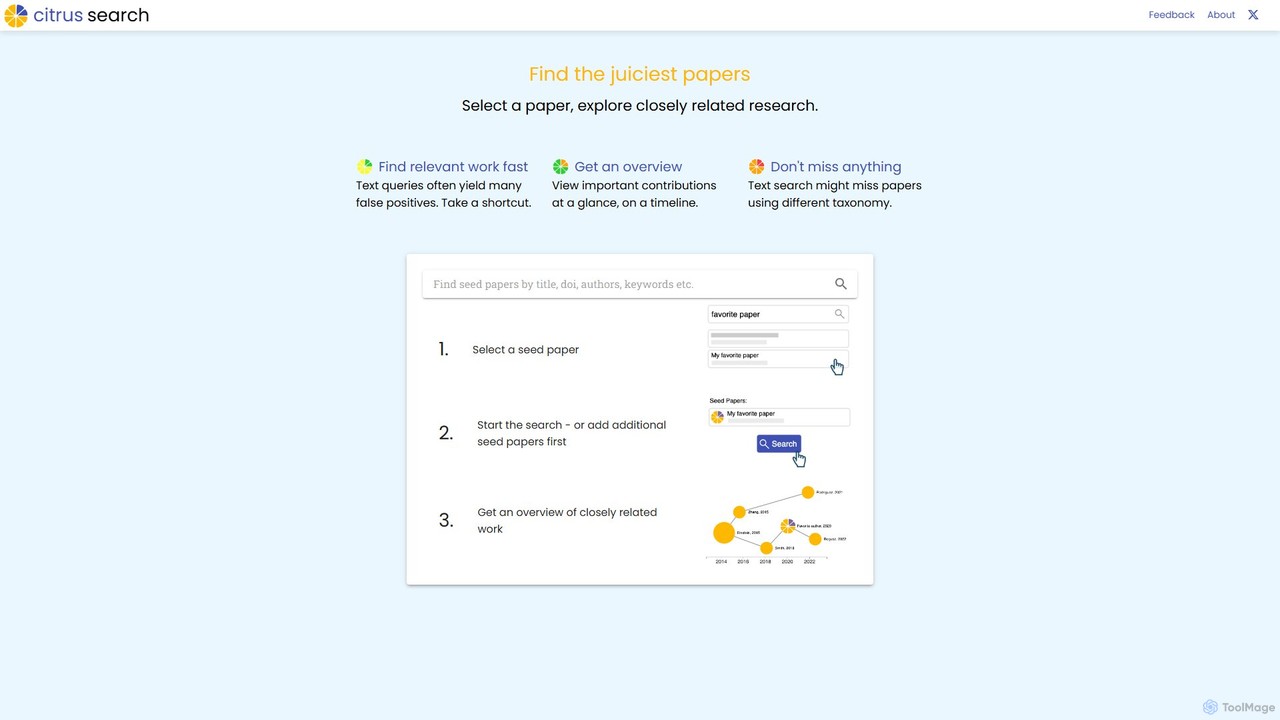
Citrus Search is an AI-powered academic search engine that revolutionizes literature discovery. Instead of keywords, you provide a …

3.0K

About Academia

AI Academia tools are a specialized category of software designed to streamline and enhance academic research, writing, and learning. These tools leverage natural language processing (NLP) and machine learning to automate tasks like literature discovery, data analysis, and manuscript drafting. Their primary value lies in accelerating the research lifecycle, improving the quality of scholarly writing, and helping users navigate vast amounts of information efficiently. They differ from general productivity tools by focusing specifically on academic workflows, such as citation management and thesis structuring.

Core Features

  • AI-Powered Literature Search: Discovers semantically related papers and identifies research gaps beyond simple keyword matching.
  • Automated Summarization & Synthesis: Condenses long research papers, articles, and book chapters into concise, coherent summaries.
  • Academic Writing Assistant: Provides grammar checks, style suggestions, and citation formatting tailored for scholarly publications.
  • Research Data Analysis: Assists in analyzing qualitative and quantitative data to identify patterns and generate insights.
  • Citation & Reference Management: Automatically generates bibliographies and manages citations in various academic styles like APA, MLA, and Chicago.

Applicable Scenarios

These tools are essential for university students, PhD candidates, postdoctoral researchers, and faculty across all disciplines. They are particularly useful for writing a thesis, preparing a comprehensive literature review, drafting grant proposals, and analyzing complex experimental data, significantly reducing manual effort.

Selection Criteria

When choosing an AI Academia tool, consider its discipline specificity, ensuring it supports your field's databases and citation styles. Evaluate its integration capabilities with your writing software (e.g., Word, LaTeX) and reference managers. Prioritize tools with clear data privacy policies and verify the accuracy of their AI-generated summaries and citations.

AcademiaUse Cases

1

Accelerating Literature Reviews for PhD Students

A PhD candidate in sociology needs to review hundreds of academic papers for their dissertation. Instead of spending weeks manually reading and synthesizing, they use an AI academia tool. They upload a list of core papers, and the tool automatically scans them, identifies recurring themes, maps out the evolution of concepts, and generates a structured summary. This allows the student to quickly grasp the state of the art, identify research gaps, and build a comprehensive theoretical framework in a fraction of the time, shifting their focus from tedious searching to critical analysis.

2

Drafting and Polishing Research Papers

A non-native English-speaking researcher is preparing a manuscript for a high-impact journal. They use an AI academic writing assistant to refine their draft. The tool helps paraphrase complex sentences for better clarity, corrects subtle grammatical errors specific to academic writing, and suggests more appropriate vocabulary. It also checks the manuscript for consistency in terminology and ensures all citations in the text match the bibliography, formatted correctly in the journal's required style (e.g., Vancouver). This significantly improves the manuscript's quality and increases its chances of passing peer review.

3

Analyzing Qualitative Interview Data

A sociologist has conducted 50 in-depth interviews for a study on community engagement. Manually coding these transcripts would be extremely time-consuming. Instead, they upload the anonymized transcripts to an AI analysis tool. The AI performs thematic analysis, identifying and clustering recurring concepts like 'social trust,' 'civic duty,' and 'local identity.' It also provides sentiment analysis for key themes. The researcher can then interactively explore these AI-generated themes, refine them with their own expertise, and export a structured report, which forms a solid basis for the results section of their paper.

4

Creating Study Aids for Undergraduates

An undergraduate student is preparing for final exams in a dense subject like biochemistry. They feel overwhelmed by the volume of lecture notes and textbook chapters. They use an AI learning tool by uploading all their course materials. The tool processes the information and automatically generates a set of interactive study aids, including:

  • Concise summaries of key concepts.
  • Digital flashcards with important terms and definitions.
  • Practice quizzes to test their knowledge and identify weak areas.
This transforms passive reading into an active learning experience, helping the student to study more effectively and improve their retention of complex information.

5

Assisting with Grant Proposal Writing

A principal investigator (PI) is drafting a grant proposal for a major funding body. The proposal requires a strong literature background and a clear articulation of the research gap. The PI uses an AI tool to quickly synthesize the last five years of research in their field, generating a summary that highlights key findings and unanswered questions. The AI assistant then helps refine the proposal's language, ensuring it is persuasive, concise, and adheres to the funder's specific formatting guidelines. This allows the PI to produce a higher-quality proposal in less time, increasing their chances of securing funding.

6

Validating Experimental Hypotheses with Data

A biologist has collected a large dataset from a series of genetic sequencing experiments. Before writing the paper, they need to analyze the data to validate their hypothesis. They use an AI data analysis tool designed for life sciences. The tool helps identify statistically significant patterns, correlates gene expression with specific outcomes, and generates publication-ready visualizations like heatmaps and volcano plots. The AI can also suggest alternative interpretations of the data that the researcher may not have considered, fostering a more robust and rigorous scientific discovery process.

AcademiaFrequently Asked Questions