Productivity Best in category 1 results Academic Assistant AI Tool

Popular AI tools in the Academic Assistant field of Productivity include Mindko, etc., helping you quickly improve efficiency.

Mindko

Mindko

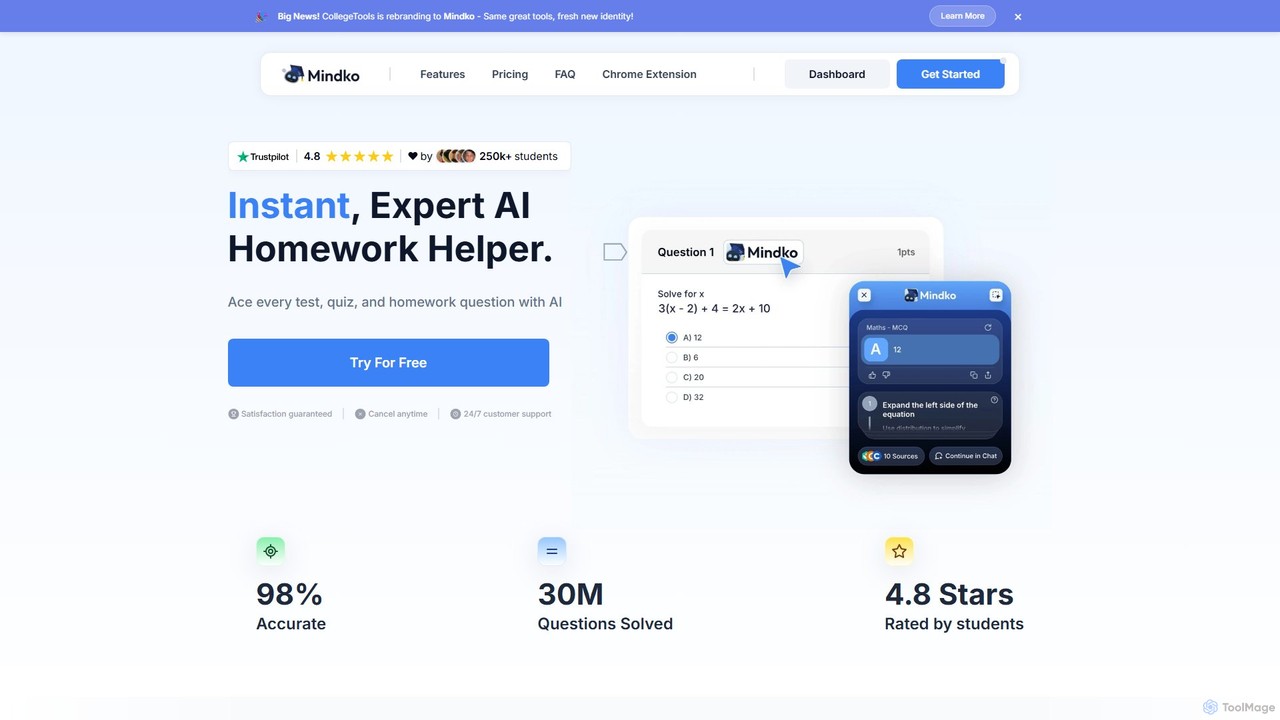
Mindko (formerly College Tools) is an AI-powered academic assistant designed to help students excel. It provides instant, accurate …

55.7K

About Academic Assistant

Academic Assistant tools are a specialized category of AI software designed to streamline the research, writing, and learning processes for students and researchers. Leveraging natural language processing (NLP), these tools analyze complex documents, generate summaries, check for plagiarism, and manage citations. They act as intelligent partners in academic work, helping to accelerate literature reviews, improve writing quality, and organize information efficiently. Unlike general productivity tools, they are fine-tuned for the specific demands of academic integrity, formatting standards, and evidence-based argumentation.

Core Features

  • AI-Powered Research: Finds, summarizes, and synthesizes relevant academic papers from vast databases.
  • Intelligent Writing Assistance: Offers paraphrasing, grammar checks, and style suggestions tailored for an academic tone.
  • Automated Citation Management: Generates accurate citations in various formats (APA, MLA, Chicago) and creates bibliographies.
  • Plagiarism Detection: Scans documents against a comprehensive database of academic publications to ensure originality.
  • Data Analysis & Interpretation: Helps extract and understand key data, methodologies, and findings from research papers.

Applicable Scenarios

These tools are primarily used by university students, PhD candidates, academic researchers, and faculty members. They are invaluable for tasks such as writing theses and dissertations, preparing journal articles for publication, conducting comprehensive literature reviews, and fact-checking complex information.

Selection Criteria

When choosing an Academic Assistant, evaluate the scope of its research database, the accuracy of its citation generator, and its integration with writing software like Word, Google Docs, or LaTeX. Also consider the reliability of its plagiarism checker and whether its pricing model (e.g., subscription vs. pay-per-use) aligns with your needs.

Academic AssistantUse Cases

1

Accelerating Literature Reviews for Theses

A PhD student working on their dissertation needs to review hundreds of academic papers. Instead of spending weeks manually reading each one, they use an AI Academic Assistant to search for keywords across multiple databases, generate concise summaries of relevant articles, and identify recurring themes and research gaps. The tool helps create a structured, annotated bibliography, reducing the initial research phase from months to weeks and providing a solid foundation for their work.

2

Drafting and Polishing Academic Papers

A university researcher is preparing a manuscript for a peer-reviewed journal. They use an AI assistant to enhance their writing. The tool suggests alternative phrasing to improve clarity, checks for grammatical errors and adherence to an academic tone, and ensures consistent terminology throughout the document. Before submission, they run a final plagiarism check against a vast academic database, ensuring the paper's originality and increasing its chances of acceptance.

3

Automated Citation and Bibliography Generation

An undergraduate student is writing a term paper with over 50 sources. Manually formatting each citation in APA 7th edition style is tedious and prone to error. They use an Academic Assistant with a browser extension. As they find sources online, they click a button to save the metadata. In their document, the tool automatically generates correct in-text citations and compiles a perfectly formatted bibliography at the end, saving hours of work and preventing potential grade deductions for citation errors.

4

Understanding and Summarizing Complex Research

A medical student needs to quickly understand the key findings of a dense clinical trial report for their studies. They upload the PDF to an AI Academic Assistant and ask it to summarize the methodology, results, and conclusions. The AI breaks down the complex jargon into simpler terms and highlights the most critical data points. This allows the student to grasp the essence of the research in minutes rather than hours, enabling more efficient and effective learning.

5

Verifying Claims and Finding Supporting Evidence

A science journalist is writing an article and needs to fact-check a specific claim. They input the statement into an AI Academic Assistant. The tool scans its database of peer-reviewed papers to find primary research that either supports or refutes the claim. It provides snippets from the relevant papers and direct links to the sources, enabling the journalist to quickly ground their article in credible, scientific evidence and maintain high standards of accuracy.

6

Interactive Learning and Concept Explanation

A high school student is struggling with a complex topic in biology, such as cellular respiration. They use an AI Academic Assistant as an interactive tutor. They can ask specific questions like, 'Explain the Krebs cycle in a simple way' or 'What's the difference between ATP and ADP?'. The AI provides clear, step-by-step explanations, uses analogies, and can even quiz the student to test their understanding. This provides personalized, on-demand learning support that complements classroom teaching.

Academic AssistantFrequently Asked Questions