StudyRecon
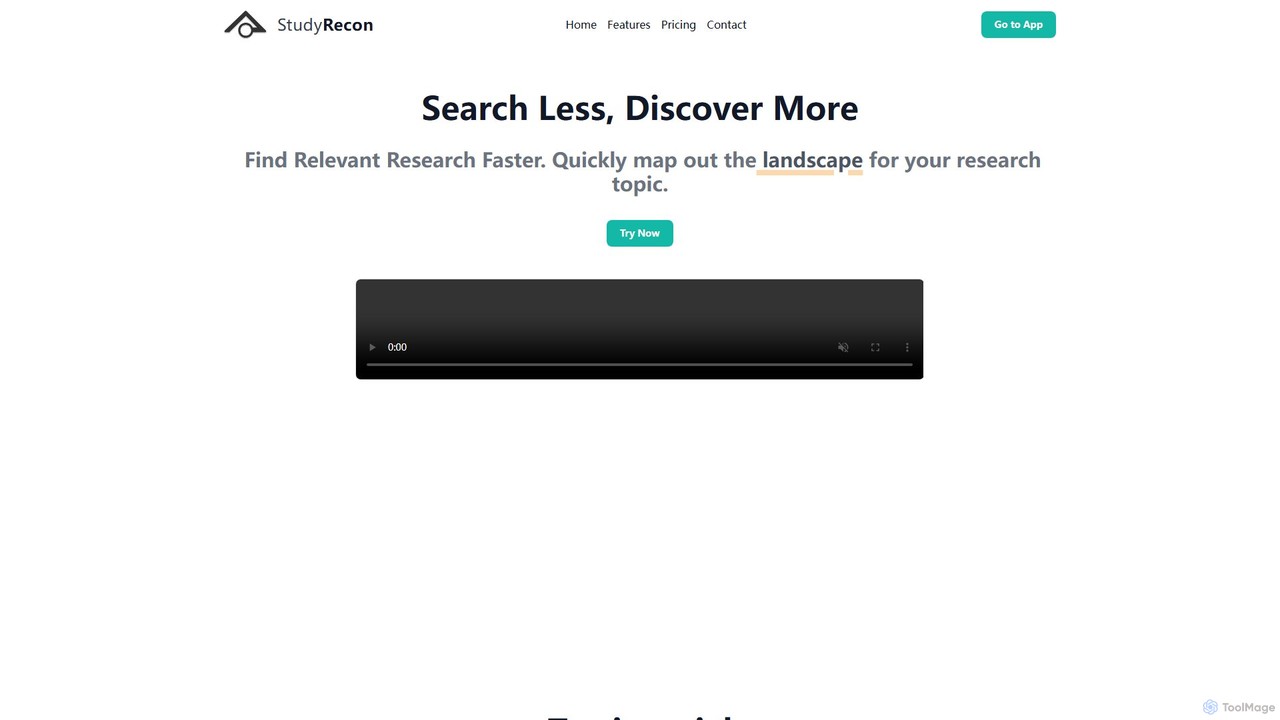
StudyRecon is an AI-powered literature review tool designed to help researchers and academics accelerate their work. It streamlines …
StudyRecon is an AI-powered literature review tool designed to help researchers and academics accelerate their work. It streamlines the process of finding, analyzing, and summarizing relevant scientific papers. By providing a visual landscape of research topics, suggesting relevant queries, and offering concise summaries, it enables users to conduct comprehensive literature reviews in a fraction of the time.
LearningHub
LearningHub by AHelp is an AI-powered educational platform designed to provide personalized learning assistance. It offers an AI …
LearningHub by AHelp is an AI-powered educational platform designed to provide personalized learning assistance. It offers an AI tutor for homework help, a writing assistant for improving essays, and tools for generating summaries and study materials, making learning more efficient and accessible for students and educators.
About Academic Research
Academic Research AI tools are specialized platforms that leverage artificial intelligence to streamline and enhance various stages of scholarly work. These tools utilize advanced natural language processing, machine learning, and data analysis algorithms to assist researchers, students, and academics. They significantly accelerate literature reviews, data processing, academic writing, and publication preparation, ultimately boosting research efficiency and quality within the broader productivity landscape.
Core Features
- Automated Literature Review: Quickly identify, summarize, and synthesize relevant academic papers and articles from vast databases.
- Intelligent Data Analysis: Assist in processing, interpreting, and visualizing complex datasets, identifying patterns and insights.
- Academic Writing Assistance: Provide grammar, style, and coherence checks, suggest phrasing, and help structure research papers.
- Citation and Reference Management: Automate the generation and formatting of citations and bibliographies according to various academic styles.
- Research Idea Generation: Help brainstorm topics, formulate hypotheses, and identify research gaps based on existing literature.
Applicable Scenarios
Researchers can use these tools to quickly sift through thousands of papers for a systematic review, identifying key theories and methodologies. PhD students can leverage AI for proofreading their dissertations, ensuring linguistic accuracy and academic tone. University faculty can employ AI to analyze large experimental datasets, revealing subtle trends that might be missed manually.
Selection Criteria
When selecting Academic Research AI tools, consider the specific research phase you need support with (e.g., literature, data, writing). Evaluate the tool's accuracy in summarization or analysis, its compatibility with your existing workflows and data formats, and the range of academic styles it supports for citations. User interface intuitiveness and data privacy policies are also crucial.

Academic ResearchUse Cases
Streamlining Literature Reviews
A doctoral candidate uses an AI tool to rapidly scan and summarize hundreds of research papers related to their thesis topic, identifying key arguments, methodologies, and authors. This significantly reduces manual reading time and ensures comprehensive coverage, allowing them to focus on critical analysis rather than information gathering.
Enhancing Academic Writing Quality
A non-native English-speaking researcher employs an AI writing assistant to refine their manuscript, checking for grammatical errors, improving sentence structure, and ensuring adherence to academic tone and style before submission to a peer-reviewed journal. This boosts confidence in their writing and increases the likelihood of acceptance.
Automating Data Extraction from Studies
A medical researcher utilizes AI to extract specific data points (e.g., patient demographics, treatment outcomes) from a large collection of clinical trial reports. This enables faster meta-analysis and synthesis of evidence, significantly reducing the manual effort and potential for human error in data collection.
Generating Research Hypotheses
A new faculty member explores an AI research assistant to brainstorm novel research questions and hypotheses by analyzing trends and gaps in existing literature within their field. This sparks new directions for their grant proposals and helps them identify unique contributions to their discipline, accelerating the initial ideation phase of research.
Efficient Citation and Reference Management
A student preparing their bibliography for a term paper uses an AI tool to automatically format citations in APA style, ensuring consistency and accuracy across all references. This saves hours of manual formatting and reduces the risk of errors, allowing them to focus more on content and less on tedious administrative tasks.
Identifying Research Gaps and Trends
An institutional research team leverages AI to analyze publication trends and emerging topics across various disciplines, helping them identify under-researched areas and inform strategic planning for future research initiatives. This proactive approach ensures their research efforts are impactful and contribute to cutting-edge knowledge.