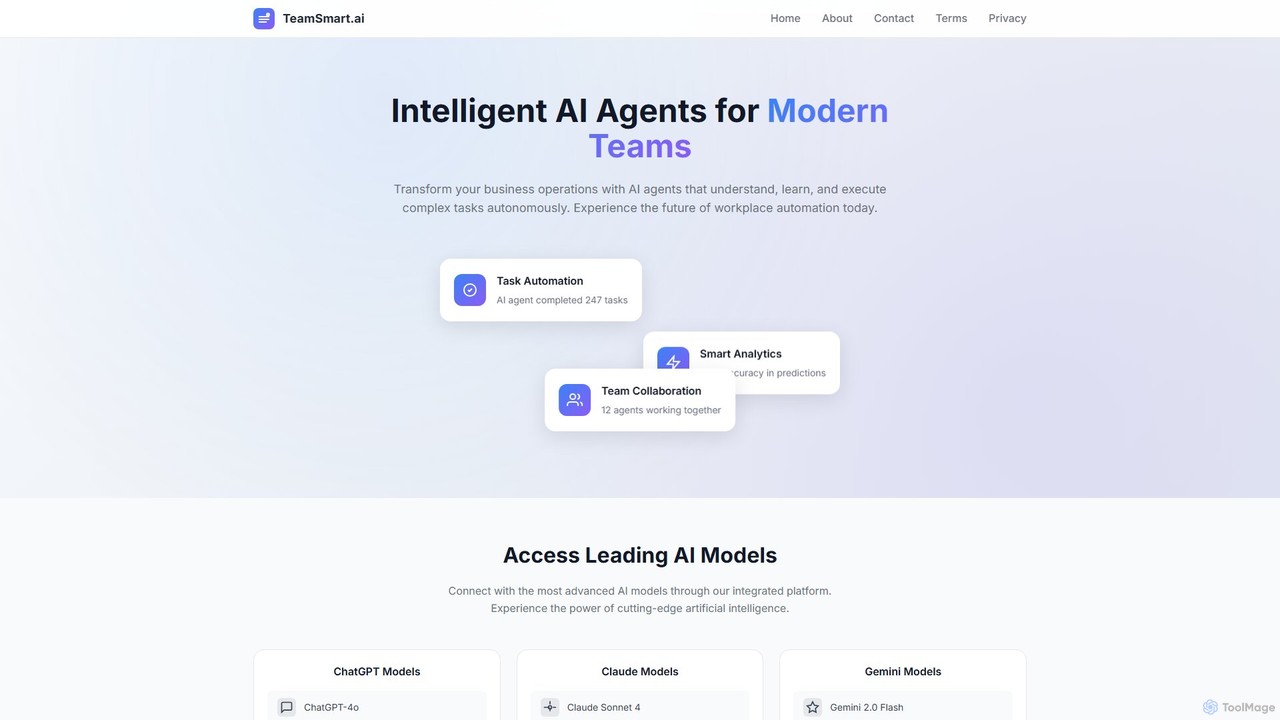
AI Agents are intelligent software systems capable of autonomously planning, executing tasks, and interacting with their environment. These tools typically leverage large language models (LLMs) or other AI models, operating through a perceive, think, act, and remember loop to achieve predefined goals. They are designed to automate complex workflows and solve multi-step problems, significantly boosting productivity for individuals and enterprises. A key advantage is their ability to handle open-ended tasks and self-correct based on feedback and learning.
Core Features
- Autonomous Task Planning: Breaks down complex objectives into executable sub-tasks and generates detailed action plans.
- Environment Interaction: Can invoke external tools, APIs, or engage in dialogue with users to gather information or perform actions.
- Memory and Learning: Possesses short-term and long-term memory, enabling learning from past experiences to optimize future decisions.
- Self-Correction and Reflection: Evaluates the outcomes of its actions, identifies errors, and adjusts strategies for better task completion.
- Multimodal Processing: Advanced AI agents can process various types of information, including text, images, and code.
Applicable Scenarios
AI Agents are invaluable in diverse professional settings. For instance, they can automate the generation of comprehensive data analysis reports by collecting data, performing analysis, and structuring insights. In customer service, they act as intelligent problem-solvers, handling complex queries beyond simple FAQs. Developers utilize them for automating software development tasks, from code generation to testing and debugging, streamlining the entire lifecycle.
How to Choose
When selecting an AI Agent, consider the complexity and autonomy required for your tasks, differentiating between simple repetitive actions and intricate multi-step problem-solving. Evaluate its integration capabilities with existing systems like CRM or project management tools, and its extensibility through custom tools or API calls. Assess the total cost, including subscription fees and computational resource consumption, alongside deployment options (cloud vs. on-premise). Finally, prioritize security and data privacy, especially for sensitive data, by checking encryption, access control, and compliance measures.