ToolMage
Sign in

Best 1 Ai Chatbot Aggregator AI tools for Productivity

Popular Ai Chatbot Aggregator AI tools in Productivity include Brainglue, helping you work more efficiently.

Brainglue
Paid

Brainglue

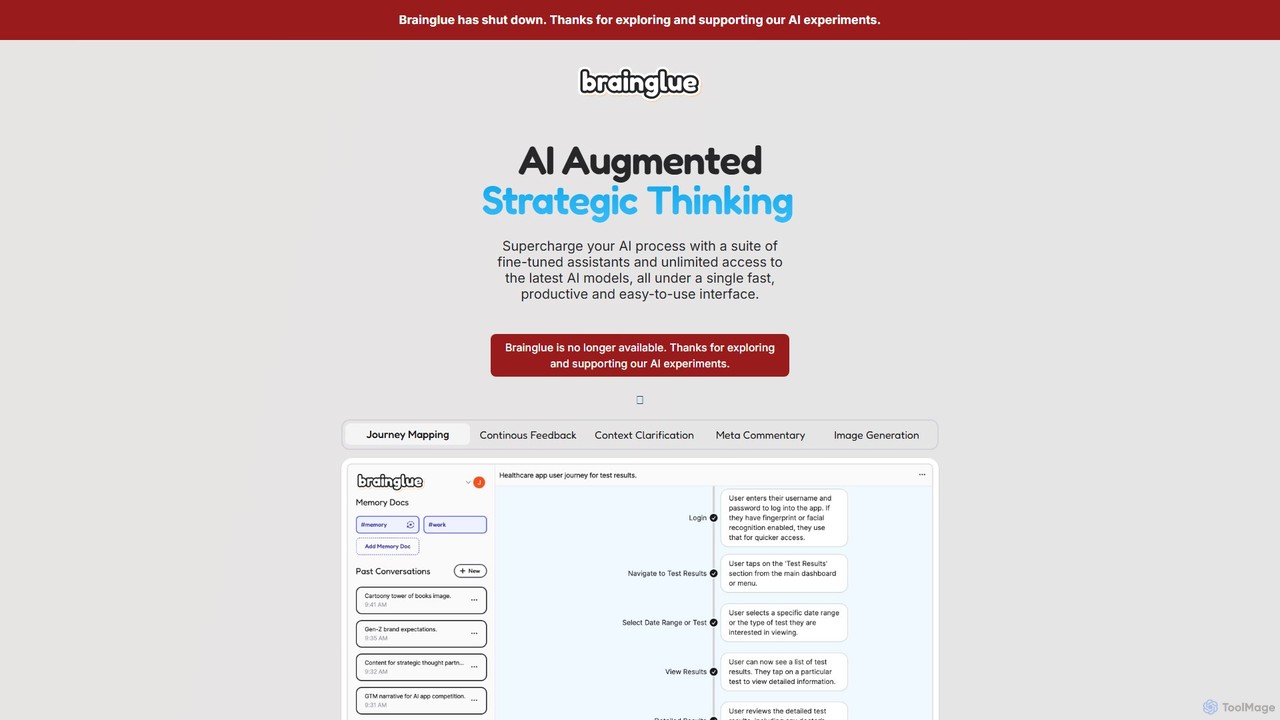
Brainglue was an advanced conversational AI client for creative professionals, providing a unified interface to access leading AI models like GPT-4o and Claude 3.5. It streamlined workflows with specialized assistants, context memory, and visual tools to enhance productivity and achieve superior results with less effort. Please note: this service has been discontinued.

Prototyping
Visits 5.4KFavorites 139Likes 136

About Ai Chatbot Aggregator

AI Chatbot Aggregators are platforms that provide a unified interface to access and interact with multiple large language models (LLMs) from different providers. Instead of switching between separate services like ChatGPT, Claude, and Gemini, these tools centralize them into a single workspace. This allows users to run the same prompt across various models simultaneously, compare their outputs side-by-side, and streamline their AI-powered workflows. As part of the Productivity category, they significantly boost efficiency for users who need to leverage the unique strengths of different AI systems.

Core Features

  • Multi-Model Integration: Access a wide range of leading LLMs (e.g., GPT series, Claude, Gemini) through a single application.
  • Simultaneous Prompting: Send one query to multiple AI models at the same time, receiving several responses in parallel.
  • Side-by-Side Comparison: Display responses from different models next to each other for easy evaluation of quality, style, and accuracy.
  • Unified Chat History: Consolidate all conversations across various models into one centralized and searchable history.
  • Prompt Management: Save, organize, and reuse effective prompts across different AI models to maintain consistency and save time.

Use Cases

These tools are ideal for developers, content creators, researchers, and marketers who frequently use AI. For instance, a writer can generate blog post drafts from three different models to select the most creative one. A developer can compare code snippets from various AIs to find the most efficient solution, enhancing both creativity and technical problem-solving.

How to Choose

When selecting an AI Chatbot Aggregator, consider the range of supported AI models and whether you can use your own API keys. Evaluate the user interface for comparison clarity, the pricing model (subscription vs. pay-per-use), and any advanced features like prompt libraries, team collaboration, or custom model settings.

Ai Chatbot Aggregator use cases

1

Comparative Content Generation for Marketing

A digital marketer needs to create compelling ad copy for a new product campaign. Using an AI Chatbot Aggregator, they input a single brief describing the product and target audience. The platform sends this prompt to GPT-4, Claude 3, and Gemini simultaneously. Within seconds, they can compare three distinct sets of headlines and descriptions side-by-side, evaluating tone, creativity, and call-to-action effectiveness. This process eliminates tab-switching and copy-pasting, allowing them to select and refine the best-performing copy in a fraction of the time.

2

Code Generation and Debugging for Developers

A software developer is stuck on a complex algorithm or needs to debug a tricky piece of code. They describe the problem in natural language within an AI Chatbot Aggregator. The tool queries multiple models, each known for different coding strengths. One model might provide a concise Python solution, another might offer a more robust Java implementation, and a third could identify a subtle logic error in their existing code. By comparing these diverse outputs, the developer can quickly synthesize the best solution or gain the insight needed to fix the bug, accelerating the development cycle.

3

Academic Research and Text Summarization

A researcher needs to quickly understand the key findings of a dense academic paper. They paste the abstract or the full text into an aggregator. The platform requests summaries from different LLMs. One model might excel at extracting quantitative data points, another might be better at interpreting the theoretical implications, and a third could provide a simplified explanation for a broader audience. By comparing these summaries, the researcher gains a multi-faceted understanding of the paper much faster than reading it in its entirety, allowing them to efficiently survey a larger body of literature.

4

Multilingual Translation and Nuance Check

A localization specialist is translating marketing material into several languages. They input the source text into an aggregator to get translation suggestions from multiple AI models. This is crucial because different models handle idiomatic expressions and cultural nuances differently. By comparing the outputs, the specialist can identify the most natural-sounding and culturally appropriate translation, or blend elements from different suggestions to create a superior final version. This approach serves as a powerful quality assurance step, reducing the risk of awkward or incorrect translations.

5

Creative Brainstorming and Idea Validation

A product manager is brainstorming new features for an app. They use an aggregator to ask different AI models, 'What are some innovative features for a fitness tracking app?' Each model, trained on different data, provides a unique perspective. One might suggest gamification elements, another might focus on mental wellness integrations, and a third could propose advanced data analytics for athletes. This diversity of ideas provides a much richer pool of concepts than relying on a single source, helping the product manager to identify truly novel and valuable feature directions.

6

AI Model Evaluation and Benchmarking

An AI enthusiast or a machine learning engineer wants to compare the capabilities of the latest LLMs. They can use an aggregator as a practical benchmarking tool. By feeding a standardized set of prompts—covering logic puzzles, creative writing, factual recall, and coding challenges—to multiple models simultaneously, they can directly observe and compare performance. This allows for a real-world assessment of each model's strengths and weaknesses on specific tasks, providing more nuanced insights than relying solely on published benchmarks or marketing claims.

Ai Chatbot Aggregator FAQ

What is an AI Chatbot Aggregator?

An AI Chatbot Aggregator is a software application that consolidates access to multiple AI chatbots and large language models (LLMs) into a single interface. Its primary function is to allow users to query different AI models simultaneously without needing to switch between individual websites or apps. Key features include side-by-side response comparison, centralized chat history, and unified prompt management. They act as a command center for leveraging the diverse capabilities of the AI landscape, enhancing productivity.

How is an aggregator different from a single chatbot like ChatGPT?

The key difference is scope. A single chatbot like ChatGPT provides access to one specific family of models (e.g., GPT-3.5, GPT-4). An AI Chatbot Aggregator, on the other hand, is a meta-tool that connects to multiple, different chatbots from various providers (like OpenAI, Anthropic, Google) in one place. The aggregator's unique value lies in its ability to facilitate direct, simultaneous comparison between these models, a feature not available in a standalone chatbot service.

Who should use an AI Chatbot Aggregator?

These tools are most beneficial for 'power users' of AI who need to get the best possible output for a task. This includes:

  • Content Creators & Marketers: To generate and compare diverse creative ideas, copy, and content drafts.
  • Developers & Engineers: To get multiple coding solutions, debug suggestions, and technical explanations.
  • Researchers & Academics: To summarize complex topics from different angles and cross-verify information.
  • AI Enthusiasts: To benchmark and experiment with the latest models from different providers.
How do I choose the right AI Chatbot Aggregator?

Consider these key factors when selecting a tool:

  • Supported Models: Ensure it includes the LLMs you use most often or want to experiment with.
  • User Interface (UI): Look for a clean, intuitive interface that makes side-by-side comparison easy and effective.
  • Pricing Model: Some tools have a monthly subscription, while others require you to bring your own API keys (BYOK) and pay the model providers directly. Choose the model that fits your usage and budget.
  • Features: Evaluate extra features like prompt libraries, team collaboration, custom instructions, and file upload capabilities.
Are AI Chatbot Aggregators free to use?

It varies. Some aggregators offer a free tier with limited usage or access to fewer models. Most professional tools operate on one of two pricing models: a flat monthly subscription that includes usage, or a model where you connect your own API keys from providers like OpenAI or Anthropic. In the latter 'Bring Your Own Key' (BYOK) model, you pay the aggregator a small platform fee (or it might be free) and pay the AI providers directly for your actual usage. This can be more cost-effective for users with variable needs.