pax
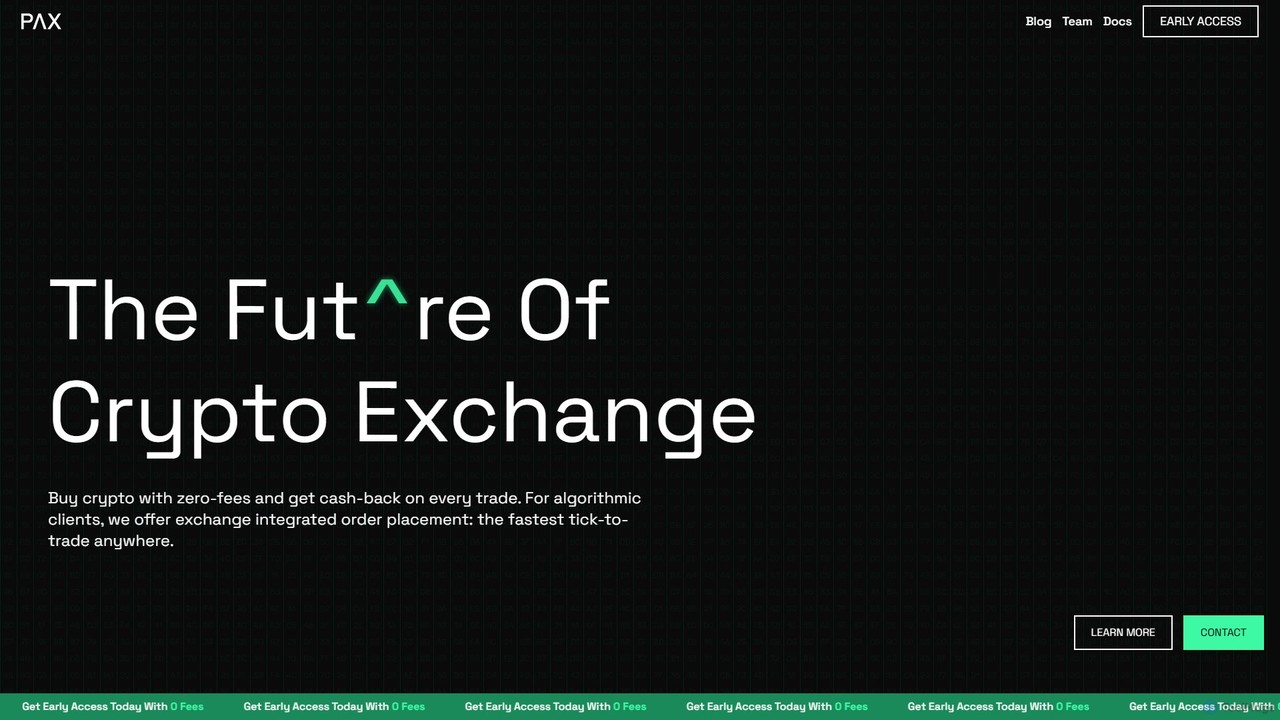
pax is an AI-powered cryptocurrency exchange designed for high-frequency and algorithmic trading. It offers a revolutionary zero-fee model …
pax is an AI-powered cryptocurrency exchange designed for high-frequency and algorithmic trading. It offers a revolutionary zero-fee model with cash-back rebates, nanosecond trade execution via its patented λ API, and integrated AI-powered price predictions to give traders a competitive edge. It aims to create the fastest and most efficient trading market.
About Algorithmic Trading
Algorithmic Trading tools are specialized software that use pre-programmed instructions and AI models to automatically execute trades in financial markets. These platforms leverage complex algorithms, machine learning, and real-time data analysis to identify trading opportunities, manage risk, and execute orders at speeds impossible for humans. They enable traders and investment firms to implement sophisticated strategies, reduce emotional decision-making, and capitalize on fleeting market movements. As a focused application within the broader Productivity category, these tools automate complex financial analysis and execution to enhance trading efficiency and performance.
Core Features
- Strategy Backtesting: Simulate trading strategies on historical market data to evaluate performance and robustness before deployment.
- Automated Order Execution: Automatically place, modify, and cancel orders with brokers based on predefined rules and signals.
- Real-time Data Analysis: Continuously process live market data feeds (prices, volume) to detect trading signals in real-time.
- AI-Powered Signal Generation: Utilize machine learning models to analyze patterns and predict market trends, generating buy or sell signals.
- Risk Management Modules: Implement automated stop-loss, take-profit, and position sizing rules to control potential losses.
Use Cases
These tools are primarily used by quantitative analysts, hedge funds, proprietary trading firms, and sophisticated individual traders. They are applicable across various financial markets, including stocks, forex, cryptocurrencies, and commodities. Common applications include developing high-frequency trading (HFT) systems, executing arbitrage strategies between different markets, and automating trend-following models.
How to Choose
When selecting an Algorithmic Trading tool, consider the following: First, check for compatibility with your required markets and brokers. Second, evaluate the strategy development environment—whether it's a no-code visual builder or supports programming languages like Python. Third, assess the quality and accuracy of the backtesting engine and the historical data provided. Finally, consider the platform's execution speed (latency) and pricing structure.

Algorithmic TradingUse Cases
Automating a Forex Mean-Reversion Strategy
A retail forex trader wants to capitalize on short-term price fluctuations in currency pairs like EUR/USD without constant screen monitoring. Using an algorithmic trading platform, they build a strategy that automatically sells when the price moves significantly above its moving average and buys when it drops below. The trader sets strict risk parameters, such as a maximum loss per trade. The resulting bot executes dozens of small trades throughout the day, systematically capturing profits from volatility while freeing the trader to focus on market research and strategy improvement.
Backtesting a Crypto Trend-Following Model
A quantitative analyst has developed a new trading model for the volatile cryptocurrency market based on momentum indicators. Before risking capital, they use a tool's backtesting engine to simulate the model's performance. They import five years of historical Bitcoin and Ethereum data and run thousands of simulations with varying parameters, such as different moving average lengths. The backtest results provide crucial metrics like total return, maximum drawdown, and a Sharpe ratio, allowing the analyst to identify the optimal parameters and understand the historical risk-reward profile before deploying the strategy with real money.
Executing Statistical Arbitrage in Equity Markets
A hedge fund manager aims to profit from temporary price discrepancies between two historically correlated stocks, such as two major companies in the same industry. They deploy an algorithm that continuously monitors the price ratio between the pair. When the ratio deviates beyond a statistical threshold, the bot automatically executes a pair trade: shorting the overperforming stock and buying the underperforming one. This strategy is market-neutral and relies on high-speed execution to capture small, frequent profits, a task that is impractical to perform manually at scale.
Developing Custom Trading Indicators with AI
A financial developer believes standard technical indicators are no longer sufficient. They use a platform with an integrated AI module to create a proprietary signal. The developer feeds the AI model with diverse data sets, including market price data, sentiment analysis from news feeds, and on-chain data for cryptocurrencies. The AI learns complex, non-linear relationships within the data to generate a custom predictive indicator. This indicator is then integrated into an automated strategy, providing a unique trading edge that is not available to other market participants using off-the-shelf tools.
Managing Portfolio Risk with Automated Rules
An investment portfolio manager needs to enforce strict risk management rules across a diverse portfolio of assets to prevent large drawdowns. They configure an algorithmic trading tool to act as a risk overlay. The system is programmed to automatically implement a portfolio-wide stop-loss; for example, if the total portfolio value drops by more than 2% in a single day, the system automatically liquidates a portion of the highest-risk positions to reduce exposure. This systematic approach controls risk and protects capital during market downturns, removing emotional hesitation from critical decisions.
High-Frequency Market Making on a Crypto Exchange
A proprietary trading firm aims to profit from the bid-ask spread by providing liquidity on a cryptocurrency exchange. They deploy a high-frequency trading (HFT) bot, often co-located in the same data center as the exchange's servers for minimal latency. The bot simultaneously places buy (bid) and sell (ask) orders around the current market price. By continuously adjusting these orders based on market flow, it captures the small spread on thousands of trades per second. This strategy is entirely dependent on the speed and reliability of algorithmic execution, making it a prime use case for advanced trading tools.