Notamify
Notamify is an AI-powered NOTAM decoder and briefing tool designed for aviation professionals. It transforms complex, raw NOTAM …
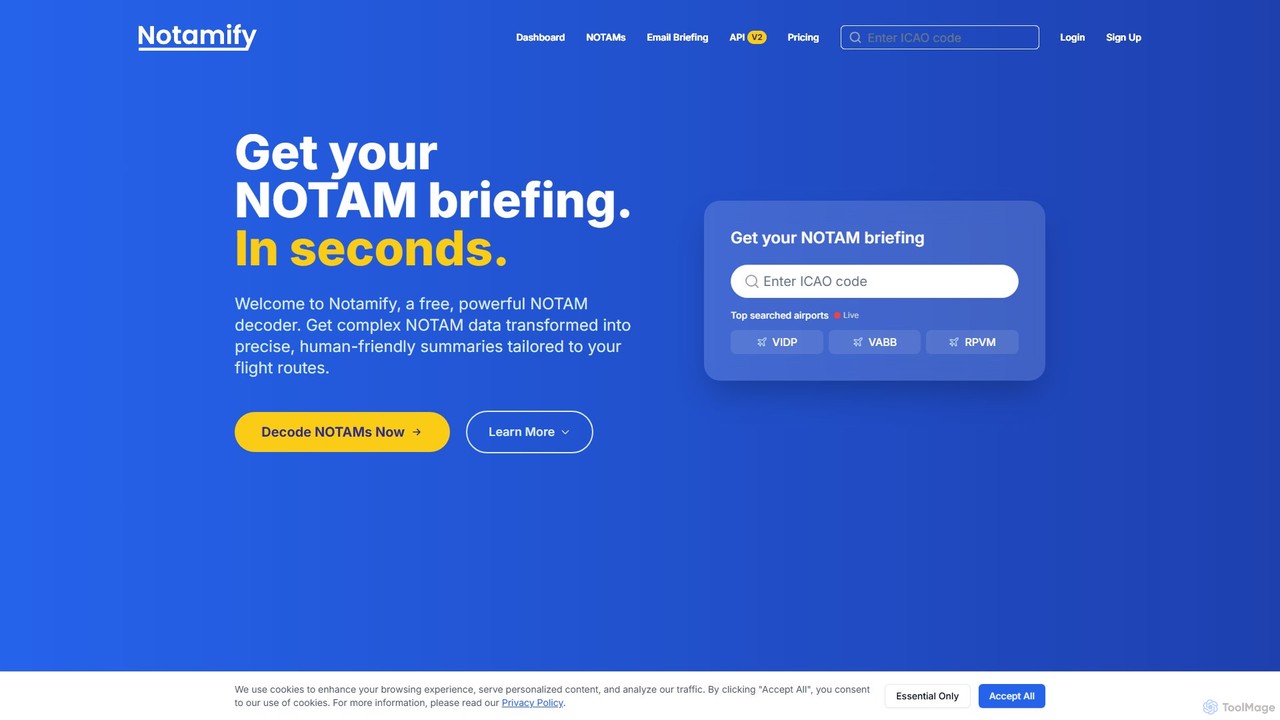
Notamify is an AI-powered NOTAM decoder and briefing tool designed for aviation professionals. It transforms complex, raw NOTAM data into clear, human-friendly summaries and structured, actionable intelligence. By filtering out noise and highlighting critical information, Notamify helps pilots, dispatchers, and airport operators save significant time on pre-flight preparations and enhance situational awareness.
About Aviation
Aviation AI tools are specialized artificial intelligence applications designed to enhance efficiency, safety, and decision-making across various sectors of the aerospace industry. These tools leverage machine learning, computer vision, natural language processing, and advanced data analytics to transform complex aviation operations. They are instrumental in optimizing flight planning, automating maintenance inspections, improving air traffic management, and assisting in aircraft design, ultimately contributing to a more productive and secure aviation ecosystem.
Core Features
- Flight Path Optimization: AI algorithms analyze real-time weather, air traffic, and aircraft performance data to suggest the most efficient and safe flight routes.
- Predictive Maintenance: Machine learning models monitor sensor data from aircraft components to forecast potential failures, enabling proactive repairs and reducing downtime.
- Air Traffic Management Assistance: AI systems help air traffic controllers predict congestion, optimize runway usage, and sequence aircraft for smoother operations.
- Pilot Decision Support: AI provides pilots with real-time operational data, alerts, and intelligent recommendations to enhance situational awareness and decision-making during flights.
- Aircraft Design & Simulation: AI accelerates the design process by generating optimized component designs and simulating performance under various conditions.
Applicable Scenarios
Aviation AI tools are vital for airlines seeking to streamline operations and reduce fuel consumption, for Maintenance, Repair, and Overhaul (MRO) organizations aiming to improve asset reliability, and for air traffic control centers focused on enhancing safety and efficiency. Aircraft manufacturers also utilize these tools for accelerated research and development, while airports benefit from optimized ground operations and passenger flow management.
How to Choose
When selecting Aviation AI tools, consider the specific needs of your aviation sector (e.g., commercial airline, cargo, MRO, ATC). Evaluate the tool's data integration capabilities with existing legacy systems, its compliance with stringent aviation regulations (e.g., FAA, EASA), and its scalability to handle growing operational demands. Vendor expertise in aerospace and the accuracy of predictive models are also crucial factors for effective implementation.

AviationUse Cases
Optimizing Flight Routes for Fuel Efficiency
Airlines utilize Aviation AI tools to analyze vast datasets including real-time weather conditions, air traffic patterns, and specific aircraft performance metrics. The AI recommends optimal flight paths that minimize fuel consumption and flight duration, directly reducing operational costs and carbon emissions. This allows flight planners to make data-driven decisions, enhancing both economic and environmental performance.
Predictive Maintenance of Aircraft Engines
Maintenance, Repair, and Overhaul (MRO) teams deploy AI models that continuously monitor sensor data from aircraft engines and other critical components. By identifying subtle anomalies and predicting potential failures before they occur, these tools enable proactive scheduling of maintenance. This approach prevents unexpected breakdowns, reduces unscheduled downtime, and significantly enhances aircraft safety and operational reliability.
Enhanced Air Traffic Flow Management
Air traffic control centers leverage AI systems to process complex real-time data on aircraft movements, weather, and airspace capacity. The AI predicts future congestion points and optimizes the sequencing of aircraft for take-offs and landings. This leads to more efficient utilization of runways and airspace, reducing delays, improving overall air traffic flow, and increasing safety margins.
Automated Visual Inspection of Aircraft Surfaces
Maintenance technicians use AI-powered computer vision systems, often integrated with drones, to conduct rapid and highly accurate visual inspections of aircraft fuselages and wings. These systems automatically detect and classify surface defects like dents, cracks, or corrosion. This significantly speeds up the inspection process compared to manual checks, reduces human error, and ensures comprehensive coverage, leading to faster turnaround times.
AI-Assisted Aircraft Design and Simulation
Aerospace engineers integrate AI into their design workflows to accelerate the development of new aircraft and components. AI algorithms can generate optimized structural designs, predict aerodynamic performance, and simulate stress under various flight conditions. This allows for rapid iteration, reduces the need for costly physical prototypes, and helps engineers identify the most efficient and robust designs early in the development cycle.
Personalized Passenger Experience and Operations
Airlines employ AI to analyze passenger preferences, travel history, and real-time operational data. This enables them to offer personalized services, such as tailored in-flight entertainment recommendations or proactive rebooking options during irregular operations (e.g., flight delays or cancellations). AI also optimizes crew scheduling and resource allocation, improving overall operational resilience and enhancing customer satisfaction.