mybrandgen
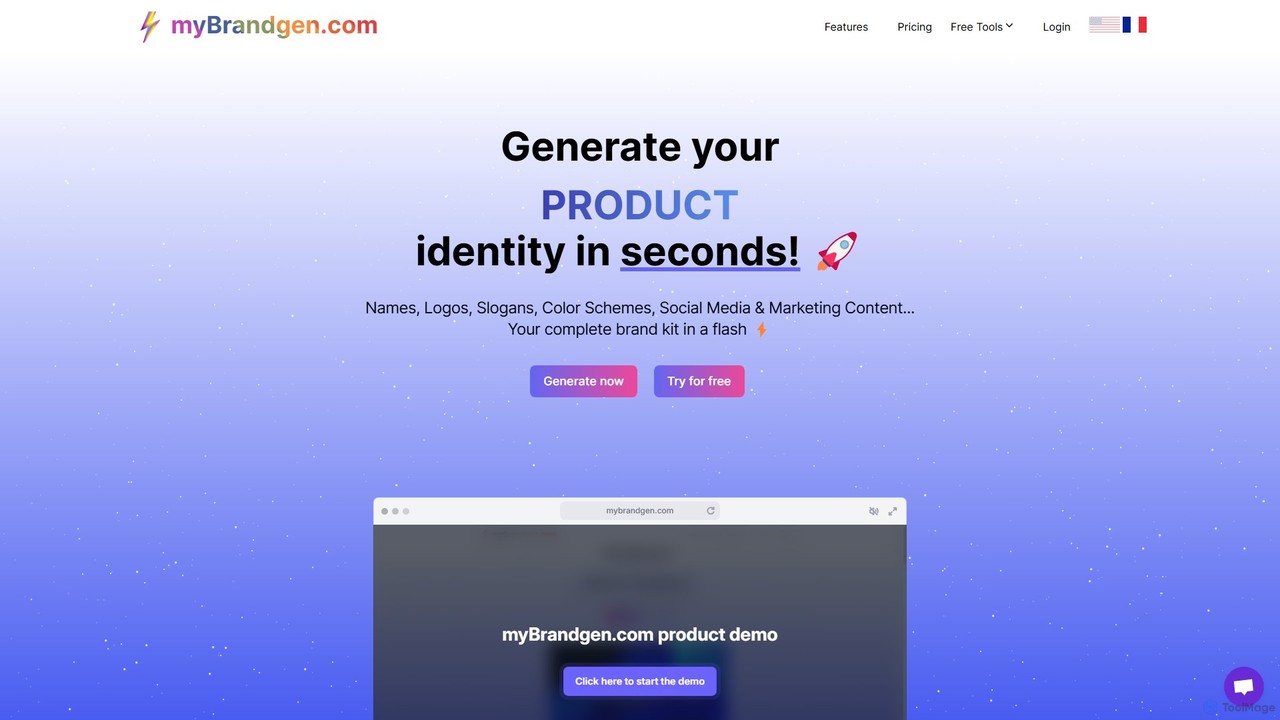
mybrandgen is an AI-powered platform that generates a complete brand identity in seconds. It provides everything from business …
mybrandgen is an AI-powered platform that generates a complete brand identity in seconds. It provides everything from business names, logos, and slogans to color schemes, marketing content, and social media posts. Designed for startups, marketers, and agencies, it streamlines the branding process, saving significant time and money. The tool also offers features for business idea validation and growth strategy, making it an all-in-one solution for launching and scaling a brand from a simple concept.
About Business Idea Generation
Business Idea Generation tools are AI-powered platforms designed to systematically create novel and viable startup concepts. They analyze vast datasets, including market trends, consumer behavior, and keyword analysis, to identify untapped opportunities. These tools help entrepreneurs, product managers, and innovators overcome creative blocks by providing data-driven suggestions instead of relying solely on intuition. By mapping user interests or existing problems to potential solutions, they significantly accelerate the initial phase of venture creation.
Core Features
- Trend Analysis: Scans market data, social media, and search patterns to identify emerging business opportunities.
- Niche Identification: Pinpoints underserved market segments with high potential and low competition.
- Problem-Solution Mapping: Connects common user pain points with potential tech or service-based solutions.
- Monetization Model Suggestion: Proposes various revenue streams like subscription, SaaS, or e-commerce for a given idea.
- Personalized Ideation: Generates concepts based on user-defined inputs such as skills, passions, and industry focus.
Use Cases
These tools are ideal for aspiring founders seeking their first startup concept, established companies exploring new product lines, and marketing teams brainstorming innovative campaign angles. They are also valuable for content creators looking for profitable niches and students participating in hackathons or business competitions who need to ideate quickly.
How to Choose
When selecting a tool, evaluate the quality and recency of its data sources. Consider the level of customization available for generating ideas, such as filtering by industry, budget, or business model. Assess the depth of the analysis provided—does it include competitive landscape or preliminary market sizing? Finally, consider the user interface and its features for saving, organizing, and developing the generated ideas.

Business Idea GenerationUse Cases
Discovering a Niche for a First Startup
An aspiring entrepreneur with a background in marketing wants to start an e-commerce business but struggles to find a unique niche. They use a business idea generation tool, inputting their interests like 'sustainable living' and 'pet care' and constraints like 'low initial investment'. The AI cross-references these inputs with real-time search trend data and competitor analysis. The tool generates a curated list of viable ideas, such as a 'subscription box for eco-friendly pet toys' or a 'dropshipping store for zero-waste kitchen products', complete with estimated audience size and potential profitability scores, providing a clear, data-backed starting point.
Corporate Innovation for New Product Lines
A product manager at an established B2B software company is tasked with identifying new revenue streams. Instead of relying on internal brainstorming sessions alone, they use an AI idea generator to analyze industry reports, customer support tickets, and patent filings within their sector. The AI identifies a recurring theme of 'inefficient compliance reporting' for small businesses. It then proposes a concept for a lightweight, automated compliance SaaS tool. The output includes a list of core features, potential integration partners from their existing ecosystem, and a target user persona, significantly accelerating the product discovery phase.
Generating Side Hustle Ideas with Low Capital
A full-time professional wants to start a side hustle but has limited time and capital. They use an AI idea generator and set specific filters: 'requires less than 10 hours/week,' 'digital product or service,' and 'startup cost under $500.' The tool filters out complex, capital-intensive businesses and suggests targeted ideas. Examples include 'creating and selling niche-specific Notion templates,' 'offering AI-powered proofreading services for academic papers,' or 'starting a curated weekly newsletter for a specific industry.' Each idea is presented with a basic action plan and potential platforms for monetization, making it easier to start small.
Validating a Startup Concept Before Pitching
A founder has a promising idea for a new mobile app but needs to validate its market potential before seeking funding. They input their core concept into an AI business idea tool. The tool doesn't just generate new ideas; it analyzes the existing one. It provides a preliminary market analysis, identifies the top three direct and indirect competitors, estimates the Total Addressable Market (TAM), and suggests key features that are currently missing in the market. This data-driven report allows the founder to refine their business plan and pitch deck, replacing assumptions with market evidence and increasing their credibility with potential investors.
Brainstorming for Hackathons and Innovation Challenges
A team of developers and designers joins a 48-hour hackathon with the theme 'Future of Education'. To quickly move past the brainstorming phase, they use an AI idea generator. They input the theme along with keywords like 'personalized learning,' 'AI tutor,' and 'virtual reality.' The tool rapidly generates dozens of project concepts, ranging from an 'AI-powered platform that creates custom study guides from lecture notes' to a 'VR lab for conducting safe chemistry experiments.' The team can quickly evaluate the feasibility and impact of each idea, select a promising concept, and dedicate more of their limited time to development and prototyping.
Finding New Angles for Content Creation
A content creator running a blog about personal finance wants to find fresh topics that stand out. They use an AI idea generator, inputting their core topic 'personal finance' and asking for underserved niches. The AI analyzes search queries and social media discussions, identifying gaps in content. It suggests hyper-specific topics like 'Financial planning for gig economy workers,' 'Ethical investing for millennials,' or 'A guide to navigating cryptocurrency taxes.' This allows the creator to move beyond generic advice and produce highly targeted content that attracts a dedicated audience and ranks better in search results.