
ToolMage
Sign in

Best 1 Directories AI tools for Productivity

Popular Directories AI tools in Productivity include Easy Save AI, helping you work more efficiently.

Easy Save AI
Freemium

Easy Save AI

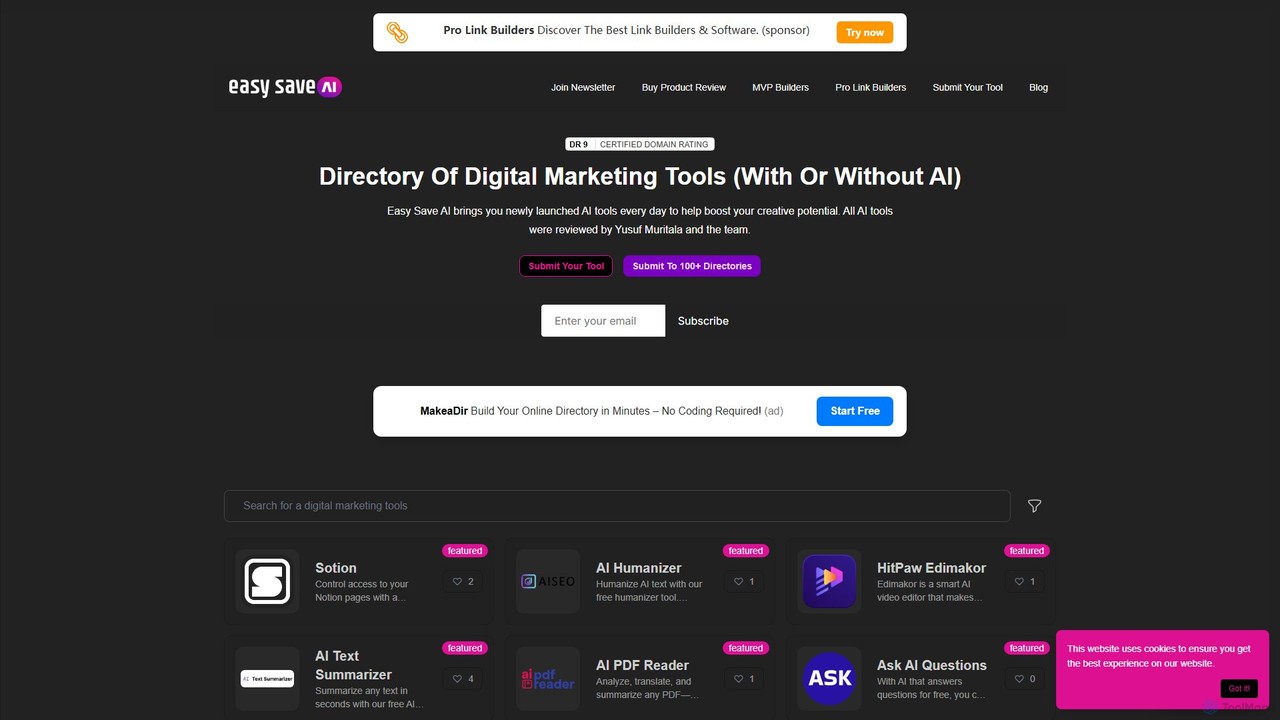
Easy Save AI is a comprehensive, expert-curated directory of AI and digital marketing tools. It helps users discover, compare, and utilize the latest software to boost creativity and productivity. The platform also offers tool submission and paid review services for founders to increase visibility and SEO.

Content Creation
Visits 8.1KFavorites 122Likes 129

About Directories

AI Directories are specialized platforms designed to discover, compare, and evaluate AI tools, serving as a key productivity resource. These platforms use structured databases and often AI-powered filtering to organize vast numbers of tools into logical categories. They significantly reduce research time, enabling users to quickly find the most suitable tool for their specific needs. By providing curated lists, user reviews, and detailed feature comparisons, AI Directories streamline the decision-making process for individuals and teams.

Core Features

  • Advanced Search & Filtering: Allows users to search for tools based on specific criteria like features, pricing, integrations, and target audience.
  • Curated Categorization: Tools are organized into intuitive and specific categories, making discovery more efficient than a general web search.
  • Side-by-Side Comparison: Provides structured comparisons of multiple tools, highlighting differences in features, capabilities, and cost.
  • User Reviews and Ratings: Aggregates community feedback to offer real-world insights into a tool's performance and reliability.
  • Trend Tracking: Highlights new, popular, or recently updated tools, helping users stay current with the latest AI innovations.

Use Cases

AI Directories are invaluable for technology consultants, startup founders, and marketing managers conducting market analysis or competitive research. Developers and product managers use them to find specific APIs or services to integrate into their products. Content creators and researchers also rely on these directories to discover new tools that can enhance their workflows and uncover emerging trends in the AI industry.

How to Choose

When selecting an AI Directory, consider the breadth and depth of its listings; a good directory covers both popular and niche tools. Evaluate the frequency of updates to ensure the information is current. The quality of search filters and comparison features is crucial for efficiency. Finally, assess the community engagement level, as active user reviews provide valuable, unbiased information for making an informed decision.

Directories use cases

1

Market Research for a New SaaS Product

A startup founder planning to launch a new AI-powered project management tool uses an AI directory for competitive analysis. Instead of spending days on Google, they use the directory's filters to isolate all tools in the 'AI Project Management' category. They then use the comparison feature to create a detailed spreadsheet of competitors' features, pricing tiers, and user ratings. This structured data allows them to identify market gaps and define a unique value proposition for their product in a fraction of the time.

2

Selecting a Tool for a Marketing Campaign

A marketing team needs an AI tool to generate ad copy for an upcoming campaign. The marketing manager visits an AI directory and filters for 'Ad Copy Generation' tools that integrate with Google Ads. They shortlist three promising options based on high user ratings and positive reviews mentioning campaign ROI. Using the side-by-side comparison, they evaluate the specific features, such as multi-language support and A/B testing capabilities. This focused approach helps them select and subscribe to the most suitable tool within an hour, accelerating their campaign launch.

3

Discovering Niche APIs for a Development Project

A software developer is building an application that requires a specialized text-to-speech API with support for uncommon languages. A general web search yields overwhelming and irrelevant results. By using an AI directory focused on developer tools, they can filter by 'API', 'Text-to-Speech', and the specific languages needed. The directory provides direct links to documentation and lists pricing models (e.g., pay-as-you-go vs. subscription), allowing the developer to quickly assess technical feasibility and cost-effectiveness, saving significant research and evaluation time.

4

Finding Inspiration for Content Creation

A tech blogger and YouTuber constantly needs new AI tools to review. They regularly browse the 'New' and 'Trending' sections of several AI directories to stay ahead of the curve. This practice helps them discover innovative or niche tools before they become mainstream. By identifying a novel AI-powered video editing tool through a directory, they can create timely review content that attracts high viewer interest and engagement, establishing their channel as a go-to source for the latest in AI technology.

5

Academic Research on AI Industry Growth

A university researcher studying the evolution of the AI market uses AI directories as a primary data source. By tracking the number of new tools added to specific categories (e.g., 'Generative Video', 'AI Agents') over time, they can quantify growth trends. Some directories offer historical data or trend reports, which provide valuable insights into market saturation, emerging technologies, and investment patterns. This structured approach is far more efficient and reliable than manually scraping news sites or company announcements for data.

6

Corporate Procurement and Tool Standardization

An IT procurement manager at a large corporation is tasked with standardizing AI tools across departments to reduce costs and improve security. They use a comprehensive AI directory to identify top-rated tools in key areas like 'AI Data Analysis' and 'AI Chatbots'. They filter for enterprise-ready solutions with features like SSO and compliance certifications. The directory's user reviews from other large companies help them gauge real-world performance and support quality. This process enables them to create a shortlist of approved vendors, streamlining internal adoption and negotiation.

Directories FAQ

What are AI Directories?

AI Directories are curated online platforms that list, categorize, and review artificial intelligence tools and services. Unlike general search engines, they provide a structured and focused environment for discovering AI solutions. Key features often include advanced filtering by function or price, side-by-side comparisons, and user-generated ratings. They serve as a vital productivity resource by significantly cutting down the time required to research and select the right AI tool for a specific task.

How do AI Directories differ from a standard search engine like Google?

The primary difference lies in curation and structure. A search engine indexes the entire web, providing vast but often unstructured and overwhelming results. An AI Directory offers a curated, pre-vetted collection of tools within a specific domain. Key differences include:

  • Structured Data: Directories use a consistent format for features, pricing, and integrations, enabling easy comparison.
  • Focused Discovery: They are designed specifically for tool discovery, with relevant categories and filters, unlike the broad nature of web search.
  • Quality Control: Tools in a directory are typically reviewed or verified, ensuring a baseline level of relevance and quality.
How should I choose the right AI Directory for my needs?

Choosing the right AI Directory depends on your specific goals. Consider the following factors:

  • Scope and Coverage: Does the directory focus on a specific niche (e.g., marketing AI) or is it comprehensive? Ensure it covers the types of tools you're interested in.
  • Data Freshness: How often is the directory updated? The AI space evolves rapidly, so up-to-date information is crucial.
  • Feature Quality: Evaluate the effectiveness of its search filters, comparison tools, and the depth of information provided for each tool.
  • Community and Reviews: A directory with an active user base provides valuable, real-world feedback that can be more insightful than official marketing copy.
What are the main benefits of using an AI Directory?

Using an AI Directory offers several key benefits that enhance productivity. The most significant is time savings; instead of sifting through countless irrelevant search results, you can quickly find a shortlist of relevant tools. They also facilitate better decision-making by providing structured comparisons and real user reviews. Furthermore, directories act as a discovery engine, helping you stay updated on the latest trends and innovative tools you might not have found otherwise, fostering continuous improvement in your workflows.

Are the tools listed in AI Directories free to use?

It varies. AI Directories list a wide range of tools with different pricing models. You can typically find:

  • Free Tools: Tools that are completely free, often with some limitations.
  • Freemium Models: Tools that offer a basic free plan with the option to upgrade to paid plans for more features.
  • Free Trials: Paid tools that offer a limited-time free trial to test their capabilities.
  • Paid/Subscription: Tools that require a subscription or one-time payment.

Most good directories allow you to filter or sort by pricing model, making it easy to find tools that fit your budget.