LilyBoard
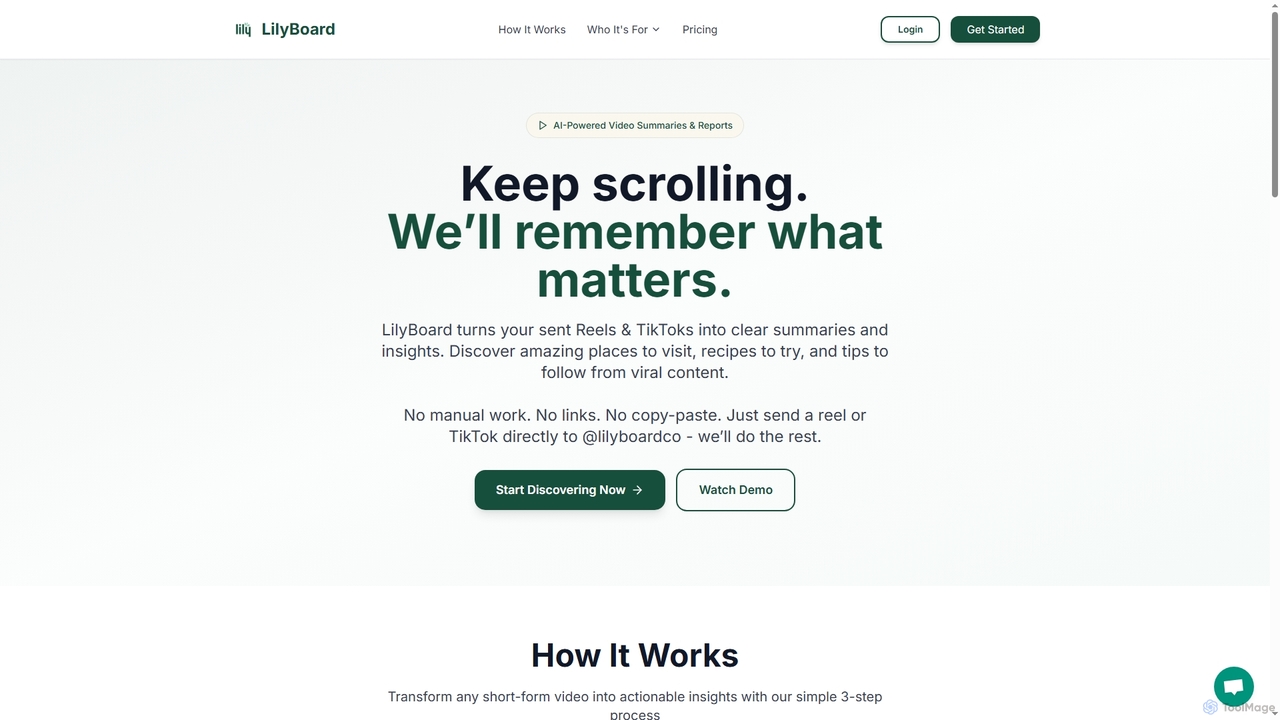
LilyBoard is an AI-powered tool that transforms your TikToks and Instagram Reels into concise summaries and actionable insights. …
LilyBoard is an AI-powered tool that transforms your TikToks and Instagram Reels into concise summaries and actionable insights. It helps users, from travel enthusiasts to curious learners, quickly extract key information like recipes, travel tips, and how-to guides from viral short-form video content without manual effort.
About Information Extraction
Information Extraction tools are AI-powered solutions designed to automatically identify and extract specific data points from unstructured or semi-structured text. These tools leverage natural language processing (NLP), machine learning, and deep learning models to understand context and patterns within vast amounts of textual data. They transform raw information from documents, web pages, and communications into structured, actionable data, significantly enhancing data analysis and decision-making within the broader productivity landscape.
Core Features
- Named Entity Recognition (NER): Automatically identifies and classifies entities such as names, organizations, locations, dates, and product names within text.
- Relationship Extraction: Discovers and extracts semantic relationships between identified entities, like "CEO of Company X" or "Product Y manufactured by Company Z."
- Event Extraction: Identifies and classifies specific events described in text, along with their participants, time, and location.
- Keyphrase Extraction: Automatically identifies the most important and relevant phrases or keywords from a document, summarizing its core topics.
- Table Data Extraction: Extracts structured data from tables embedded within documents, even from complex layouts.
Applicable Scenarios
Information Extraction tools are indispensable across various industries for automating data processing. Legal professionals use them to analyze contracts and case files, quickly identifying key clauses, parties, and obligations. Financial analysts leverage these tools to extract critical figures like revenue, profit, and market trends from earnings reports and news articles. Customer service departments apply them to analyze vast volumes of customer feedback, identifying common issues, sentiment, and emerging trends from support tickets and reviews.
How to Choose
When selecting an Information Extraction tool, consider its accuracy and precision for your specific data types and languages, as performance can vary significantly. Evaluate its ability to handle diverse document formats, including PDFs, scanned images, and web pages, and assess the ease of customization for your unique extraction rules or domain-specific terminology. Finally, check for robust API integration capabilities to ensure seamless workflow automation with your existing business systems.

Information ExtractionUse Cases
Automated Contract Analysis for Legal Teams
Legal professionals use AI information extraction to rapidly scan thousands of legal documents, such as contracts, agreements, and case files. The tools automatically identify and extract critical clauses, expiration dates, party names, obligations, and liabilities, significantly reducing manual review time and ensuring compliance.
Financial Data Extraction from Market Reports
Financial analysts and researchers employ these tools to extract specific numerical data (e.g., revenue, profit margins, stock prices) and qualitative insights (e.g., market sentiment, competitor strategies) from quarterly earnings reports, news articles, and analyst briefings. This automates data aggregation for financial modeling and investment decisions.
Customer Feedback and Sentiment Analysis
Marketing and customer service teams utilize information extraction to process large volumes of customer reviews, social media comments, and support tickets. The AI identifies common complaints, product features mentioned, and overall sentiment (positive, negative, neutral), providing actionable insights for product improvement and service enhancement.
Resume Parsing for HR and Recruitment
Human Resources departments use information extraction to automatically parse resumes and CVs. The tools extract key candidate information such as skills, work experience, education, contact details, and certifications, streamlining the candidate screening process and populating applicant tracking systems efficiently.
Medical Record Data Entry and Analysis
Healthcare providers and researchers apply these tools to extract structured data from unstructured medical notes, patient histories, and clinical trial documents. This includes identifying diagnoses, medications, treatment plans, and patient demographics, facilitating faster data entry, research, and compliance reporting.
Competitive Intelligence from Web Content
Businesses use information extraction to monitor competitor websites, news sources, and industry blogs. The tools automatically pull data on new product launches, pricing changes, marketing campaigns, and strategic partnerships, providing timely competitive intelligence for strategic planning and market positioning.