Productivity Best in category 1 results Innovation AI Tool

Popular AI tools in the Innovation field of Productivity include Prism, etc., helping you quickly improve efficiency.

Prism

Prism

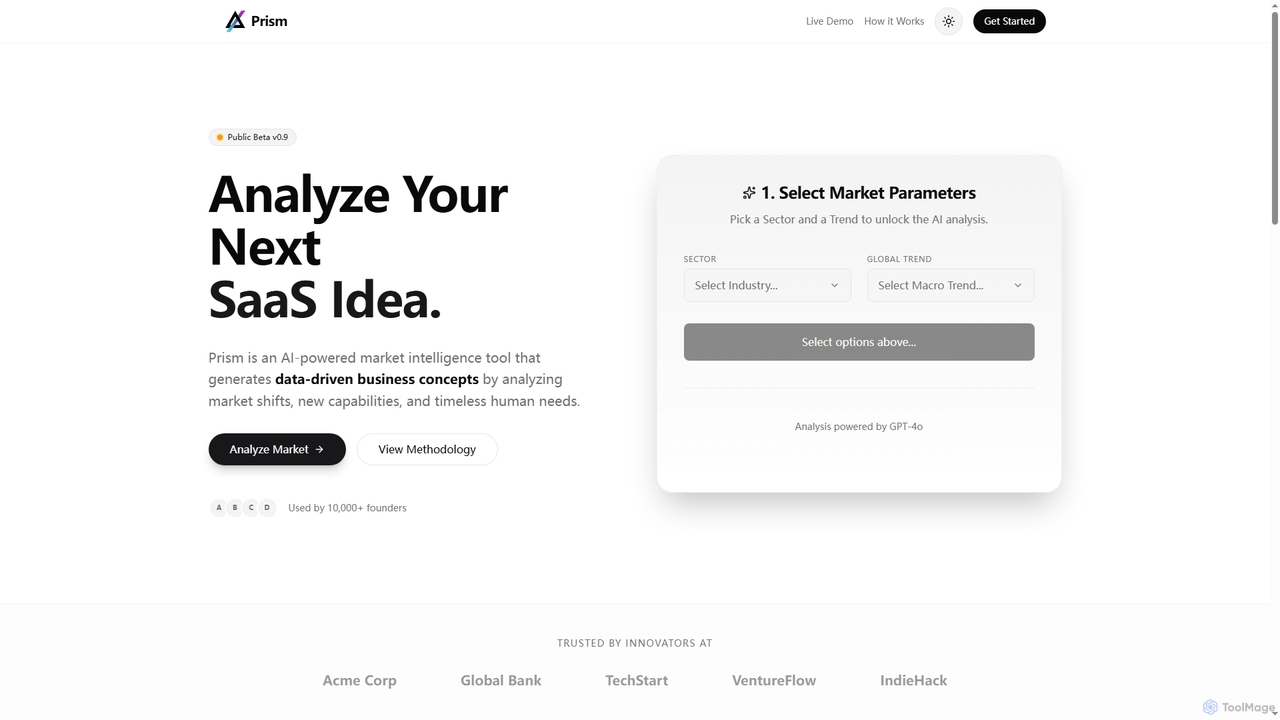
Prism is an AI-powered market intelligence tool that generates data-driven business ideas and performs market analysis. It leverages …

3.0K

About Innovation

AI Innovation tools are a specialized category of software designed to structure, accelerate, and manage the entire innovation lifecycle. These tools leverage artificial intelligence, such as large language models and predictive analytics, to help users generate novel ideas, analyze market trends, and validate new concepts. Their primary value lies in transforming the often chaotic process of innovation into a more systematic and data-driven workflow, significantly reducing the time from initial concept to market-ready solution. They act as a strategic partner for creative and developmental processes within the broader productivity landscape.

Core Features

  • AI-Powered Ideation: Utilizes generative AI to produce a wide range of creative ideas, business models, and solutions based on initial prompts or data inputs.
  • Trend Analysis & Forecasting: Scans and analyzes vast datasets from market reports, social media, and academic papers to identify emerging trends and future opportunities.
  • Concept Validation: Simulates potential market reception, identifies risks, and provides data-backed feedback on the viability of new ideas before significant resources are invested.
  • Innovation Workflow Management: Offers structured platforms to capture, evaluate, prioritize, and track ideas from conception through to implementation.

Use Cases

These tools are primarily used by product managers, R&D departments, startup founders, and corporate strategists. They are applied in new product development, business model innovation, competitive analysis, and identifying technological white spaces. For example, a marketing team might use an AI innovation tool to brainstorm campaign angles, while an R&D team could use it to discover untapped patent areas.

How to Choose

When selecting an AI Innovation tool, consider its specific focus—whether it excels at front-end ideation or back-end workflow management. Evaluate its data integration capabilities, the quality of its AI-driven insights, and its collaborative features for team-based work. Also, assess the tool's analytical depth and whether its pricing model aligns with your team's scale and project frequency.

InnovationUse Cases

1

New Product Ideation for a Beverage Company

A product manager at a beverage company is tasked with developing a new line of health-conscious drinks. They use an AI Innovation tool to analyze thousands of online customer reviews, social media posts, and nutritional databases. The AI identifies a recurring theme of consumers seeking low-sugar, high-antioxidant drinks with exotic fruit flavors. Based on this insight, the tool generates several product concepts, including 'Sparkling Dragon Fruit & Ginger' and 'Cold-Brew Hibiscus Tea'. This data-driven approach allows the team to bypass weeks of manual research and focus on developing concepts with a higher probability of market success.

2

Validating a Tech Startup's Business Model

A startup founder has an idea for a new SaaS platform but is unsure about the best go-to-market strategy. They input their core business concept into an AI Innovation tool. The tool performs a competitive analysis, identifying key players and their pricing strategies. It also simulates different market scenarios, highlighting potential risks such as high customer acquisition costs in a saturated market. Furthermore, the AI suggests alternative revenue models, like a usage-based pricing tier, which the founder hadn't considered. This process provides a comprehensive risk and opportunity analysis, enabling the founder to refine their business plan with greater confidence before seeking investment.

3

Identifying Technological White Space for R&D

An R&D team at a large tech corporation needs to identify promising new areas for investment. Instead of manually sifting through thousands of academic papers and patent filings, they use an AI Innovation tool. The tool is configured to scan and categorize documents related to their industry. The AI's natural language processing capabilities allow it to understand complex technical concepts and identify connections between seemingly unrelated fields. It generates a visual map highlighting 'white spaces'—areas with low patent density but high scientific interest—suggesting a potential breakthrough in 'quantum-resistant encryption algorithms'. This directs the R&D team's focus towards a high-potential, less crowded field of research.

4

Brainstorming Marketing Campaign Angles

A marketing team is launching a new eco-friendly cleaning product. To ensure their campaign resonates with the target audience, they use an AI Innovation tool for brainstorming. They input product details, target demographics (e.g., millennials, environmentally conscious consumers), and campaign goals. The AI generates a hundred different campaign slogans, social media post ideas, and content marketing angles. It suggests concepts like a '30-Day Clean Home, Clean Planet Challenge' and a partnership with environmental influencers. This process provides a vast pool of creative options, allowing the team to select and combine the most compelling ideas for a multi-faceted and impactful campaign.

5

Managing a Corporate Innovation Challenge

An innovation manager at a large enterprise runs a company-wide 'Innovation Challenge' to source ideas from employees. They use an AI Innovation platform to manage the entire process. Employees submit ideas through a centralized portal. The AI automatically detects and flags duplicate or similar submissions, grouping them together for easier review. It also scores ideas based on pre-defined criteria like strategic alignment, feasibility, and potential impact. This allows the innovation committee to quickly filter through hundreds of submissions and focus their attention on the top-rated, most promising ideas, streamlining a process that would otherwise take weeks of manual coordination and review.

6

Prioritizing Features for a SaaS Product

A product team for a mature SaaS application needs to decide which new features to build for the next quarter. They use an AI Innovation tool to analyze thousands of pieces of user feedback from support tickets, community forums, and in-app surveys. The AI categorizes the feedback into themes like 'user interface improvements,' 'new integrations,' and 'reporting features.' It then quantifies the frequency and sentiment of each request, creating a prioritized list of features that would have the most positive impact on user satisfaction. This data-driven approach removes personal bias from the decision-making process and ensures the development roadmap is aligned with actual customer needs.

InnovationFrequently Asked Questions