ClauseQuick
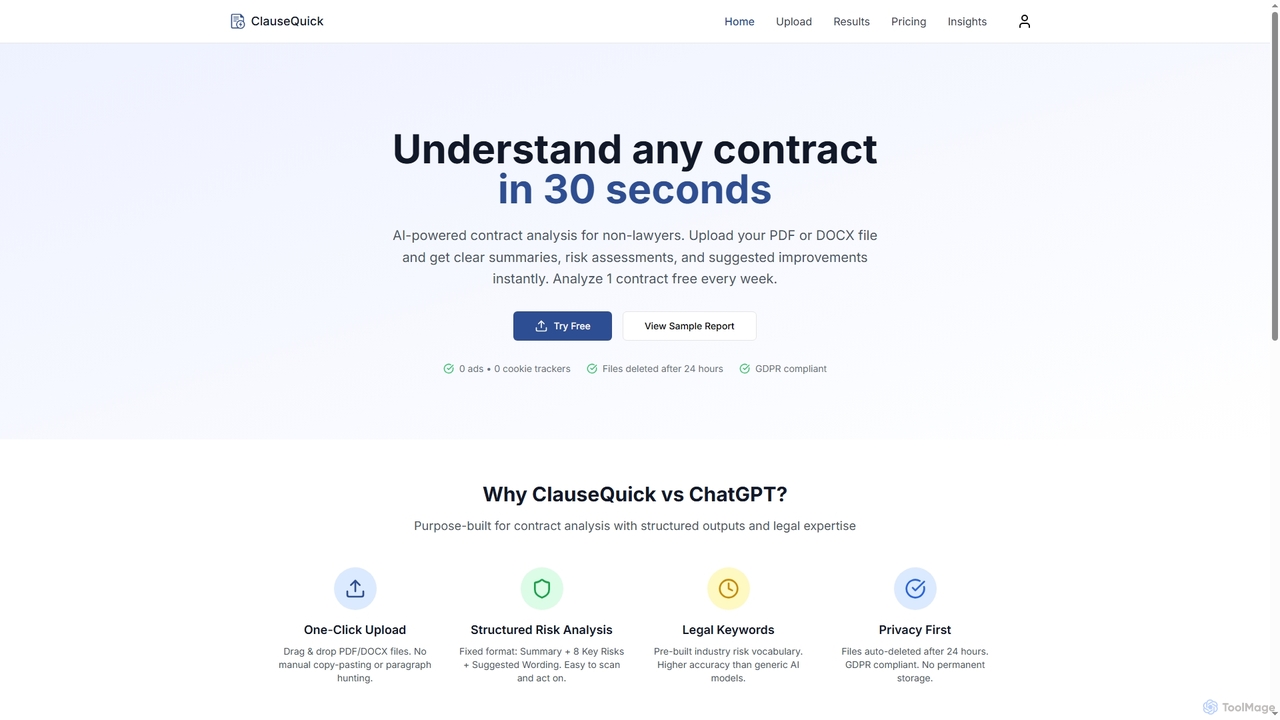
ClauseQuick is an AI-powered contract analysis tool designed for non-lawyers, enabling users to understand complex legal documents in …
ClauseQuick is an AI-powered contract analysis tool designed for non-lawyers, enabling users to understand complex legal documents in seconds. It provides clear summaries, structured risk assessments, and actionable improvement suggestions for PDF and DOCX files, helping individuals and small businesses make informed decisions without expensive legal fees.
About Legal Tools
Legal Tools are AI-powered applications designed to automate, streamline, and enhance various legal processes. Leveraging advanced natural language processing (NLP) and machine learning, these tools transform how legal professionals conduct research, review documents, manage cases, and ensure compliance. They significantly boost productivity by reducing manual effort and improving accuracy in complex legal tasks.
Core Features
- Document Review & Analysis: Automatically identifies key clauses, risks, and anomalies in contracts and legal documents.
- Legal Research Automation: Quickly sifts through vast legal databases to find relevant cases, statutes, and precedents.
- Contract Management: Assists in drafting, reviewing, and managing contracts, ensuring consistency and compliance.
- E-Discovery Support: Expedites the identification and collection of electronically stored information for litigation.
- Compliance Monitoring: Tracks regulatory changes and assesses potential impacts on business operations.
Use Cases
Legal departments, law firms, and individual practitioners utilize these tools to manage heavy workloads and complex information. They are essential for tasks like due diligence in M&A, preparing for litigation, or ensuring ongoing regulatory adherence.
How to Choose
When selecting Legal Tools, consider the specific legal tasks you need to automate (e.g., contract review vs. research), the tool's accuracy and reliability in handling legal nuances, its integration capabilities with existing legal tech stacks, and data security protocols. Scalability and user-friendliness are also crucial for adoption.
Legal ToolsUse Cases
Automating Contract Review for M&A Due Diligence
Corporate legal teams involved in mergers and acquisitions can use AI legal tools to rapidly review thousands of contracts. The AI identifies critical clauses, potential liabilities, and compliance issues, significantly reducing the time and human effort traditionally required for due diligence, allowing lawyers to focus on strategic negotiation.
Expediting Legal Research for Litigation Preparation
Litigators and paralegals can leverage AI legal research platforms to quickly find relevant case law, statutes, and scholarly articles. By inputting specific legal questions or facts, the AI analyzes vast databases, identifies precedents, and summarizes key findings, drastically cutting down research time and ensuring comprehensive coverage for trial preparation.
Ensuring Continuous Regulatory Compliance Monitoring
Compliance officers in regulated industries utilize AI legal tools to monitor evolving legal and regulatory landscapes. These tools automatically track changes in laws, identify new obligations, and assess the impact on internal policies and procedures, helping organizations proactively adapt and avoid costly penalties.
Drafting & Managing Standardized Legal Documents
Small law firms or in-house legal departments often need to generate numerous standardized documents like NDAs, service agreements, or privacy policies. AI legal drafting tools can automate this process by generating documents based on templates and user inputs, ensuring consistency, accuracy, and compliance with legal standards, freeing up lawyers for more complex tasks.
Streamlining E-Discovery in Complex Litigation
During complex litigation, legal teams face the challenge of reviewing massive volumes of electronically stored information (ESI). AI e-discovery tools use machine learning to identify relevant documents, filter out privileged information, and categorize data, making the review process faster, more cost-effective, and significantly reducing the burden on human reviewers.
Analyzing Legal Data for Predictive Insights
Legal data analysts and strategists can employ AI legal tools to analyze historical case outcomes, judicial behaviors, and settlement patterns. This provides predictive insights into potential litigation outcomes, helping legal teams make more informed decisions on case strategy, settlement negotiations, and risk assessment.