ToolMage
Sign in

Best 1 Math Solver AI tools for Productivity

Popular Math Solver AI tools in Productivity include TryTremi, helping you work more efficiently.

TryTremi
Freemium

TryTremi

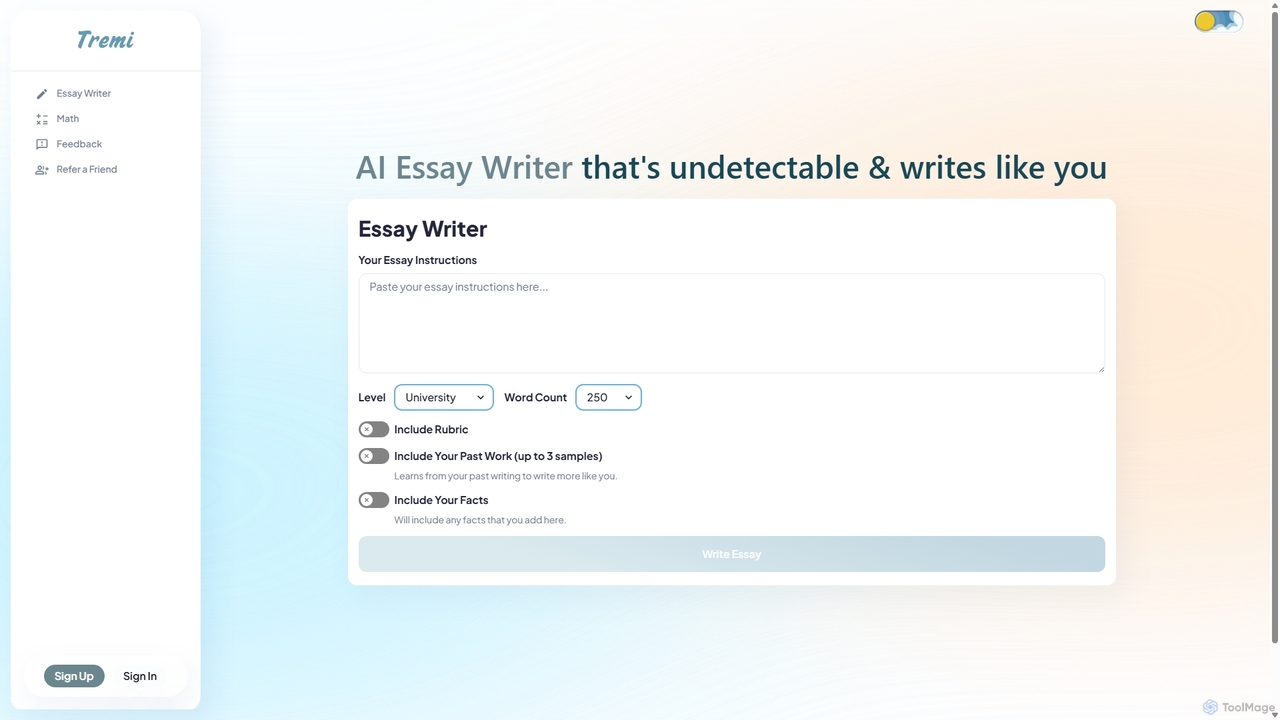
TryTremi is a dual-purpose AI academic assistant, offering an undetectable AI essay writer that mimics your personal writing style and a highly accurate math solver that provides detailed, step-by-step solutions for complex problems in calculus and algebra.

Academic Assistance
Visits 3.4KFavorites 96Likes 105

About Math Solver

Math Solver tools are AI-powered applications designed to interpret, solve, and explain mathematical problems across various disciplines. Leveraging advanced algorithms and natural language processing, these tools can tackle everything from basic arithmetic to complex calculus, providing step-by-step solutions and detailed explanations. They significantly enhance learning, problem-solving efficiency, and comprehension for students, educators, and professionals alike, making intricate mathematical concepts more accessible.

Core Features

  • Problem Interpretation: Accurately understands mathematical problems presented in text, image, or symbolic formats.
  • Step-by-Step Solutions: Generates detailed, logical solution paths, breaking down complex problems into manageable steps.
  • Multi-Disciplinary Support: Covers a wide range of math topics including algebra, geometry, trigonometry, calculus, and statistics.
  • Interactive Graphing: Visualizes equations and functions, aiding in the understanding of mathematical relationships.
  • Equation Solving: Solves linear, quadratic, differential, and integral equations with precision.

Use Cases

These tools are invaluable for students needing homework assistance or exam preparation, providing instant solutions and explanations. Educators utilize them to verify problem solutions, create diverse practice questions, or demonstrate complex concepts visually. Researchers and engineers apply Math Solvers for quick calculations, formula verification, and data analysis in their projects, streamlining their quantitative tasks.

How to Choose

When selecting a Math Solver, consider its accuracy and the breadth of mathematical topics it covers. Evaluate the clarity and detail of its step-by-step explanations, as well as its input flexibility (e.g., text, handwriting, photo). Look for interactive graphing capabilities and integration options with other learning or productivity platforms to ensure it meets specific educational or professional needs.

Featured tool rankings

Math Solver use cases

1

Solving Complex Calculus Problems for Students

University students often face challenging calculus problems in their coursework. A Math Solver allows them to input complex integrals or derivatives, receive immediate step-by-step solutions, and understand the underlying principles. This helps students verify their own work, learn advanced techniques, and prepare effectively for exams, reducing study time and improving comprehension.

2

Verifying Engineering Design Calculations

Engineers working on structural or electrical designs frequently perform intricate calculations. Using a Math Solver, they can quickly input equations and parameters to verify their manual calculations or explore different scenarios. This ensures accuracy in design specifications, minimizes errors and accelerates the iterative design process, enhancing project reliability and efficiency.

3

Generating Practice Problems for Educators

Mathematics teachers need to create diverse and challenging practice problems for their students. A Math Solver can assist by generating variations of existing problems or solving new ones to provide answer keys. This saves significant time in curriculum development, allows for personalized learning materials, and ensures a consistent level of difficulty across assignments.

4

Analyzing Statistical Data in Research

Researchers in fields like social sciences or biology often deal with large datasets requiring statistical analysis. Math Solvers with statistical functions can help process data, calculate probabilities, perform regressions, and interpret results. This streamlines the quantitative analysis phase of research, enabling more robust conclusions and efficient report generation.

5

Visualizing Functions for Better Understanding

Students and professionals alike can struggle to visualize abstract mathematical functions. A Math Solver with interactive graphing capabilities allows users to plot equations and observe how variables affect the curve. This visual representation deepens understanding of concepts like transformations, asymptotes, and intersections, making abstract math more tangible.

6

Assisting with Financial Modeling and Projections

Financial analysts and business professionals often build complex models involving compound interest, annuities, and depreciation. Math Solvers can quickly compute these financial formulas, verify model outputs, and assist in scenario planning. This enhances the accuracy of financial forecasts, supports strategic decision-making, and saves time on repetitive calculations.

Math Solver FAQ

What are AI Math Solvers?

AI Math Solvers are intelligent tools that use artificial intelligence to understand, solve, and explain mathematical problems. They typically feature natural language processing to interpret various input formats and advanced algorithms to break down complex equations, providing detailed, step-by-step solutions across a wide range of mathematical disciplines.

How do AI Math Solvers work?

AI Math Solvers typically work by first interpreting the problem using natural language processing (NLP) or optical character recognition (OCR) for image inputs. Then, a symbolic AI engine or machine learning model processes the mathematical expression, applies relevant theorems and algorithms, and generates a step-by-step solution. Finally, it presents the solution in an understandable format, often with explanations.

What types of math problems can AI Math Solvers solve?

AI Math Solvers can solve a broad spectrum of problems, including arithmetic, algebra (equations, inequalities, functions), geometry (shapes, angles, areas), trigonometry, calculus (derivatives, integrals, limits), statistics (probability, regression), and even some discrete mathematics. Their capabilities vary by tool, but most cover core high school and university-level topics.

How do I choose the best AI Math Solver for my needs?

To choose the best AI Math Solver, consider the specific math topics you need help with, the clarity and detail of its step-by-step explanations, and its input methods (text, photo, handwriting). Also, evaluate its graphing capabilities, user interface, and whether it offers additional learning resources or integration with other platforms. Free trials can help assess suitability.

Are AI Math Solvers only for students, or can professionals use them too?

While widely popular among students for homework and learning, AI Math Solvers are also highly beneficial for professionals. Engineers use them for verifying complex calculations, researchers for statistical analysis, and educators for creating and checking problems. They serve as powerful productivity tools for anyone dealing with quantitative tasks, enhancing accuracy and efficiency.