
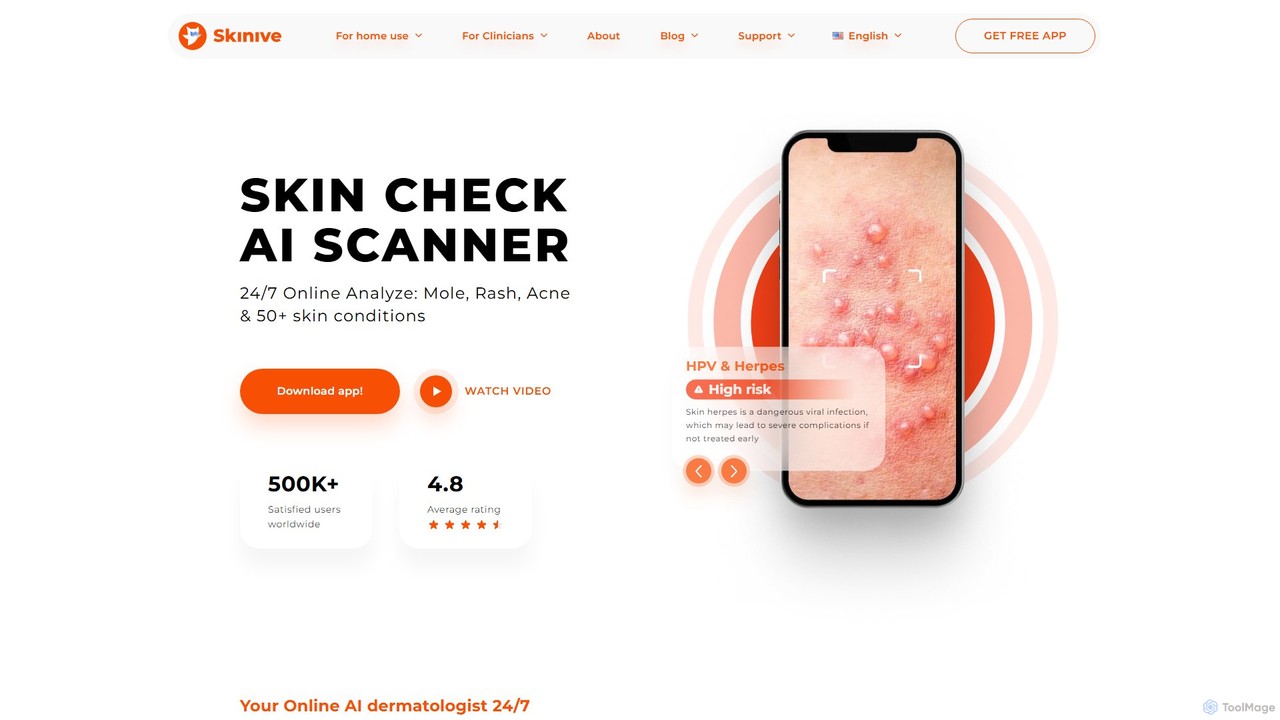
Skinive
Skinive is an AI-powered skin scanner app that provides instant analysis of over 50 skin conditions. By taking …
Skinive is an AI-powered skin scanner app that provides instant analysis of over 50 skin conditions. By taking a photo with your smartphone, you can get a risk assessment for moles, rashes, acne, and potential signs of skin cancer. It's a CE-marked medical device designed for both personal home use and to assist medical professionals, helping users monitor their skin health proactively and seek timely dermatological advice.
About Medical
Medical AI tools are AI-powered applications designed to enhance various aspects of healthcare. These tools leverage machine learning, natural language processing, and computer vision to process complex medical data. They aim to improve diagnostic accuracy, personalize treatment, accelerate drug discovery, and streamline administrative workflows, ultimately boosting productivity and patient outcomes in the medical field.
Core Features
- Diagnostic Assistance: Analyzes medical images (e.g., X-rays, MRIs) and patient data to identify disease patterns and assist in early detection.
- Drug Discovery & Development: Accelerates research by predicting molecular interactions, optimizing drug candidates, and analyzing clinical trial data.
- Personalized Treatment Planning: Recommends tailored therapies based on individual patient genetics, medical history, and real-time health data.
- Medical Record Analysis: Extracts actionable insights from electronic health records (EHRs) for research, risk assessment, and administrative efficiency.
- Predictive Analytics: Forecasts disease outbreaks, patient deterioration, or treatment outcomes, enabling proactive interventions.
Applicable Scenarios
Medical AI tools are indispensable in diverse healthcare settings. Hospitals and clinics utilize them for enhancing diagnostic precision and optimizing patient care pathways. Pharmaceutical companies deploy AI to significantly accelerate the drug discovery and development process, reducing time and cost. Research institutions benefit from AI's ability to analyze vast datasets for groundbreaking medical insights, while public health organizations use it for disease surveillance and population health management.
How to Choose
Selecting the right Medical AI tool requires careful consideration of several factors. Prioritize tools with proven accuracy and reliability, backed by clinical validation and regulatory approvals (e.g., FDA, CE Mark). Ensure robust data privacy and security measures are in place, complying with standards like HIPAA or GDPR. Evaluate its integration capabilities with existing electronic health record (EHR) and picture archiving and communication systems (PACS). Finally, consider the interpretability of the AI's decisions (explainable AI) and the level of technical support provided.
MedicalUse Cases
Early Disease Detection from Medical Imaging
Radiologists and clinicians utilize Medical AI tools to analyze complex medical images such as X-rays, MRIs, and CT scans. The AI algorithms can quickly identify subtle anomalies or patterns indicative of early-stage diseases, like cancerous lesions or neurological conditions, which might be missed by the human eye. This significantly reduces diagnostic errors and speeds up the detection process, allowing for earlier intervention and improved patient prognoses.
Accelerating Drug Discovery and Development
Pharmaceutical researchers leverage Medical AI tools to significantly shorten the drug discovery pipeline. AI can analyze vast chemical libraries, predict molecular interactions, identify potential drug candidates, and simulate their efficacy and toxicity in silico. This drastically reduces the need for costly and time-consuming laboratory experiments, allowing companies to bring new, more effective treatments to market faster, benefiting patients and reducing R&D costs.
Personalized Treatment Planning for Oncology
Oncologists and medical teams use AI to create highly personalized treatment plans for cancer patients. By analyzing a patient's genomic data, tumor characteristics, medical history, and response to previous treatments, AI can predict the most effective therapies, including specific drug combinations or radiation dosages. This precision medicine approach minimizes side effects, maximizes treatment efficacy, and improves patient survival rates by tailoring interventions to individual biological profiles.
Automated Medical Transcription and Documentation
Clinicians and administrative staff utilize Medical AI tools for automated medical transcription. AI-powered speech-to-text technology accurately converts dictated notes, patient consultations, and surgical reports into structured electronic health records (EHRs). This significantly reduces the time spent on manual documentation, minimizes transcription errors, and frees up healthcare professionals to focus more on patient care, thereby enhancing operational productivity and data accuracy within clinics and hospitals.
Predicting Patient Readmission Risk
Hospital administrators and care coordinators employ Medical AI tools to predict which patients are at high risk of readmission after discharge. By analyzing a patient's medical history, demographics, social determinants of health, and previous hospitalizations, AI algorithms can identify individuals needing additional support or follow-up care. This allows healthcare providers to implement proactive interventions, such as enhanced post-discharge planning or home health services, reducing readmission rates and improving overall patient outcomes and resource allocation.
Virtual Health Assistants for Patient Engagement
Patients and healthcare providers utilize Medical AI tools in the form of virtual health assistants or chatbots. These AI assistants can answer common patient queries, provide medication reminders, offer personalized health information, and guide patients through pre-operative instructions or post-discharge care plans. This improves patient engagement, reduces the burden on human staff for routine inquiries, and ensures patients receive timely and accurate information, leading to better adherence to treatment and improved health literacy.