Truefoundry
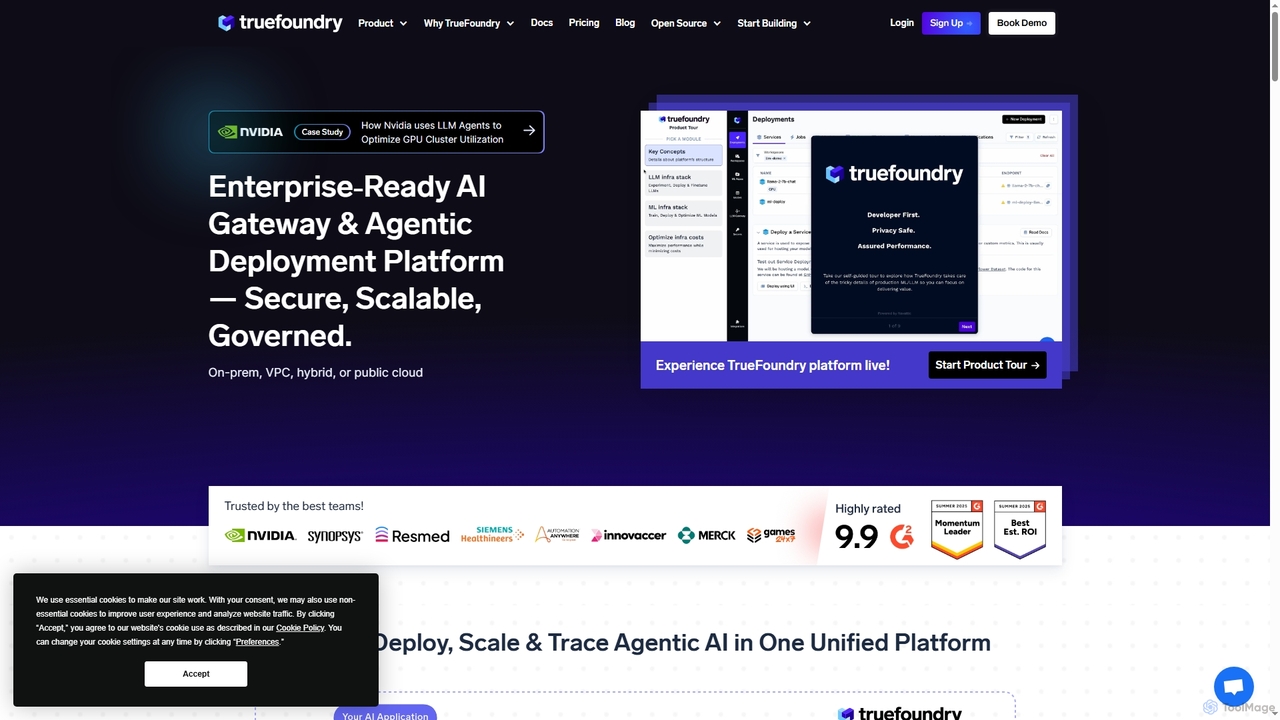
Truefoundry is an enterprise-ready platform for deploying, managing, and scaling agentic AI applications. It provides a unified AI …
Truefoundry is an enterprise-ready platform for deploying, managing, and scaling agentic AI applications. It provides a unified AI Gateway to orchestrate complex AI workflows, manage models, and ensure security, governance, and observability. Designed for developers and MLOps teams, it supports on-premise, cloud, and hybrid deployments, optimizing GPU utilization and accelerating time-to-production.
Laminar
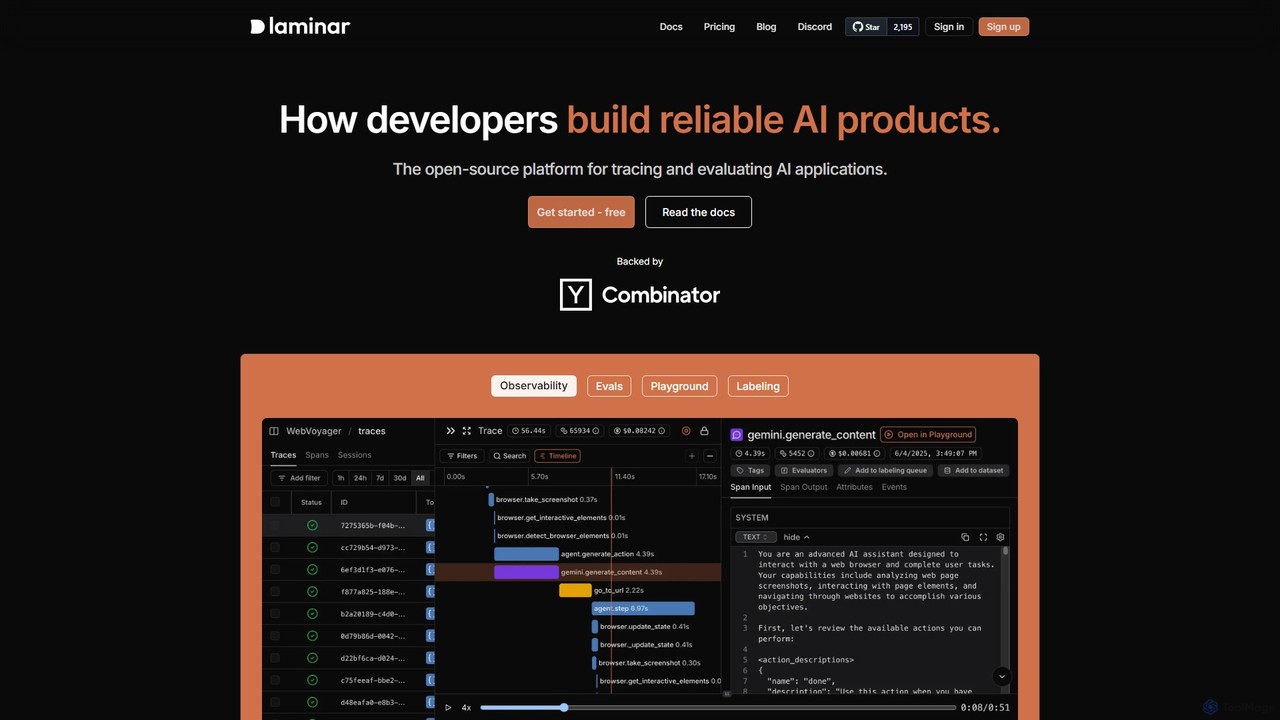
Laminar is an open-source observability and evaluation platform designed for developers building reliable AI applications. It provides comprehensive …
Laminar is an open-source observability and evaluation platform designed for developers building reliable AI applications. It provides comprehensive tools for tracing, evaluating, and debugging LLM-powered systems. Key features include real-time tracing, browser agent observability, an interactive playground, and integrated dataset management, simplifying the entire MLOps lifecycle from development to production.
About Mlops
MLOps (Machine Learning Operations) tools are platforms designed to streamline and automate the entire machine learning lifecycle. They apply DevOps principles to machine learning, unifying model development (Dev) with operational deployment (Ops). The primary goal of MLOps tools is to shorten development cycles, improve model quality, and ensure reliable, scalable deployment in production environments. This approach transforms experimental models into robust, enterprise-grade AI systems.
Core Features
- CI/CD/CT Pipelines: Automates the integration, testing, delivery (Continuous Integration/Continuous Delivery), and retraining (Continuous Training) of ML models.
- Model Versioning & Registry: Tracks and manages different versions of models, their associated code, data, and parameters in a central repository.
- Experiment Tracking: Logs all metadata from ML experiments, including hyperparameters, metrics, and artifacts, for reproducibility and comparison.
- Model Monitoring: Continuously observes the performance of deployed models in production to detect issues like data drift, concept drift, and performance degradation.
- Feature Store: Provides a centralized system for storing, retrieving, and managing curated features for both model training and real-time inference.
Applicable Scenarios
MLOps tools are essential for organizations moving machine learning projects from research to production. They are widely used by ML engineers, data scientists, and IT operations teams in industries like finance for fraud detection, e-commerce for recommendation systems, and manufacturing for predictive maintenance. Any scenario requiring frequent model updates and reliable performance monitoring benefits from an MLOps framework.
Selection Criteria
When choosing an MLOps tool, consider its integration capabilities with your existing tech stack (e.g., cloud providers, data warehouses). Evaluate the scope of the platform—whether it's an end-to-end solution or a specialized tool for a specific stage like monitoring. Also, assess its scalability to handle your data volume and model complexity, and consider the technical expertise required by your team to operate it effectively.
MlopsUse Cases
Automating Model Retraining for E-commerce Recommendations
An e-commerce data science team uses an MLOps platform to automate the daily retraining of their product recommendation model. The platform's CI/CT pipeline automatically pulls the latest user interaction data, retrains the model, validates its performance against a baseline, and deploys the updated version without manual intervention. This ensures recommendations remain highly relevant, adapting to new trends and user behaviors, which directly contributes to increased user engagement and sales.
Managing the Lifecycle of a Fraud Detection Model
A fintech company's ML engineers use an MLOps tool to manage their critical fraud detection models. The model registry provides a single source of truth for all model versions, allowing for easy rollbacks if a new model underperforms. The monitoring component continuously tracks prediction accuracy and latency in real-time, triggering alerts for the operations team if performance metrics fall below a set threshold, ensuring financial security and system reliability.
Collaborative Development with a Central Feature Store
A large data science team working on various personalization models uses an MLOps platform with a feature store. This allows data scientists to define, share, and reuse features (e.g., 'user_lifetime_value', 'product_view_count_7_days') across different projects. It prevents redundant work, ensures feature consistency between training and serving, and accelerates the development of new models by providing a library of pre-approved, high-quality features.
Reproducing Experiments for Regulatory Compliance
In a highly regulated industry like healthcare, a data science team uses an MLOps tool's experiment tracking feature to ensure reproducibility. For a model that predicts disease risk, every training run is logged with the exact code version, dataset hash, hyperparameters, and resulting metrics. This creates a complete audit trail, allowing the team to reproduce any past result precisely, which is crucial for internal validation and for satisfying external regulatory audits.
Monitoring Computer Vision Models for Performance Drift
A manufacturing company deploys a computer vision model on its assembly line to detect product defects. An MLOps tool continuously monitors the model's predictions against ground truth data from quality control. It tracks metrics like precision and recall, and alerts engineers if the model's performance degrades over time (concept drift), perhaps due to changes in lighting or new defect types. This proactive monitoring prevents defective products from reaching customers.
Scaling Model Deployment for a Multi-Tenant SaaS Application
A SaaS company provides personalized analytics to thousands of business clients. This requires deploying and managing a unique ML model for each client. Using an MLOps platform, their engineering team automates the entire process: provisioning infrastructure, deploying a containerized model, and setting up monitoring for each new client. This scalable approach allows them to onboard new clients in minutes instead of days, while ensuring model isolation and reliable service for all tenants.