ToolMage
Sign in

Best 1 Model Evaluation AI tools for Productivity

Popular Model Evaluation AI tools in Productivity include Rival, helping you work more efficiently.

Rival
Freemium

Rival

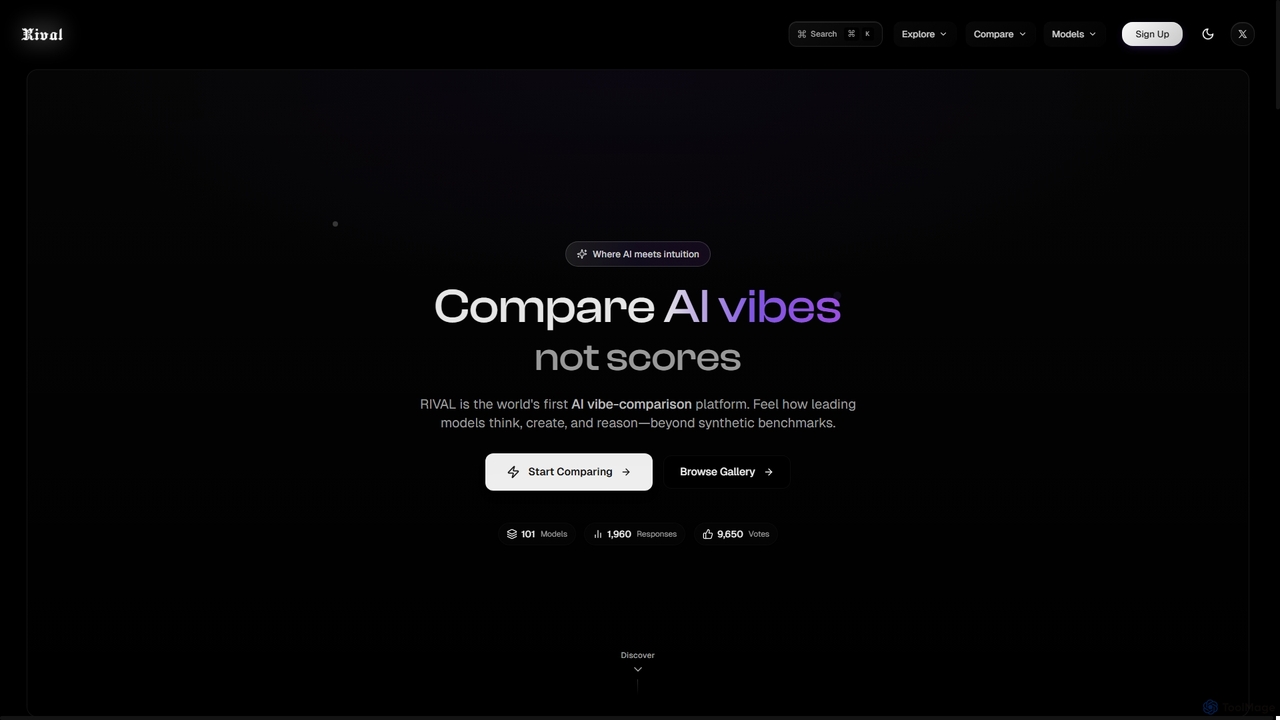
Rival is a unique AI model comparison platform that focuses on "vibe" rather than just benchmarks. It allows users to intuitively compare leading models like GPT, Gemini, and Claude through side-by-side duels, response galleries, and historical evolution tracking. Discover the distinct personalities, creative styles, and reasoning approaches of different AIs to find the perfect model for your specific task, moving beyond quantitative scores to a qualitative, hands-on experience.

Testing
Visits 46.6KFavorites 198Likes 179

About Model Evaluation

Model Evaluation tools are a specialized category of software designed to systematically assess the performance, fairness, and robustness of machine learning models. These tools provide quantitative metrics and visualizations to analyze a model's accuracy, precision, recall, and other key performance indicators on validation datasets. Their primary value lies in enabling data scientists and MLOps teams to make evidence-based decisions, compare different model versions, and ensure that only reliable and unbiased models are deployed into production, directly enhancing development productivity.

Core Features

  • Performance Metrics Tracking: Automatically calculates and logs standard metrics like accuracy, F1-score, AUC-ROC, and Mean Absolute Error.
  • Bias and Fairness Auditing: Analyzes model predictions across different demographic subgroups to detect and mitigate potential biases.
  • Model Comparison and Versioning: Provides side-by-side comparisons of different models or versions on the same dataset to identify the top performer.
  • Explainability (XAI) Analysis: Integrates techniques like SHAP or LIME to help users understand the reasoning behind a model's predictions.
  • Robustness Testing: Evaluates model performance against adversarial attacks, data drift, or edge cases to ensure reliability in real-world scenarios.

Use Cases

Model Evaluation tools are critical for any team building or deploying machine learning models. They are extensively used by data science and MLOps teams in sectors like finance for credit risk model validation, healthcare for assessing the accuracy of diagnostic models, and e-commerce for A/B testing recommendation engines. These tools are integral to the CI/CD for ML (MLOps) pipeline for automated model validation before deployment.

How to Choose

When selecting a Model Evaluation tool, consider its compatibility with your machine learning frameworks (e.g., TensorFlow, PyTorch, Scikit-learn). Evaluate the breadth of its metric library and its support for your specific use case (e.g., classification, NLP, computer vision). Assess its integration capabilities with your existing MLOps stack, such as experiment trackers and model registries. Finally, consider the quality of its visualization dashboards and reporting features for communicating results to stakeholders.

Model Evaluation use cases

1

Iterative Model Improvement for Data Scientists

A data scientist is developing a customer churn prediction model. They use a model evaluation tool to log each training run with different algorithms, such as Logistic Regression and Gradient Boosting. The tool automatically generates ROC curves, confusion matrices, and precision-recall scores for each experiment. By comparing these visualizations side-by-side, the scientist can quickly identify the most effective model architecture and hyperparameters, significantly speeding up the development cycle and improving the final model's accuracy.

2

Pre-Deployment Fairness Audit in Finance

A compliance team at a financial institution must ensure a new loan approval model is not biased against any protected group. They use a model evaluation tool to perform a fairness audit. The tool segments the model's performance metrics (like false positive rates) by demographic attributes such as age, gender, and ethnicity. It generates a detailed report highlighting any disparities, allowing the team to address fairness issues before the model is deployed, thus mitigating regulatory and reputational risk.

3

A/B Testing LLM-Powered Chatbots

A product manager wants to compare two different large language models (LLMs) for their customer service chatbot. Using a model evaluation platform, they deploy both chatbot versions in an A/B test. The platform collects user interactions and automatically scores conversations based on metrics like task completion rate, sentiment analysis, and response relevance. The resulting dashboard provides a clear comparison, enabling the product manager to make a data-driven decision on which LLM provides a better user experience and business value.

4

Assessing Computer Vision Model Accuracy

A computer vision engineer is training a model to detect defects in manufacturing. They use a model evaluation tool to measure performance on a test dataset of images. The tool calculates key object detection metrics like mean Average Precision (mAP) and Intersection over Union (IoU). It also provides visualizations that overlay the model's predicted bounding boxes on the images, allowing the engineer to visually inspect errors and understand where the model is failing, which is crucial for targeted improvements.

5

Continuous Monitoring of Production Models

An MLOps team is responsible for a live fraud detection model. They integrate a model evaluation tool into their production environment to continuously monitor its performance. The tool tracks key metrics like precision and recall in real-time and compares them against the performance on the training data. If it detects a significant performance drop (a sign of data drift), it automatically triggers an alert, notifying the team to investigate and potentially retrain the model before it negatively impacts the business.

6

Benchmarking and Selecting Third-Party AI APIs

A development team needs to choose a commercial sentiment analysis API for their application. Instead of relying on marketing claims, they use a model evaluation tool to benchmark several competing APIs. They prepare a standardized test dataset with known sentiment labels and run it through each API. The tool then generates a comparative report showing the accuracy, latency, and cost-per-prediction for each service. This objective data allows the team to select the API that offers the best balance of performance and cost for their specific needs.

Model Evaluation FAQ

What are Model Evaluation tools?

Model Evaluation tools are software applications that help data scientists and developers systematically measure the performance and quality of machine learning models. They provide quantitative metrics like accuracy, F1-score, and AUC to assess predictive power, and also offer capabilities to audit models for fairness, bias, and robustness. These tools are essential for comparing different model versions and ensuring a model is reliable before it is deployed to production.

How do I choose the right Model Evaluation tool?

To choose the right tool, consider these factors:

  • Framework Compatibility: Ensure it supports your primary ML frameworks like TensorFlow, PyTorch, or Scikit-learn.
  • Metric Support: Check if it offers the specific metrics required for your tasks (e.g., mAP for object detection, BLEU for translation).
  • Integration: Evaluate how well it integrates with your existing MLOps stack, including experiment trackers, data versioning tools, and CI/CD pipelines.
  • Scalability and Usability: Consider its ability to handle large datasets and the intuitiveness of its dashboards for analysis and reporting.
What's the difference between Model Evaluation and Model Monitoring?

Model Evaluation is typically a discrete process performed before deployment. It involves testing a trained model on a static, held-out dataset (a validation or test set) to assess its quality and decide if it's ready for production. In contrast, Model Monitoring is a continuous process that happens after deployment. It involves tracking the live model's performance on real-world data to detect issues like data drift or performance degradation over time, which may trigger a need for retraining.

What are the most common metrics in model evaluation?

The metrics depend on the type of ML task. For classification tasks, common metrics include Accuracy, Precision, Recall, F1-Score, and AUC-ROC. For regression tasks, you'll often see Mean Absolute Error (MAE), Root Mean Squared Error (RMSE), and R-squared. For Large Language Models (LLMs), metrics like Perplexity, BLEU, and ROUGE are frequently used to evaluate text generation quality. A good evaluation tool will support a wide range of these metrics.

Who are the primary users of Model Evaluation tools?

The primary users are technical professionals involved in the machine learning lifecycle. This includes Data Scientists who build and iterate on models, and Machine Learning Engineers who are responsible for deploying and maintaining them. Additionally, MLOps Engineers use these tools for creating automated validation pipelines. Non-technical stakeholders like Product Managers and Compliance Officers also use the reports and dashboards generated by these tools to make informed business and regulatory decisions.