DogNames.top
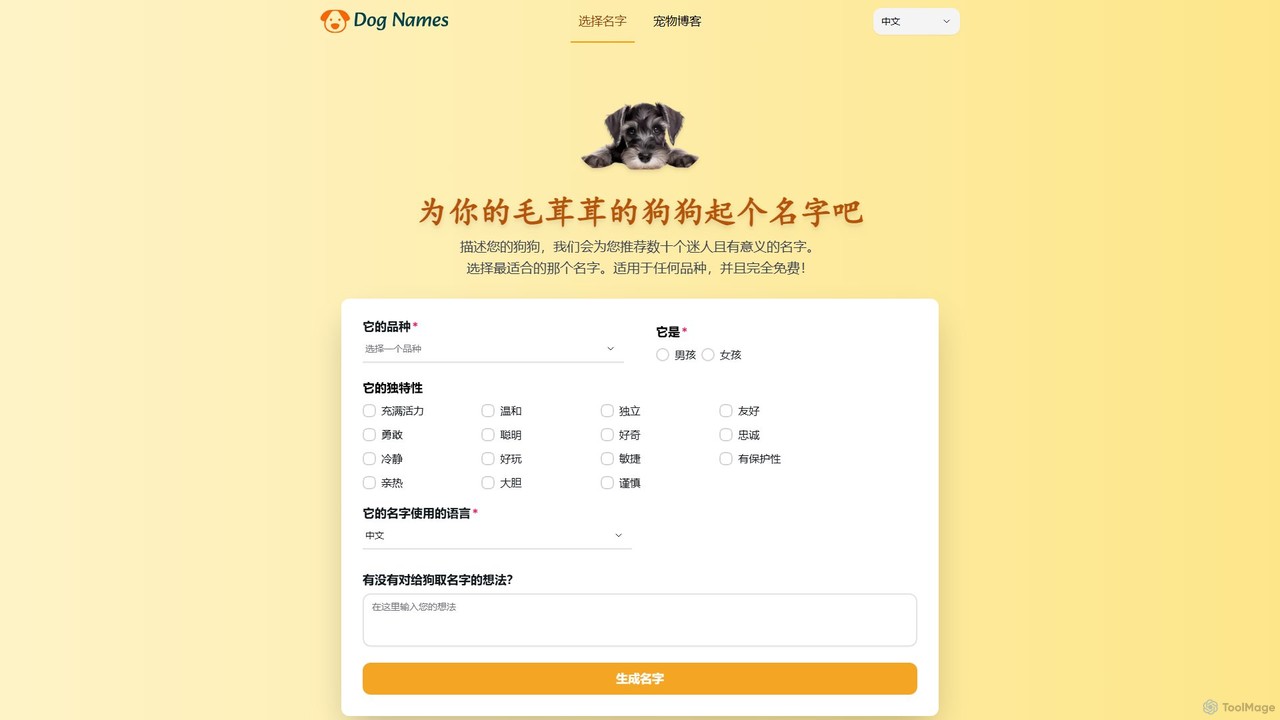
An AI-powered dog name generator that provides personalized, meaningful, and charming name suggestions for your furry friend. Simply …
An AI-powered dog name generator that provides personalized, meaningful, and charming name suggestions for your furry friend. Simply describe your dog's breed, gender, and personality to receive dozens of unique names for free.
oneword
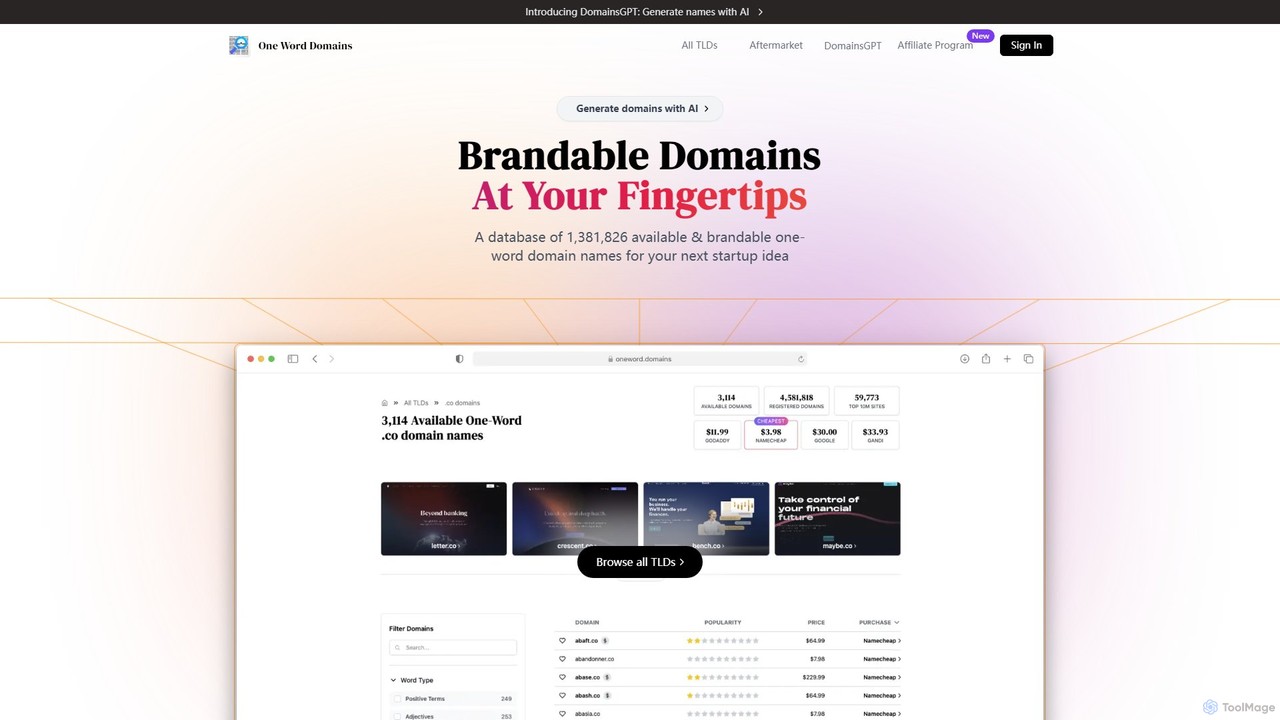
oneword is an AI-powered platform offering a massive, curated database of over 1.3 million available one-word domain names. …
oneword is an AI-powered platform offering a massive, curated database of over 1.3 million available one-word domain names. It helps startups, developers, and businesses find short, brandable, and memorable domains across 93 TLDs. The tool uses AI to generate domain ideas and crawls registrars to provide real-time availability and price comparisons, simplifying the search for the perfect domain.
About Niche Tools
Niche Tools are a class of AI solutions designed to perform highly specific tasks within a narrow domain or industry. Unlike general-purpose AI, these tools are trained on specialized datasets to understand unique contexts and terminologies, enabling them to deliver high-precision results. Their primary value lies in automating complex or repetitive workflows that require deep, domain-specific knowledge, significantly enhancing productivity for specialists. This focus allows them to outperform broader tools in their designated area of expertise.
Core Features
- Domain-Specific Training: Models are trained on curated datasets from specific fields like law, medicine, or engineering for higher accuracy.
- Task-Focused Functionality: Features are tailored to solve one particular problem, avoiding the complexity of multi-purpose tools.
- Specialized Outputs: Generates results in formats and language appropriate for a specific industry's standards and jargon.
- Streamlined Workflow Integration: Designed to fit seamlessly into existing specialized software and professional processes.
Use Cases
Niche Tools are invaluable in professions requiring specialized knowledge. For example, legal professionals use them for contract analysis to identify specific clauses, medical researchers use them to analyze biological data, and architects employ them for building code compliance checks. They are also used in highly specific creative fields, such as AI tools that generate music in a particular historical style or write poetry following strict metrical rules.
How to Choose
When selecting a Niche Tool, first verify that its specialization precisely matches your task. Evaluate the accuracy and reliability of its outputs, as this is its main advantage. Consider its ability to integrate with your existing software ecosystem. Finally, compare its performance on your specific task against a more general-purpose tool to ensure the specialized investment provides a tangible benefit in efficiency and quality.
Niche ToolsUse Cases
Automated Legal Contract Clause Analysis
A paralegal at a corporate law firm is tasked with reviewing dozens of vendor agreements each week to check for non-compliance with company policy. Using a niche AI tool trained on legal documents, they can upload all contracts in bulk. The AI automatically scans each document, identifies and flags specific clauses (e.g., liability limitations, data privacy terms) that deviate from pre-defined standards. This reduces the manual review time from several hours to minutes per contract, allowing the legal team to focus on negotiation and strategic advice rather than tedious proofreading.
Scientific Image Analysis for Cell Counting
A biologist in a research lab needs to quantify the number of specific cell types in hundreds of microscopy images for a study. This manual process is time-consuming and prone to human error. By using a niche AI tool specialized in bio-imaging, the researcher can upload the entire image set. The AI, trained on thousands of similar images, accurately identifies, segments, and counts the target cells within minutes. It also generates a data report with cell counts and morphological statistics, accelerating the research data collection phase significantly and ensuring consistency across the analysis.
Generating E-commerce Descriptions for Luxury Watches
An e-commerce manager for a high-end watch retailer needs to write compelling and technically accurate product descriptions for a new collection. A general AI writer might produce generic text. Instead, they use a niche AI tool trained on horological literature and luxury brand marketing copy. By inputting the watch model and key specifications (e.g., movement type, case material, complications), the tool generates sophisticated descriptions that use precise industry terminology, evoke a sense of craftsmanship, and adhere to the brand's luxury tone of voice, saving hours of specialized writing and research.
Architectural Code Compliance Verification
An architect is finalizing the design for a new commercial building and needs to ensure it complies with local accessibility regulations (e.g., ADA standards). Manually checking every doorway width, ramp slope, and restroom layout in a complex blueprint is tedious. They use a niche AI tool that integrates with their CAD or BIM software. The AI analyzes the 3D model against a database of building codes, automatically flagging any design elements that are non-compliant and providing specific recommendations for correction. This automates a critical but time-consuming part of the design validation process.
Isolating Drum Tracks in Music Production
A music producer wants to remix a classic song but only has the final mixed audio track, not the individual instrument stems. They need to isolate the drum beat to use as a sample. A general audio editor's tools are often imprecise. Instead, they use a niche AI tool specifically designed for audio source separation. The AI, trained on countless hours of music, can distinguish the frequency patterns and transients of drums from other instruments like bass, guitar, and vocals. It outputs a clean, isolated drum track, saving the producer from hours of complex and often unsuccessful manual EQ and filtering work.
Identifying Plant Diseases from Leaf Photos
A commercial farmer notices unusual spots on the leaves of their tomato plants and fears a widespread disease. Instead of waiting for a specialist or relying on guesswork, they use a niche AI horticulture app. They take a clear photo of an affected leaf with their smartphone. The AI, trained on a massive database of plant pathology images, analyzes the photo to identify the specific disease (e.g., early blight, septoria leaf spot) with high accuracy. The app then provides immediate, actionable advice on treatment options and preventative measures, helping the farmer act quickly to save their crop.