
English Lovers
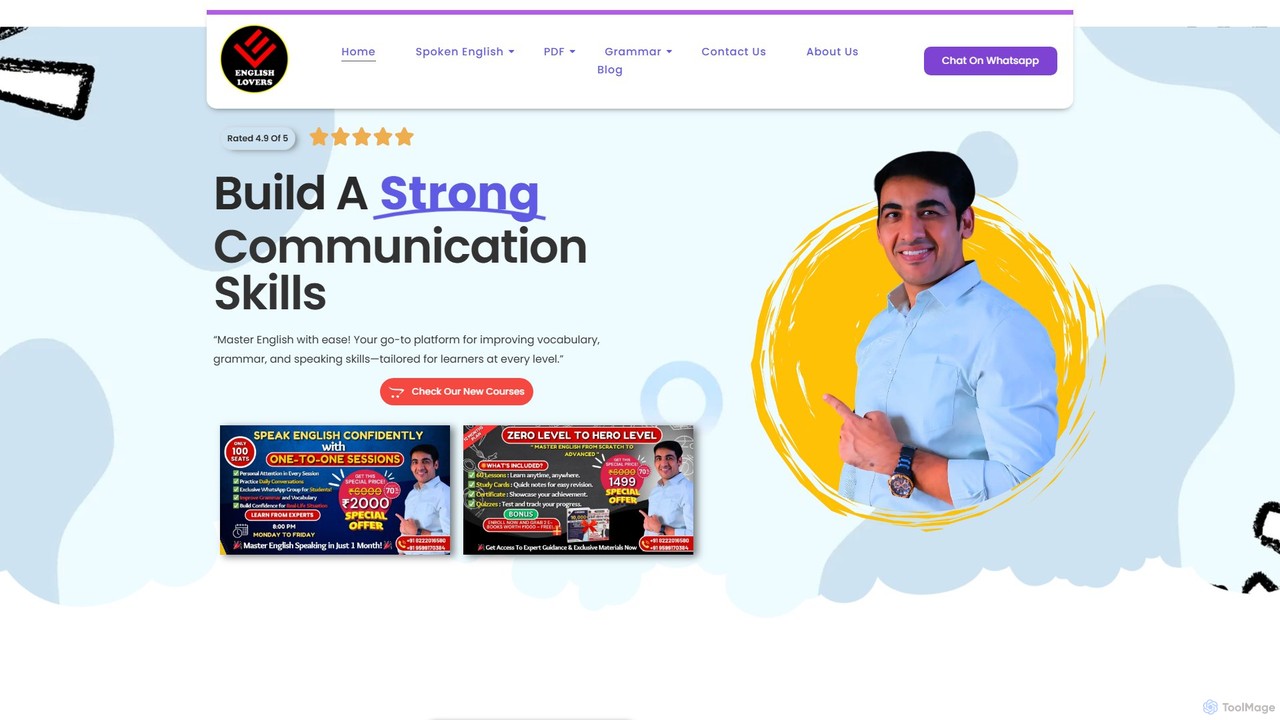
English Lovers is a comprehensive online English learning platform founded by Satender Singh. Designed for learners of all …
English Lovers is a comprehensive online English learning platform founded by Satender Singh. Designed for learners of all levels, especially Hindi speakers, it offers structured video courses, quizzes, and study notes to improve vocabulary, grammar, and speaking skills. The platform focuses on practical, real-world communication with an engaging and easy-to-understand teaching style.
About Online Courses
Online Courses in the AI context are structured digital learning platforms focused on teaching artificial intelligence, machine learning, and data science. These tools provide comprehensive curricula, expert-led video lectures, and interactive assignments to build practical skills. As a key component of productivity, they enable individuals and teams to acquire critical technical knowledge and stay relevant in a rapidly evolving job market. Many platforms also leverage AI to offer personalized learning paths and instant feedback, accelerating skill development.
Core Features
- Interactive Coding Environments: Practice programming and run models directly in the browser without complex local setup.
- Project-Based Curriculum: Learn by building real-world applications and portfolio-worthy projects.
- Expert-Led Instruction: Access courses taught by leading academics and industry professionals from top tech companies.
- Specialized Learning Paths: Follow curated tracks for specific career goals like Machine Learning Engineer or Data Analyst.
- Verifiable Certifications: Earn credentials upon completion to showcase new skills on professional profiles.
Applicable Scenarios
These platforms are ideal for software developers upskilling in machine learning, analysts transitioning to data science, and business leaders seeking to understand AI's strategic impact. They also cater to students and enthusiasts building foundational knowledge for future careers or personal projects in the AI field.
Selection Criteria
When selecting a course, first assess the curriculum's depth and its alignment with your career goals. Investigate the instructors' credentials and real-world experience. Prioritize platforms that offer robust, hands-on projects and strong community or mentor support. Finally, consider the course's prerequisites, cost, and the industry recognition of its certification.
Online CoursesUse Cases
Transitioning to a Machine Learning Engineer Role
A software developer enrolls in a machine learning specialization to pivot their career. The course covers Python, key libraries like TensorFlow, and deep learning principles. Through project-based modules, they build and deploy models for image classification and sentiment analysis. This hands-on experience allows them to create a strong portfolio, which becomes a key asset in job interviews. Upon completing the capstone project, they successfully secure a Machine Learning Engineer position at a tech startup.
Mastering Prompt Engineering for Creative Work
A marketing professional takes a specialized course on generative AI and prompt engineering. They learn the principles of crafting effective prompts for text-to-image models and large language models. The course includes practical exercises on controlling style, composition, and tone. By mastering these skills, they can generate unique visuals for marketing campaigns and draft creative copy more efficiently, significantly reducing reliance on stock assets and accelerating content production cycles.
Upskilling a Data Analytics Team in Advanced AI
A company enrolls its data analytics team in an advanced AI for business course. The objective is to move beyond descriptive analytics to predictive and prescriptive modeling. The team learns about deploying machine learning models at scale, MLOps principles, and using cloud AI services. The course provides a shared knowledge base and common vocabulary, improving collaboration. As a result, the team successfully develops and deploys a customer churn prediction model, leading to a measurable increase in customer retention.
Business Leader Understanding AI's Strategic Impact
A non-technical executive takes a high-level course on AI strategy. The curriculum focuses on AI applications across industries, ethical considerations, and how to build an AI-ready culture. Instead of coding, the course uses case studies and frameworks for evaluating AI opportunities. This knowledge empowers the executive to ask the right questions, effectively allocate budget for AI initiatives, and lead their organization's digital transformation with a clear, strategic vision, avoiding common pitfalls of technology adoption.
Building a Foundation in AI as a University Student
A computer science undergraduate supplements their formal education with an online course in deep learning. While their university provides strong theoretical foundations, the online platform offers practical, hands-on experience with modern frameworks like PyTorch. They complete several projects, including building a generative adversarial network (GAN). This applied knowledge gives them a competitive edge when applying for internships and helps them choose a specialization for their final year project and future graduate studies.
Freelancer Adding AI Services to Their Offerings
A freelance graphic designer takes a course on AI-powered design tools. They learn to use generative AI for ideation, AI-powered features in Adobe Photoshop for faster editing, and AI upscaling tools to improve image quality. This allows them to offer new services like 'AI-assisted branding packages' and complete projects faster. The investment in the course pays off quickly by enabling them to take on more clients and charge premium rates for specialized, AI-enhanced creative work.