Nookly
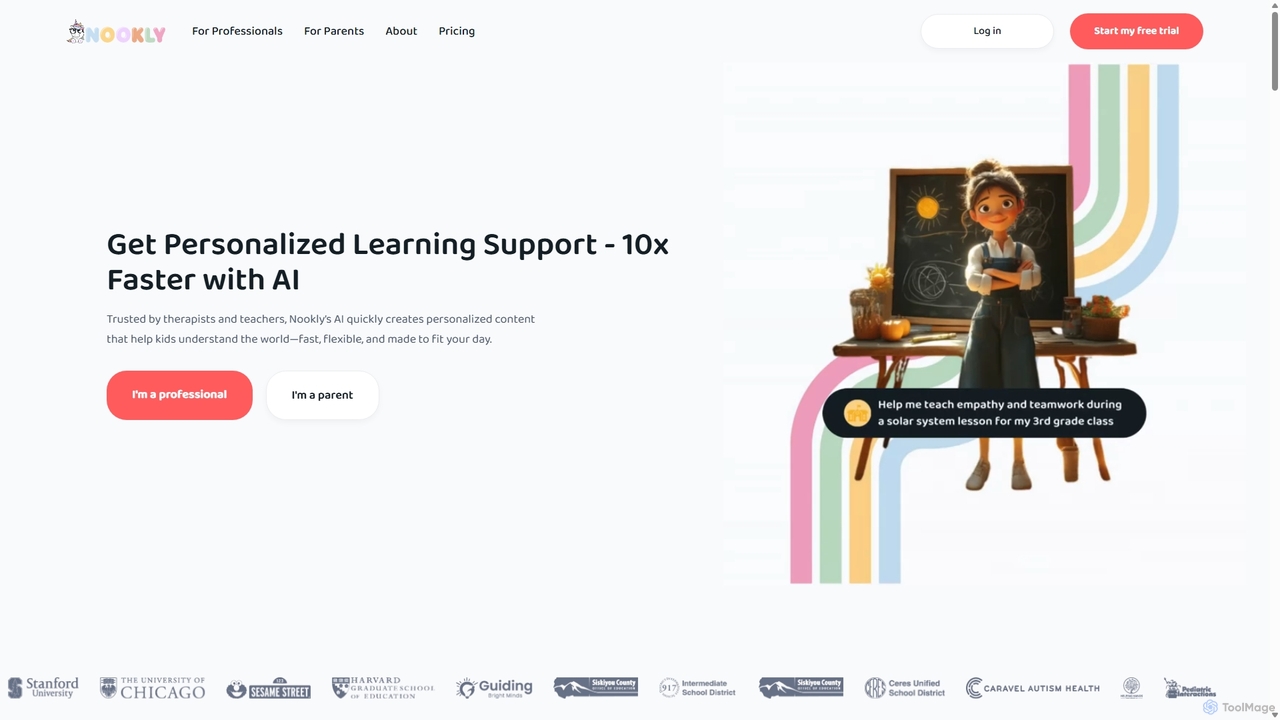
Nookly is an AI-powered platform for parents, teachers, and therapists to create personalized visual learning materials for children. …
Nookly is an AI-powered platform for parents, teachers, and therapists to create personalized visual learning materials for children. It generates custom stories, visual schedules, emotion cards, and more in minutes, helping support children's social, emotional, and early learning development, with a special focus on neurodivergent needs.
About Personalized Content
Personalized Content tools are a class of AI-powered applications that dynamically tailor digital experiences for individual users. These tools analyze user data—such as browsing history, purchase behavior, and demographic information—to generate or modify content like text, images, and product recommendations in real time. The primary value lies in creating highly relevant and engaging user journeys, which can significantly boost conversion rates and customer loyalty. As a key component of modern productivity suites, they automate the complex task of delivering one-to-one communication at scale.
Core Features
- User Data Analysis: Ingests and interprets user data from various sources to build comprehensive user profiles.
- Dynamic Content Generation: Automatically alters website elements, email copy, or ad creatives to match individual user preferences.
- AI-Powered Recommendation Engines: Suggests relevant products, articles, or services based on predictive algorithms.
- Automated Audience Segmentation: Groups users into micro-segments for hyper-targeted campaigns without manual intervention.
- Real-time Optimization: Continuously tests content variations and adapts strategies based on live user interactions.
Use Cases
These tools are widely used across industries like e-commerce, media, and SaaS. For instance, an online retailer can display unique product recommendations on their homepage for each visitor. A media company can curate a personalized news feed, while a SaaS business can tailor the user onboarding experience based on the user's role and initial actions within the application.
How to Choose
When selecting a Personalized Content tool, consider its integration capabilities with your existing CRM, analytics, and marketing platforms. Evaluate the sophistication of its AI models and whether it supports the channels you operate on (website, mobile app, email). Also, assess the balance between ease of use for marketing teams (no-code interfaces) and the flexibility it offers for developers through APIs.

Personalized ContentUse Cases
Dynamic Product Recommendations for E-commerce
An e-commerce manager uses a personalized content tool to increase sales and average order value. The tool integrates with their online store's data, analyzing a visitor's real-time browsing behavior, past purchases, and items in their cart. Based on this, it dynamically populates sections like 'You Might Also Like' and 'Frequently Bought Together' with highly relevant products. For a user viewing a specific camera, the tool might recommend a compatible lens and a camera bag, significantly increasing the likelihood of an upsell. This automated process replaces generic recommendations, leading to a more tailored shopping experience and improved conversion rates.
Personalized Email Marketing Campaigns
A digital marketer aims to improve email engagement metrics like open rates and click-through rates. By connecting their email platform to a personalization tool, they can move beyond simple name tokenization. The AI analyzes each subscriber's interaction history and segments them automatically. It then crafts unique emails for each segment, or even each individual, by dynamically inserting relevant blog posts, product offers, or event invitations. A subscriber who frequently reads about 'AI in marketing' will receive different content than one interested in 'social media analytics'. This level of relevance makes emails feel less like mass marketing and more like a one-to-one conversation, boosting engagement and reducing unsubscribe rates.
Adapting Website Content for Different Visitor Segments
A SaaS company's marketing team wants to increase free trial sign-ups from their website. They use a personalization tool to show different headlines, testimonials, and case studies based on the visitor's industry, which is identified from their IP address or referral source. A visitor from the healthcare industry sees a headline like 'Secure Patient Data Management, Simplified,' while a visitor from the finance sector sees 'Compliance-Ready Financial Reporting Software.' This immediate relevance captures attention and demonstrates a clear understanding of the prospect's specific pain points, making the call-to-action to start a free trial much more compelling than a generic, one-size-fits-all message.
Curating Personalized News and Media Feeds
A content platform manager for a news outlet or streaming service wants to increase user session duration and daily active users. They implement an AI personalization engine that tracks which articles a user reads, which videos they watch, and what topics they follow. The system then curates the user's homepage and 'For You' sections with content that aligns with these discovered interests. It can also introduce new, related topics to encourage content discovery. This transforms a static, uniform content library into a dynamic, individual-centric experience, making users more likely to return daily and spend more time on the platform.
Generating Tailored Ad Creatives at Scale
A performance marketer running campaigns across multiple platforms needs to create hundreds of ad variations to appeal to different audience segments. Instead of manually designing each one, they use a personalized content tool. The marketer provides base assets like images, logos, and copy points. The AI then generates numerous ad creatives by combining these elements in different ways and tailoring the headline or call-to-action to specific segments (e.g., '50% Off for New Customers' vs. 'Exclusive Offer for Loyal Members'). This not only saves a significant amount of design time but also improves ad performance by ensuring the message resonates more strongly with each target group.
Personalizing the SaaS User Onboarding Journey
A product manager for a SaaS application wants to improve user activation and long-term retention. They use a personalization tool to customize the in-app onboarding experience. Based on the user's role (e.g., 'Admin', 'Marketer', 'Developer') selected during sign-up, the tool triggers a unique sequence of tutorials, tooltips, and feature highlights. A 'Marketer' is immediately shown how to build a campaign, while a 'Developer' is guided to the API documentation. This tailored guidance helps users discover the features most relevant to their job-to-be-done quickly, leading to a faster 'aha!' moment, higher feature adoption, and a lower likelihood of churn.