Productivity Best in category 1 results Reference Tool AI Tool

Popular AI tools in the Reference Tool field of Productivity include MDN Web Docs, etc., helping you quickly improve efficiency.

Free
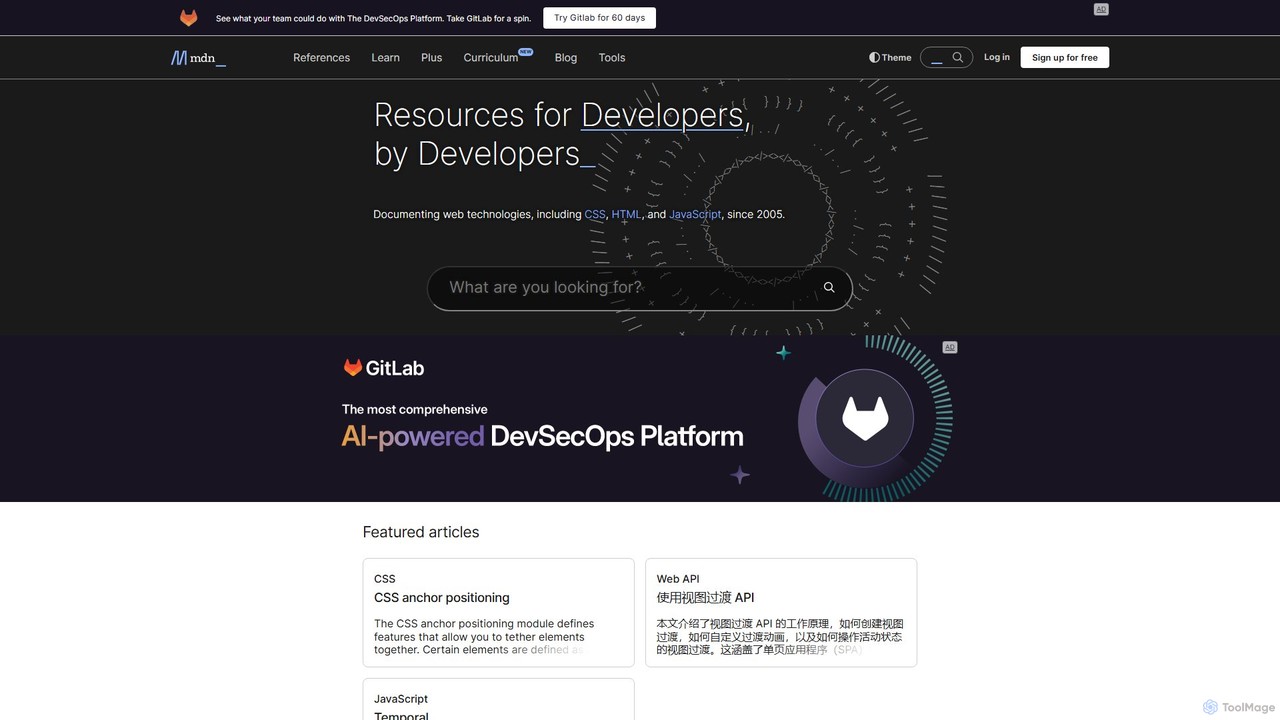
MDN Web Docs

MDN Web Docs

MDN Web Docs, maintained by Mozilla and contributors, is the definitive, free resource for web developers. It provides …

7.5M

About Reference Tool

AI Reference Tools are a specialized category of productivity software designed for rapid and accurate information retrieval. They leverage natural language processing (NLP) and curated knowledge bases to provide precise, context-aware answers, definitions, and data points. Unlike general search engines, these tools query verified, domain-specific databases, making them highly reliable for professional and academic use. Their primary value lies in delivering trustworthy information instantly, which accelerates research, fact-checking, and decision-making processes.

Core Features

  • Domain-Specific Knowledge Base: Accesses curated information from specific fields like law, medicine, or engineering for higher accuracy.
  • Contextual Search: Understands the user's intent and query context to provide relevant, not just keyword-matched, results.
  • Structured Data Output: Presents information in clear, digestible formats such as summaries, tables, or direct answers.
  • Source Citation: Often provides links or references to the original source material, allowing for easy verification.

Use Cases

These tools are invaluable for professionals and students in information-intensive fields. For example, software developers use them to look up API documentation and code syntax. Legal professionals rely on them for case law research, while medical practitioners use them to check symptoms and drug interactions. Researchers and academics also use them to streamline literature reviews and data collection.

How to Choose

When selecting an AI Reference Tool, first consider the specificity and reliability of its knowledge base—does it cover your domain? Evaluate the accuracy and speed of its search capabilities. Check for integrations with your existing workflow, such as IDE plugins or browser extensions. Finally, assess the clarity of its data presentation and the trustworthiness of its source citations.

Reference ToolUse Cases

1

Code & API Documentation Lookup for Developers

A software developer is working on a complex feature requiring an unfamiliar third-party library. Instead of leaving their integrated development environment (IDE) to search through web forums and dense documentation, they use an AI Reference Tool plugin. They type a natural language query like 'how to implement OAuth2 with Python requests library'. The tool instantly provides a concise explanation, a correct code snippet with comments, and a direct link to the relevant section of the official API documentation. This saves significant time and reduces context-switching, allowing the developer to maintain focus and productivity.

2

Legal Precedent Research for Paralegals

A paralegal is preparing a case brief and needs to find relevant case law supporting their argument. Traditionally, this involves hours of searching through complex legal databases with specific Boolean operators. By using an AI Reference Tool specialized in law, they can describe the facts of their case in plain English. The tool analyzes the query and retrieves a ranked list of the most relevant precedents, complete with summaries, key holdings, and citations. This reduces research time from hours to minutes and helps uncover relevant cases that might have been missed with keyword-based searches.

3

Fact-Checking and Source Verification for Journalists

A journalist is writing an article on a tight deadline and needs to verify a statistic cited in a press release. Instead of manually searching through multiple academic journals or government reports, they use an AI Reference Tool. They input the claim, and the tool cross-references it against its curated database of reputable sources. Within seconds, it confirms the statistic, provides the original source (e.g., a specific Bureau of Labor Statistics report), and even offers related data points for additional context. This ensures accuracy and journalistic integrity while significantly speeding up the writing process.

4

Medical Terminology and Drug Interaction Lookup

A medical student is studying for an exam and encounters a rare disease and several associated medications. Using a medical AI Reference Tool on their tablet, they can quickly look up the disease's pathophysiology, symptoms, and standard treatments. More importantly, they can input the list of medications to instantly check for potential adverse interactions, contraindications, and dosage guidelines. The information is sourced from peer-reviewed medical literature and official pharmaceutical databases, providing a reliable and efficient study aid that is more structured than a general web search.

5

Academic Literature Review for Researchers

A PhD candidate is beginning their literature review for a dissertation. This process typically involves sifting through hundreds of academic papers. They use an AI Reference Tool for academic research to accelerate this. By inputting their core research question, the tool identifies seminal papers, summarizes key arguments from relevant articles, and generates a conceptual map of how different theories and studies are related. It can also identify key authors in the field and track citation networks. This transforms the literature review from a manual search-and-read task into a guided exploration of the academic landscape.

6

Financial Data Retrieval for Analysts

A financial analyst needs to compare the quarterly revenue growth of three competitor companies over the past five years. Instead of manually downloading multiple financial reports and compiling the data in a spreadsheet, they use an AI Reference Tool with a financial database. They ask, 'Show me a table of quarterly revenue for Apple, Microsoft, and Google from Q1 2019 to present'. The tool instantly generates a clean, formatted table with the requested data, sourced directly from SEC filings. This allows the analyst to focus on analysis rather than data collection, improving efficiency and reducing the risk of manual data entry errors.

Reference ToolFrequently Asked Questions