ToolMage
Sign in

Best 1 Reference AI tools for Productivity

Popular Reference AI tools in Productivity include TokenLimits, helping you work more efficiently.

TokenLimits
Free

TokenLimits

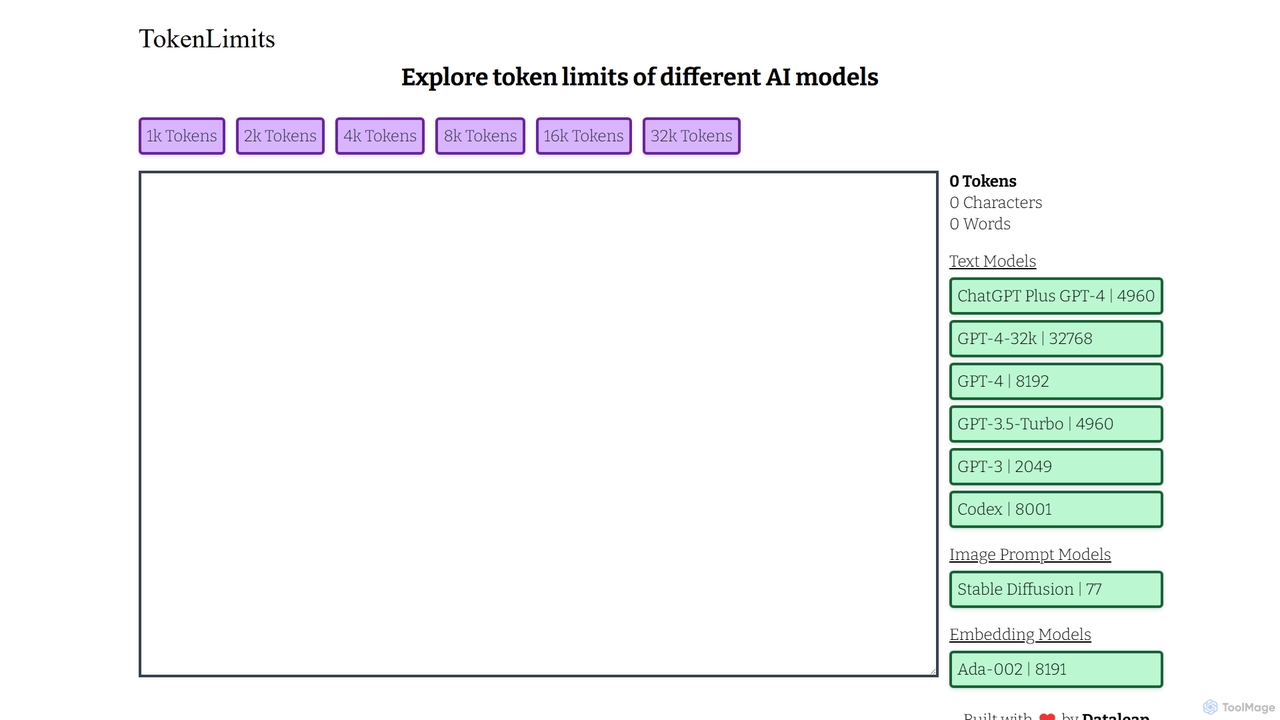
A free, quick-reference web tool for developers, researchers, and AI enthusiasts to check the token limits of popular AI models. It provides a centralized, up-to-date database for text, image, and embedding models, simplifying workflow and development.

Api
Visits 10KFavorites 154Likes 167

About Reference

AI Reference tools are specialized applications designed to find, verify, and cite information with high accuracy. Leveraging natural language processing (NLP) and large knowledge bases, these tools go beyond standard search engines by providing synthesized answers, source validation, and structured data. They are crucial for enhancing research productivity and ensuring informational integrity. Their primary value lies in saving time on manual fact-checking and formatting citations, allowing users to focus on analysis and content creation.

Core Features

  • Fact-Checking & Verification: Cross-references information against multiple reliable sources to assess accuracy.
  • Automated Citation Generation: Instantly creates citations in various academic formats like APA, MLA, and Chicago.
  • Semantic Search: Understands the contextual meaning of queries to deliver precise answers instead of just links.
  • Knowledge Synthesis: Summarizes complex topics from multiple documents into a coherent overview.
  • Data Extraction: Pinpoints and extracts specific data points, statistics, or quotes from source materials.

Use Cases

These tools are indispensable for academics, researchers, students, journalists, and legal professionals. In academic writing, they streamline the literature review process. For journalists and content creators, they serve as a rapid fact-checking assistant. Legal and business analysts use them to quickly gather evidence and market data from extensive reports.

How to Choose

When selecting an AI Reference tool, evaluate the breadth and quality of its source database. Consider the range of citation styles offered and its integration capabilities with word processors or other software. Also, assess the accuracy of its fact-checking algorithms and whether its user interface aligns with your research workflow. For professional use, data privacy and security policies are critical considerations.

Reference use cases

1

Academic Research and Paper Writing

A graduate student writing a dissertation uses an AI Reference tool to streamline their literature review. Instead of manually searching dozens of databases, they input their research questions and keywords. The tool synthesizes information from relevant academic papers, identifies key themes, and provides summaries. As they write, the tool automatically generates accurate citations in APA 7th edition format for every source mentioned, saving dozens of hours and reducing the risk of plagiarism. This allows the student to focus on critical analysis and argumentation rather than tedious administrative tasks.

2

Journalistic Fact-Checking and Reporting

An investigative journalist working on a tight deadline needs to verify a politician's claims. They use an AI Reference tool to quickly cross-reference the statements against a database of news articles, official reports, and public records. The tool highlights inconsistencies and provides links to primary sources for verification. It also helps extract key statistics and quotes from lengthy documents, enabling the journalist to build a fact-based narrative efficiently. This process, which would typically take hours of manual research, is completed in minutes, ensuring accuracy and integrity in their reporting.

3

Legal Research and Case Preparation

A paralegal is preparing for a complex litigation case and needs to find relevant legal precedents. Using an AI Reference tool specialized for legal databases, they can perform semantic searches for case law related to specific legal concepts, rather than just keywords. The tool quickly identifies and summarizes the most relevant cases, extracts key arguments, and even highlights how different jurisdictions have ruled on similar issues. This accelerates the research phase, ensures no critical precedent is missed, and helps the legal team build a stronger, more informed case strategy.

4

Market Research and Business Analysis

A business analyst is tasked with creating a competitive landscape report. They use an AI Reference tool to scan and synthesize information from industry reports, financial filings, and news articles. The tool helps extract key market size data, competitor revenue figures, and trends in consumer behavior. By asking natural language questions like "What are the main growth drivers in the SaaS market for 2024?", the analyst receives a consolidated summary with sourced data points. This allows for the rapid creation of an accurate, data-driven report without spending days manually sifting through documents.

5

Creating Educational Content and Lesson Plans

A high school history teacher is developing a new curriculum on ancient civilizations. They use an AI Reference tool to gather accurate historical facts, find primary source documents, and check for common misconceptions. The tool helps them create engaging lesson plans by providing summaries of key events, biographies of historical figures, and links to reputable academic resources. It also assists in generating quiz questions based on the verified information, ensuring the educational materials are both accurate and effective for student learning.

6

Personal Learning and Topic Exploration

An individual curious about quantum computing uses an AI Reference tool to understand the complex subject. Instead of getting lost in technical jargon from search results, they ask the tool to "explain quantum computing to a beginner." The tool provides a structured overview, defines key terms like 'qubit' and 'superposition' with simple analogies, and links to credible introductory articles and videos. It acts as a personal tutor, guiding the user through the topic step-by-step and providing verified information, making self-directed learning more efficient and reliable.

Reference FAQ

What are AI Reference tools?

AI Reference tools are a specialized type of productivity software designed to help users find, verify, and cite information accurately. Unlike general search engines that provide a list of links, these tools use AI to synthesize information, check facts against reliable sources, and automatically generate citations in various formats. They are built to support tasks that require a high degree of informational accuracy and proper sourcing, such as academic research, journalism, and legal work.

How do AI Reference tools differ from standard search engines?

The main difference lies in their purpose and output. A standard search engine (like Google) indexes the web and returns a list of links for you to explore. An AI Reference tool aims to provide direct, synthesized answers and verify information. Key differences include:

  • Synthesis vs. Indexing: Reference tools synthesize information from multiple sources into a single answer, while search engines provide links to the sources themselves.
  • Verification: Many reference tools have built-in fact-checking capabilities, which is not a primary function of search engines.
  • Structured Output: They often generate structured outputs like citations, summaries, or data tables, which search engines typically do not.
  • Niche Focus: They are often trained on specific, high-quality datasets (e.g., academic journals, legal documents) for greater accuracy in a particular domain.

Who can benefit most from using AI Reference tools?

While anyone seeking accurate information can benefit, certain professions find these tools particularly valuable. This includes:

  • Students and Academics: For conducting literature reviews, writing papers, and generating bibliographies, saving significant time and improving accuracy.
  • Journalists and Content Creators: For quickly fact-checking claims, finding source material, and ensuring the integrity of their work.
  • Legal Professionals: For performing case law research, finding precedents, and analyzing legal documents efficiently.
  • Business and Market Analysts: For gathering competitive intelligence, market data, and industry trends from various reports and sources.

How do I choose the right AI Reference tool?

Choosing the right tool depends on your specific needs. Consider the following factors:

  • Source Quality: Does the tool access high-quality, relevant databases for your field (e.g., PubMed for medical research, Scopus for academic papers)?
  • Feature Set: Do you need advanced features like plagiarism checking, collaborative tools, or integration with specific software like Zotero or Word?
  • Accuracy and Reliability: Check reviews or test the tool to assess the accuracy of its summaries, fact-checking, and citation generation.
  • User Interface: Is the tool intuitive and does it fit well into your existing workflow? A complex interface can negate productivity gains.
  • Pricing Model: Evaluate if a subscription or pay-per-use model is more suitable for your usage frequency and budget.

Are AI Reference tools always accurate?

While AI Reference tools are designed for high accuracy, they are not infallible. Their accuracy depends heavily on the quality of the data they were trained on and the sophistication of their algorithms. Users should always maintain a level of critical evaluation. It's good practice to cross-verify critical information, especially for academic or professional publications. Think of them as powerful assistants that accelerate research and reduce errors, but not as a replacement for human judgment and final verification.