Netradyne
Netradyne is an AI-powered fleet safety and management platform featuring the Driver•i camera system. It analyzes 100% of …
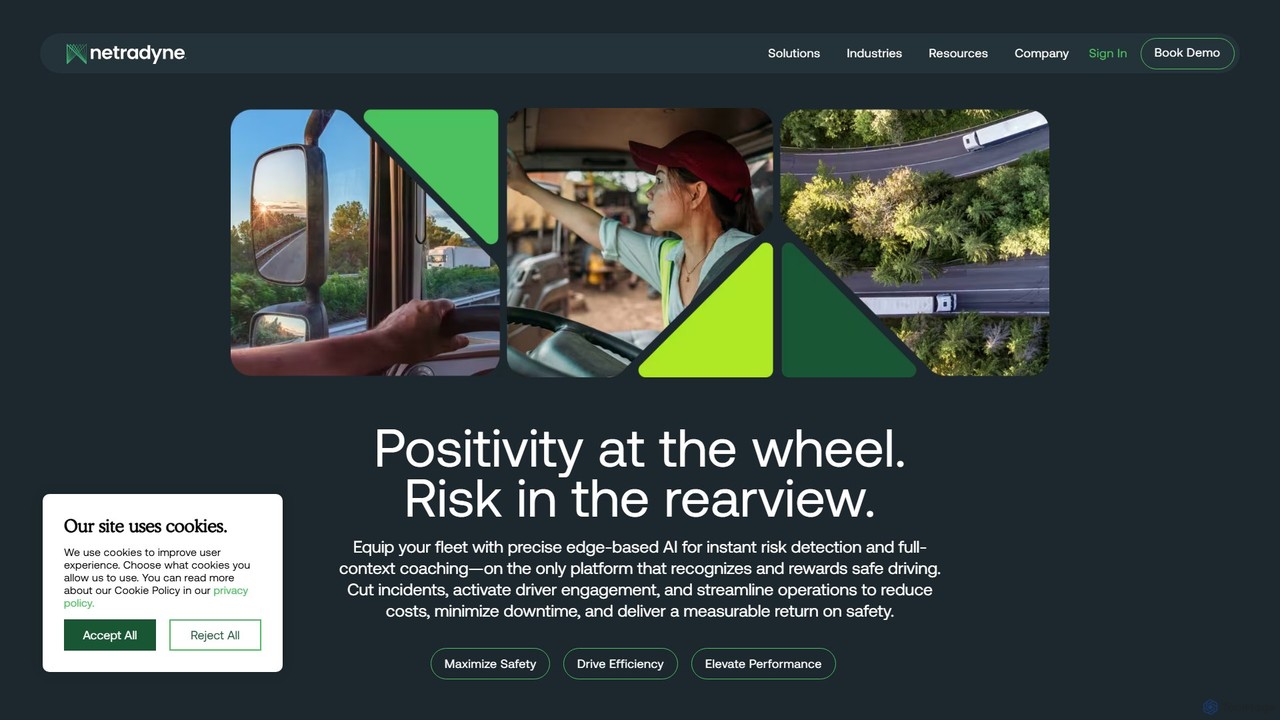
Netradyne is an AI-powered fleet safety and management platform featuring the Driver•i camera system. It analyzes 100% of drive time to provide real-time in-cab alerts, driver coaching, and comprehensive video data. The platform helps reduce risk, exonerate drivers, improve safety culture through positive reinforcement, and enhance overall operational efficiency for commercial fleets.
About Safety Management
AI Safety Management tools are a class of software that uses artificial intelligence to proactively identify, analyze, and mitigate workplace risks. These systems leverage machine learning and computer vision to process data from cameras, sensors, and reports to detect potential hazards in real time. Their primary value lies in shifting safety protocols from reactive to predictive, helping organizations prevent incidents, ensure regulatory compliance, and enhance operational productivity. By automating monitoring and analysis, these tools create a safer and more efficient work environment.
Core Features
- Predictive Risk Analysis: Uses historical data and real-time inputs to forecast potential safety incidents before they occur.
- Real-time Hazard Detection: Employs computer vision to monitor video feeds for unsafe conditions, such as lack of personal protective equipment (PPE) or proximity to machinery.
- Automated Compliance Monitoring: Continuously checks operations against regulatory standards (e.g., OSHA, ISO) and flags non-compliance issues.
- Intelligent Incident Reporting: Streamlines the reporting process by automatically categorizing incidents, identifying root causes, and generating detailed analytics.
Applicable Scenarios
These tools are essential in high-risk industries like construction, manufacturing, logistics, and energy. Safety officers, operations managers, and compliance teams use them to monitor large-scale sites, analyze complex operational data, and automate safety audits. For example, a construction manager can receive instant alerts about workers without hard hats, or a factory supervisor can be notified of an impending machine failure.
Selection Criteria
When choosing an AI Safety Management tool, consider its industry-specific modules and compliance support. Evaluate its integration capabilities with existing hardware like IoT sensors and security cameras. Assess the accuracy and reliability of its predictive models and the customization options for alerts and reporting. Finally, consider the user interface's ease of use for both on-site personnel and management.

Safety ManagementUse Cases
Real-Time Content Moderation for Online Communities
A community manager for a large online forum uses an AI Safety Management tool to maintain a healthy environment. The tool is integrated with their platform to automatically scan every new post and comment in real-time. It flags content related to hate speech, harassment, and spam based on pre-defined policies. This allows the human moderation team to focus on nuanced cases rather than manually sifting through thousands of posts, reducing moderator burnout and improving response time to critical issues by over 90%.
Automated Construction Site PPE Monitoring
A construction site manager is responsible for the safety of hundreds of workers across a large area. Using an AI Safety Management tool integrated with existing CCTV cameras, the system continuously monitors the site. It uses computer vision to automatically detect if workers are wearing the required Personal Protective Equipment (PPE) like hard hats and high-visibility vests. If a violation is detected, an instant alert with a snapshot is sent to the site manager's mobile device, allowing for immediate corrective action. This automates a tedious manual task and significantly reduces the risk of head injuries.
Auditing Financial AI Models for Fairness
A compliance officer at a bank is tasked with ensuring their AI-powered loan application system is fair and unbiased. They use an AI Safety Management tool to run a comprehensive audit on the model. The tool analyzes historical loan decision data and simulates new applications to detect any statistical bias against protected groups based on race, gender, or age. It generates a detailed report highlighting potential discriminatory patterns, allowing the data science team to retrain the model with balanced data, thus ensuring regulatory compliance and promoting ethical lending practices.
Predictive Maintenance for Manufacturing Safety
An operations manager in a manufacturing plant needs to prevent equipment failures that could lead to serious accidents. The AI safety system is connected to IoT sensors on critical machinery, collecting data on vibration, temperature, and performance. The AI's predictive analytics model analyzes these data streams to identify subtle patterns that precede a failure. When the system predicts a high probability of a breakdown, it automatically creates a maintenance work order and alerts the manager, specifying which component is at risk. This allows for proactive repairs, preventing accidents and costly unplanned downtime.
Protecting Customer PII in AI Chatbots
An e-commerce company deploys an AI chatbot for customer support. To comply with data privacy laws like GDPR, they integrate an AI Safety Management tool. This tool acts as a filter, automatically identifying and redacting Personally Identifiable Information (PII) such as names, addresses, and credit card numbers from the chat logs before they are stored. This automated process ensures that sensitive customer data is never exposed to unauthorized personnel or stored insecurely, significantly reducing the risk of data breaches and ensuring compliance without manual intervention.
Ergonomic Risk Assessment in Warehouses
A logistics company aims to reduce musculoskeletal injuries among its warehouse staff. They deploy an AI safety tool that uses cameras to analyze workers' movements as they lift and move packages. The AI assesses postures, repetition, and force to calculate an ergonomic risk score in real time. It can identify individuals who consistently use improper lifting techniques or perform tasks that put excessive strain on their bodies. The system generates reports for safety officers, highlighting high-risk areas and tasks, which can then be redesigned. It also provides direct feedback to workers through on-floor displays, promoting safer work habits.
Securing Internal LLMs from Prompt Injection
A technology firm provides its employees with access to an internal Large Language Model (LLM) for productivity tasks. To prevent misuse, their security team implements an AI Safety Management tool as a protective layer. This tool inspects all user prompts before they reach the LLM. It is configured to detect and block attempts at 'prompt injection,' where a user tries to trick the model into ignoring its safety instructions or revealing confidential system information. This ensures the LLM remains a helpful and secure internal resource, preventing data leaks and maintaining system integrity.
Automated Incident Reporting and Analysis
When a minor safety incident occurs, a supervisor uses a mobile app to report it. They can speak or type a description of the event and upload photos. The AI tool automatically transcribes the speech, categorizes the incident type (e.g., slip, fall, minor burn), and extracts key information like location, time, and equipment involved. It then analyzes the report against historical data to identify potential root causes or recurring trends. This process reduces the time spent on paperwork from hours to minutes and provides the safety team with structured, actionable data to implement preventative measures more effectively.
Ensuring Brand Safety in AI-Generated Marketing
A marketing agency uses generative AI to create ad copy and social media posts at scale. To protect their clients' brand reputation, they use an AI Safety Management tool to screen all generated content before publication. The tool checks for text and images that might be off-brand, offensive, or politically sensitive. The marketing team can set custom policies for each client, ensuring the AI's output consistently aligns with specific brand voice and values. This prevents embarrassing or damaging content from being published, safeguarding brand image while leveraging the speed of AI content creation.
Managing Fleet Driver Safety in Logistics
A logistics company wants to improve the safety of its delivery fleet. They install AI-powered dashcams in all their vehicles. These devices analyze driver behavior in real time, detecting actions like harsh braking, speeding, distracted driving (e.g., phone use), and drowsiness. The system provides immediate in-cab audio alerts to the driver to correct the behavior. Fleet managers receive a daily safety score for each driver, along with video clips of critical events. This data is used for targeted coaching and training, helping to reduce accidents, lower insurance premiums, and ensure compliance with transportation regulations.
Automating AI Governance and Compliance Reporting
A large enterprise in a regulated industry (like healthcare or insurance) uses dozens of AI models across its operations. A dedicated AI governance team uses a Safety Management platform to centralize monitoring and reporting. The platform automatically logs all model interactions, flags any policy violations, and generates quarterly compliance reports required by regulators. This automates a previously manual and error-prone process, providing a consistent audit trail and demonstrating a proactive approach to responsible AI, which simplifies regulatory reviews and builds stakeholder trust.
Real-time Monitoring of Hazardous Zones
In an oil and gas facility, certain areas are designated as hazardous zones where unauthorized entry is strictly forbidden. An AI safety system uses geofencing and computer vision to monitor these zones. If a person or vehicle without proper authorization credentials enters a restricted area, the system triggers an immediate alarm at the central control room and sends alerts to nearby safety personnel. The AI can also use thermal cameras to detect overheating equipment or gas leaks, providing an early warning system that operates 24/7, far exceeding the capabilities of manual patrols and enhancing overall site security and productivity.