StarQuiz
StarQuiz is an AI-powered formative assessment platform for K-12 and higher education. It instantly transforms lesson materials, such …
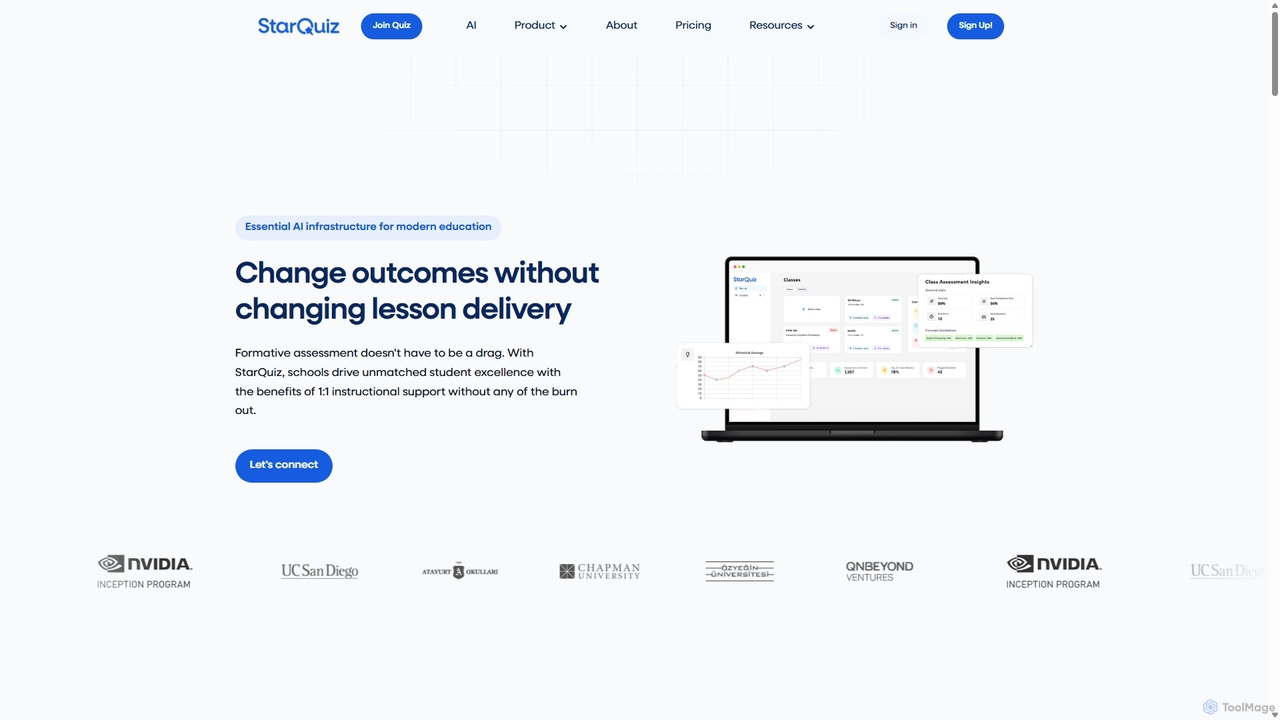
StarQuiz is an AI-powered formative assessment platform for K-12 and higher education. It instantly transforms lesson materials, such as lectures and documents, into interactive quizzes. Teachers gain real-time insights into student comprehension, while students receive immediate feedback to enhance learning. The platform streamlines grading, supports personalized instruction, and integrates with Learning Management Systems (LMS) to improve educational outcomes without increasing teacher workload.
About Teaching Aid
Teaching Aid AI tools are specialized applications designed to enhance and streamline various aspects of the educational process. Leveraging artificial intelligence, these tools automate content creation, personalize learning experiences, and provide intelligent assistance for both educators and students. They significantly boost productivity in academic settings by reducing manual workload, fostering engagement, and adapting to individual learning needs.
Core Features
- Automated Content Generation: Quickly create lesson plans, quizzes, presentations, and study materials from raw input or existing curricula.
- Personalized Learning Paths: Adapt educational content and pace to individual student performance, preferences, and learning styles.
- Intelligent Assessment & Feedback: Automatically grade assignments, provide constructive feedback, and identify areas where students need extra support.
- Interactive Learning Environments: Develop engaging simulations, virtual labs, and gamified experiences to make complex subjects more accessible.
- Multilingual Support: Translate and adapt educational materials across different languages, facilitating global learning and diverse classrooms.
Applicable Scenarios
Educators use these tools to prepare engaging lessons more efficiently, freeing up time for direct student interaction. Students benefit from tailored study materials and immediate feedback, improving comprehension and retention. Educational institutions leverage AI teaching aids to standardize curriculum development, manage large-scale assessments, and provide equitable access to high-quality learning resources.
How to Choose
When selecting an AI teaching aid, consider its integration capabilities with existing learning management systems (LMS), the breadth of its content generation features, and its ability to offer truly personalized learning experiences. Evaluate the accuracy of its assessment algorithms, the intuitiveness of its user interface, and the level of data privacy and security it offers, especially concerning student information.

Teaching AidUse Cases
Automate Lesson Plan Creation
A high school history teacher needs to prepare weekly lesson plans covering diverse topics. Using an AI teaching aid, they input curriculum standards and learning objectives. The tool then generates a structured lesson plan, complete with activity suggestions, discussion prompts, and assessment ideas, significantly reducing preparation time from hours to minutes. This allows the teacher to focus more on classroom delivery and student engagement.
Personalize Student Learning Paths
An elementary school teacher has a class with varying reading levels. An AI teaching aid analyzes each student's performance on reading comprehension tasks and identifies their strengths and weaknesses. Based on this data, the tool automatically assigns personalized reading materials and exercises, ensuring each student receives content appropriate for their current level, fostering continuous progress and confidence.
Generate Interactive Quizzes and Assessments
A university lecturer wants to create engaging and varied quizzes for a large online course. With an AI teaching aid, they can upload lecture notes or textbook chapters. The tool then generates multiple-choice questions, fill-in-the-blank exercises, and short-answer prompts, complete with answer keys and explanations. This saves immense time in assessment design and provides students with diverse practice opportunities.
Adapt Educational Content for Multilingual Classrooms
An international school has students from various linguistic backgrounds. An AI teaching aid can take existing English science textbooks and automatically translate them into Spanish, Mandarin, and Arabic, while also adapting cultural references where necessary. This ensures all students, regardless of their native language, have access to understandable and culturally relevant learning materials, promoting inclusivity.
Provide Instant, AI-Powered Feedback on Assignments
A writing instructor receives hundreds of essays each semester. An AI teaching aid can quickly scan student essays for grammatical errors, stylistic inconsistencies, and logical fallacies. It provides instant, objective feedback on specific areas for improvement, allowing students to revise their work immediately and learn from their mistakes, while the instructor can focus on higher-level conceptual feedback.
Develop Virtual Lab Simulations for Science Education
A science department wants to offer hands-on lab experiences without the cost and safety concerns of physical labs. An AI teaching aid can help create realistic virtual lab simulations where students can conduct experiments, manipulate variables, and observe outcomes in a safe, interactive digital environment. This provides valuable practical experience and reinforces theoretical concepts, especially for remote learning.